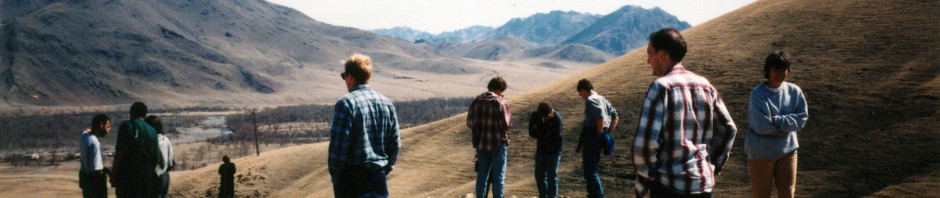
Lakeland Swan Song

The fells of Lakeland have been in my life for almost half a century. In 1974, my (considerably older) boomer brother was living the hippy dream, working at the giant Waterhead youth hostel on the north-eastern shore of Lake Windermere, Zappa moustache and hair halfway down his back, rock-climbing in Borrowdale by day and playing tenor by night in a jazz-rock band. In the week that Richard Nixon finally choppered off the White House lawn into the history books, my dad (world-war-two veteran bomber pilot turned textile executive) sped us up from Yorkshire to Cumbria, twisting his tank-like Mercedes through the winding lanes of Langdale, windows wide open in the sunshine and blasting Count Basie Big Band full volume. I have a photo of him standing on a hummock of fell above Wrynose with the valley open behind him, hands in the pockets of his beige business trousers, pale pink open-necked shirt, navy jacket with red handkerchief nestled in the breast pocket, and aviator shades. Meanwhile my brother stood in the hostel kitchen with his hair down (1970s food hygiene standards!) over a cauldron in which 150 eggs could be boiled simultaneously.

I began hiking, and the ridges of Lakeland became as familiar as the streets of my town. In 1977, on a school trip, we raced shouting up Striding Edge to Helvellyn. In December that year, alone, I repeated the climb in bright sunshine, wondering at the wisps of mist that spilled over the ridge ahead and through the col of Grisedale Tarn away to my left. As I crested the mountain – no-one else in sight – a revelation: the western slope descended ahead of me perhaps a hundred metres to the shore of an ocean of cloud, extending as far as the eye could see, with only a handful of Lakeland’s highest peaks raised above the mist as islands rising from the sea – a vision similar (except in daylight) to Wordsworth’s on Snowdon, which sparked one of his wilder nature meditations. All day long I walked the ridge northward, catching the light on the shining sea of mist, pausing to sun myself in my t-shirt (in December!) on the tops of the Dodds, while the Lake District beneath me laboured under cloud. It seemed a moment that would never end; yet time moved on.

In the late 1980s, amid shattering heartbreak, a friend of my mother’s lent me a caravan on the Windermere shore to which I would retire alone for weeks to wish I was a fisherman, seeking solace for my wounded heart in the craggy landscapes of Bowfell and the Scafell range.

My children, as toddlers, clambered up the kiddy peaks of Helm Crag and Catbells, and later – higher – Fairfield; in 2019, returning to live in England after three decades, our first expedition (with my sister and her boy Joseph) was to Eskdale, from where we scrambled up Great Gable and Bowfell, staring out over dozens of miles of windblown sun-and-cloudscape from the summits of high fells.

In 2023, as my son Ian’s first year at Lancaster University came to an end, we were figuring out how to get his stuff back to Sheffield for the summer. I said I’d hire a car; he suggested a few days’ walking in the Lake District while we were at it. This became four days, five nights, with Joseph joining us for the first. I planned a couple of leisurely hikes, and a medium day up Helvellyn; Ian said he wanted to climb Scafell Pike, as the highest there is, and to throw in Bowfell (2019 revisited), which made for one strenuous walk. We were staying at Scales, so Blencathra, right behind our accommodation, would be a good first day warmer.

Then Ian’s brain began to whirr. If we were to climb the highest (Scafell Pike), and the second highest (Scafell) was right next door, we should throw that in too. The same day could include the sixth highest (Bowfell), and a small detour en route would bag us the fifth (Great End). Another day we were doing Helvellyn (third), but that left the fourth (Skiddaw) – could we somehow fit that in? Top six.

Well, yes, I said, we could make Blencathra a big day and take in Skiddaw too.

Ian went away and came back with his iPad showing Wainwright’s list of the ten highest fells in Lakeland: dad?

OK, Catstycam (tenth) and Nethermost Pike (ninth) can go together with Helvellyn; and for the leisurely fourth day I had planned, we could substitute another tough one: Pillar (eighth) and Great Gable (seventh). So yes, it’s doable.

From that moment on – father and son – it’s going to get done.

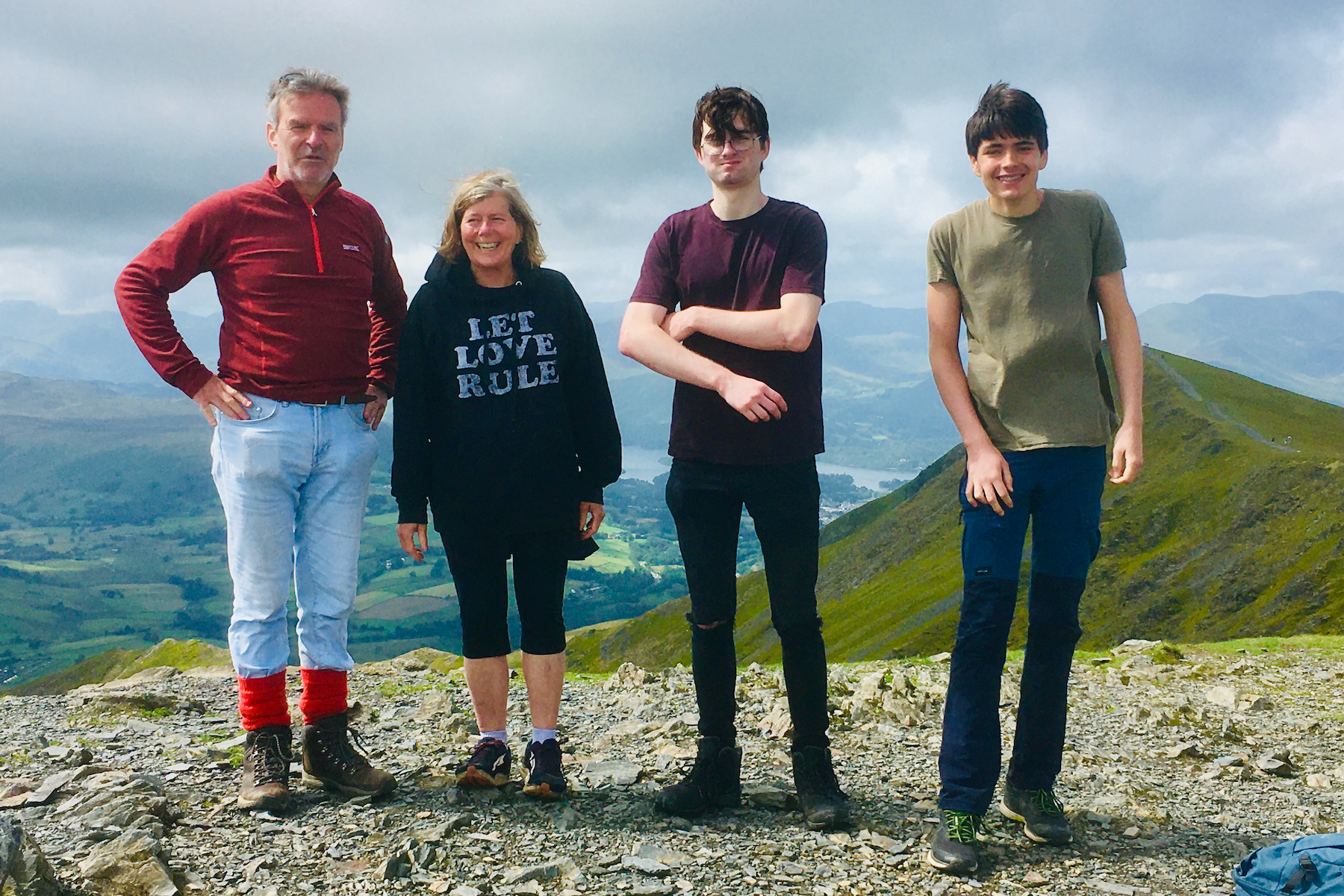
We set out the first morning fresh and early, with Ian and Joseph charging ahead up the slopes of Blencathra. Ian’s mother Allison was always going to drop out after the first peak; some rough scrambling up Halls Fell, which terrifies the life out of her, only reinforces that conclusion. We get to the top and take our snap:
Then the serious stuff starts. Ian and Joseph and I strike out across bare fellside, no paths, towards the distant top of Skiddaw. Spongy tussocks and tinkling becks; line-of-sight free hiking. It’s easy getting to the low point; now Skiddaw looms ahead. Joseph, fifteen-year-old muscles pumping, becomes a dot in the distance; Ian slows down to keep me company, then races ahead again. I step ahead at a steady sexagenarian pace: one foot in front of the other, we’ll get there. Showers and sunshine.

After an age of climbing we hit the ridge. Joseph sits waiting idly by the fence. The higher slopes are peppered with dog-walkers, Sunday flaneurs and other tourists. Man, this hurts. How long have we been going? Before Ian and Joseph become dots on the horizon again, I admonish Ian: be careful, the summit is not the first one you come to, it’s further along. Oh, he retorts – you mean it’s the highest point?
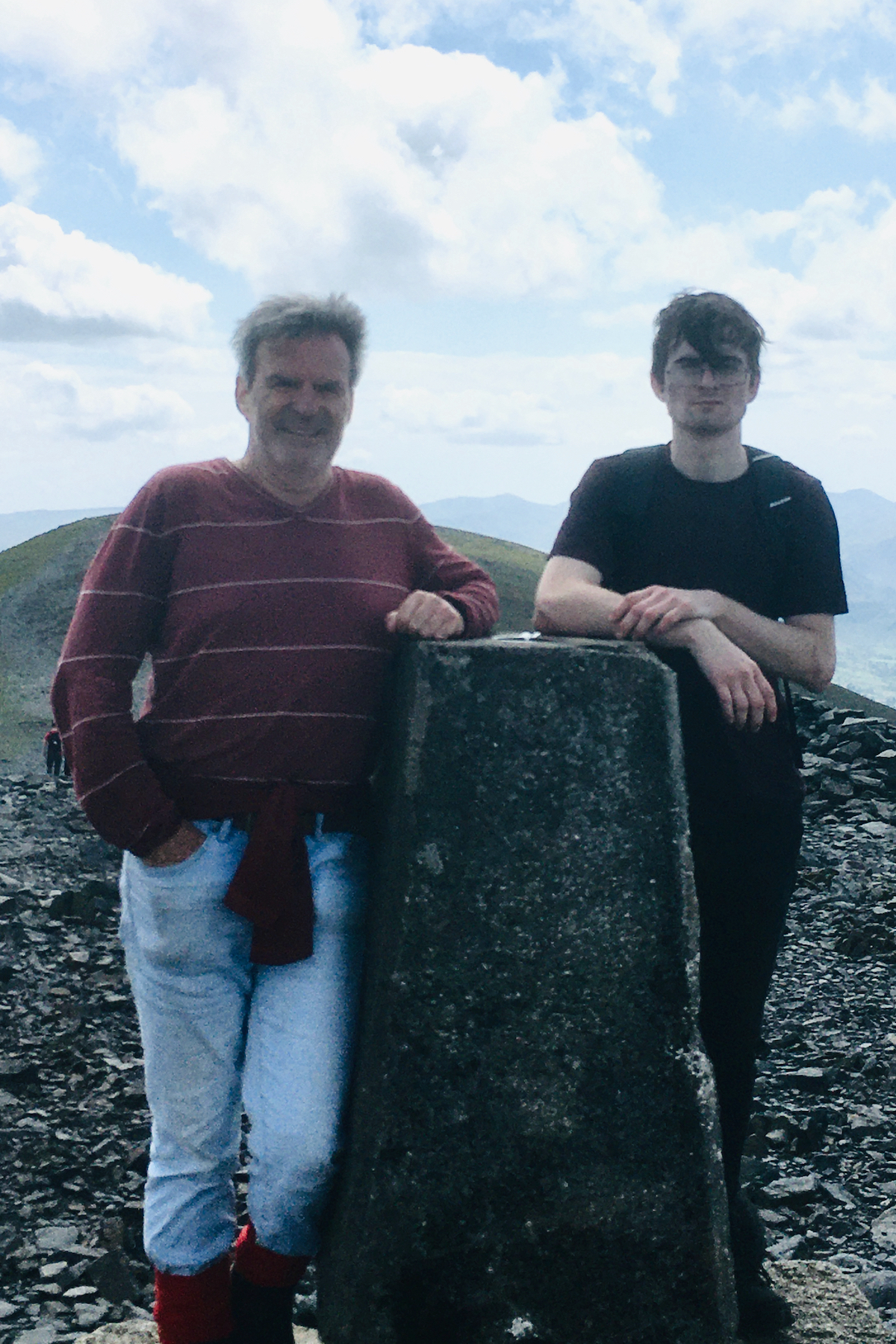
Skiddaw, fourth-highest point in the Lake District, and the first of Ian’s top ten

We clatter down the fellside towards Keswick, puzzled by the eastward detour the path takes, discoursing in the sunshine on the limits of scientific endeavour. Twigging that it’s touch and go whether we make the bus, we run leggily downhill through shady woodland, and now being well ahead of time, saunter through the family-jammed streets of Keswick. After seven-and-a-half hours on our feet, we loll in the bus shelter for quarter of an hour. When the bus comes, Ian doesn’t notice he’s left his coat on the bench. “Ian”, I say, “don’t forget your coat.” Dad mode still active. But man, do I feel tired.

Next day we drive up Ullswater to the village of Glenridding. Allison peels off to shop and visit waterfalls. Ian and I stride up the valley past old mines and onto open fell. It’s a long way up. Missing the junction to the path up Catstycam, we have to dogleg back across open fell, over springy tussocks and damp marsh. Recovering the stony path, we press up the fellside. Man, this is beginning to hurt again. Trudge to the pinnacle of Catsycam in stiff damp breeze: take the photo.
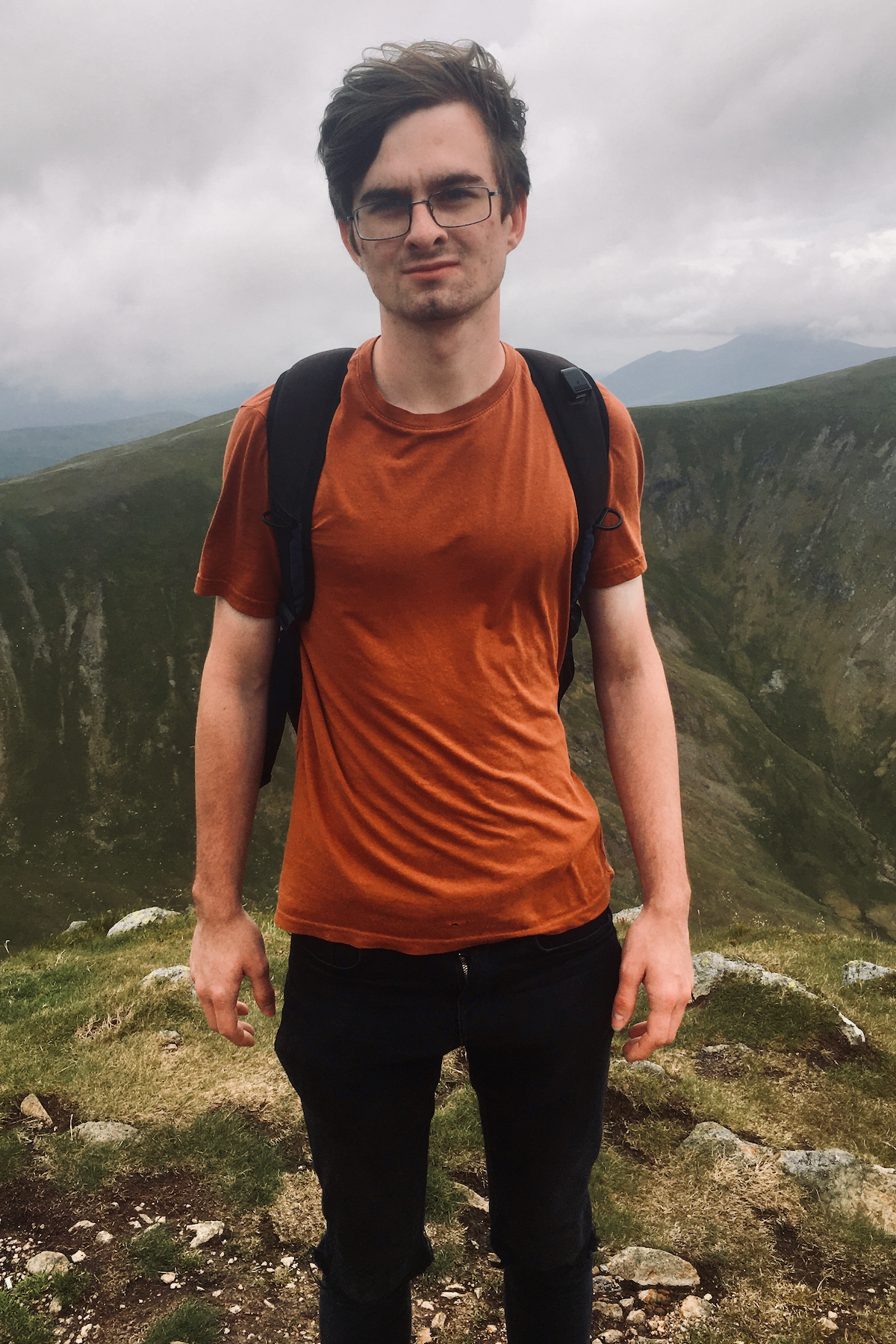
Catstycam, tenth highest and second in Ian’s top ten

Down, and up again, relentless scramble. Ian beelines straight up whilst I dogleg, fighting scree, line of least resistance. Just when the struggle steepens most we are on top of Helvellyn, heading for the cairn.

Helvellyn, third-highest and third in Ian’s top ten

Now it all seems easy, except for the rough ground and fatigue. We traverse indistinct ridge to the featureless top of Nethermost Pike.
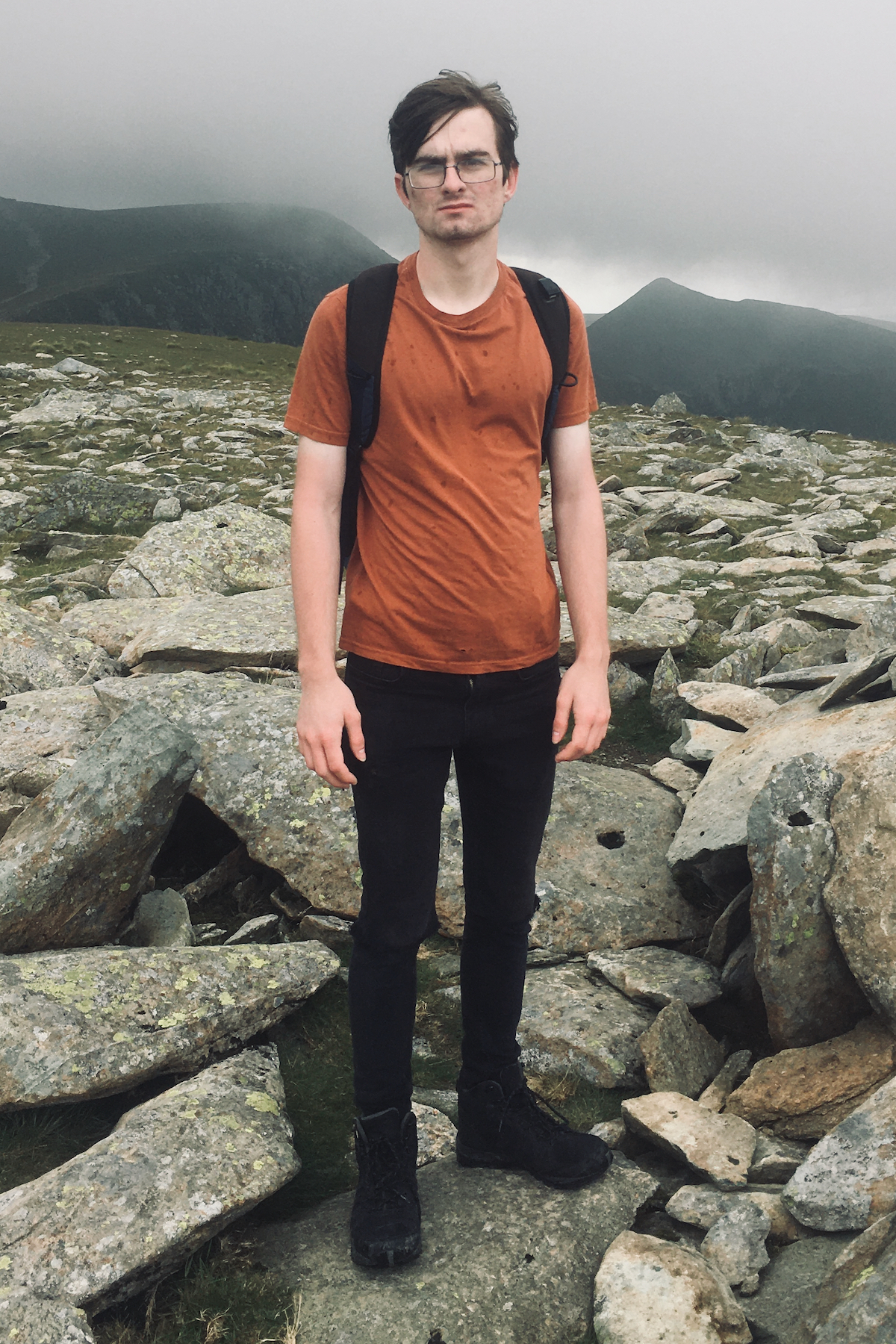
Nethermost Pike, ninth-highest and fourth in Ian’s top ten

Manoeuvring across Dollywaggon Pike, we start the zigzag descent to Grisedale Tarn: stones and more stones. I begin to feel like I’m hobbling. Halfway down we pause to eat sandwiches, watching the wind rippling on the surface of the water. Afterwards, I expect, the roughness will ease as we approach the valley; it doesn’t. The stones keep rising up to meet us, all the way down Grisedale, legs bracing for impact. By the time we trudge the last mile into Glenridding, I am weary.

Day three is the big one. We drive an hour and a half to Wasdale Head, and park in the National Trust car park. Five minutes along the valley path, my legs already ghosting with yesterday’s fatigue, I realise I have left my Wainwright in the shop and trudge wearily back to fetch it. After that the first two or three hours pass smoothly: past the tiny parish church, through the farm, right onto the valley route to Sty Head; gentle ascent to the sound of rushing waters, crossing and re-crossing the beck. Up grass to the tarn, turn right: a complaisant path up the narrowing dale to Sprinkling Tarn, under the looming crags of Great End. Barely noticing the climb, we are soon at Esk Hause: 2500 feet, getting up there!

The ease ends here. As we work our way up the rocky slopes of Esk Pike, the mist snaps down. We fumble our way across rocks to what we take to be the summit; anyway, it doesn’t matter, it’s only number eleven. A stony path leads obscurely down to a boggy col; then a faint trail onto Bowfell. In clammy cloud, this way or that? Clinging to cairns, we forge our way through the mist until the clarity of the path disappears into fumbling boulders: here a boot mark, there an erosion of lichen. We creep to the summit of Bowfell, at least we think it is: in barren mist we half-recognise its rocky features from the clear sunshine of four years before.
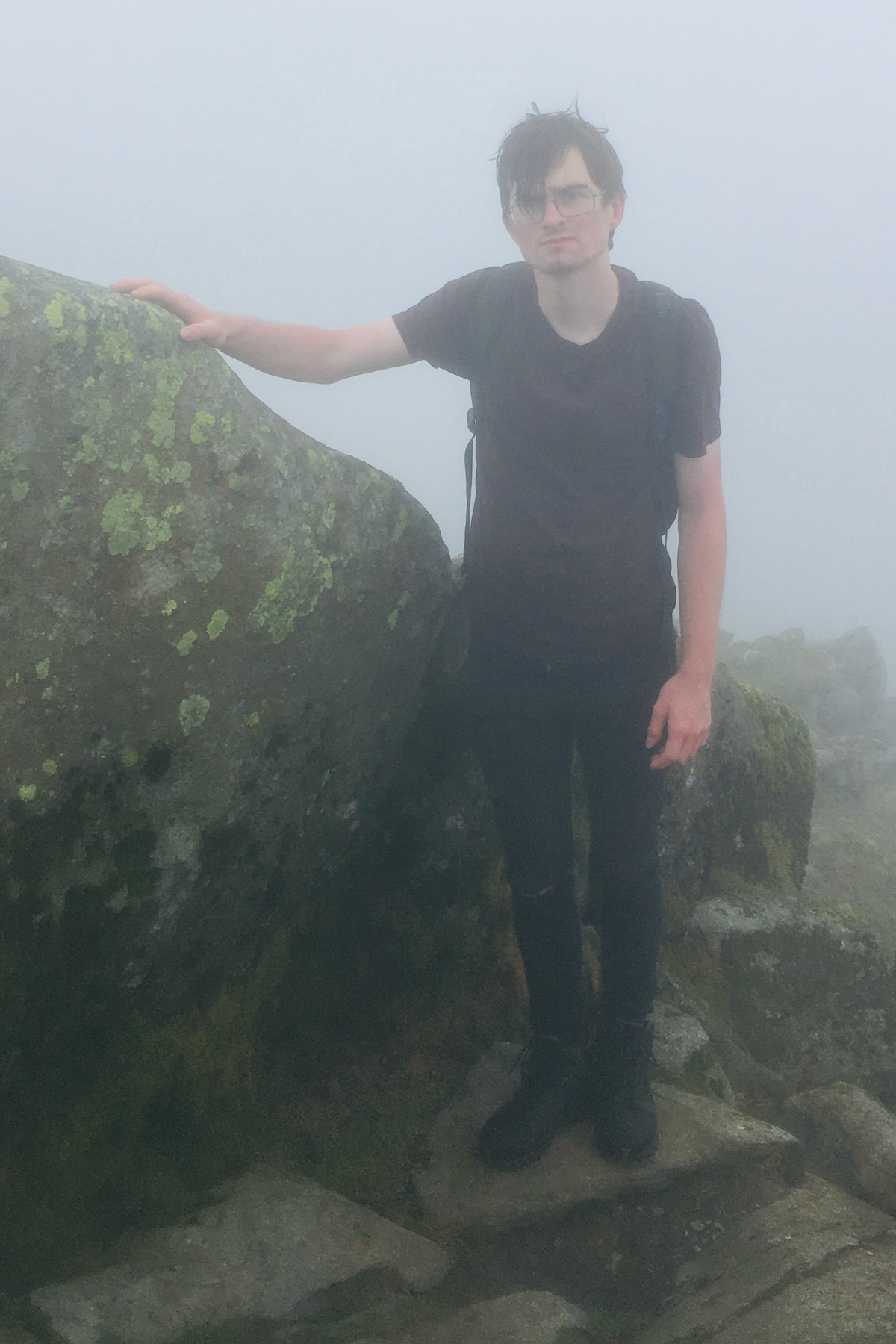
Bowfell, sixth highest and fifth in Ian’s top ten

Retracing steps is easier than tracing them, even in cloud. Esk Pike the second time, the summit bypassed, pains the feet, the muscles, the thighs. Back at Esk Hause, we begin the grind up Great End. We pass an older couple with a younger couple, beating their way up the slope, and nod to them; how is this working as a family outing? As we enter the mist again, they head left towards Scafell Pike. Ian and I make the right turn to Great End; immediately it begins to rain. We tramp across dismal terrain, dampening. I pull my waterproof on; Ian concedes and dons his ragged coat. When we reach the summit, we see nothing around. But we have it, our sixth; four to go.
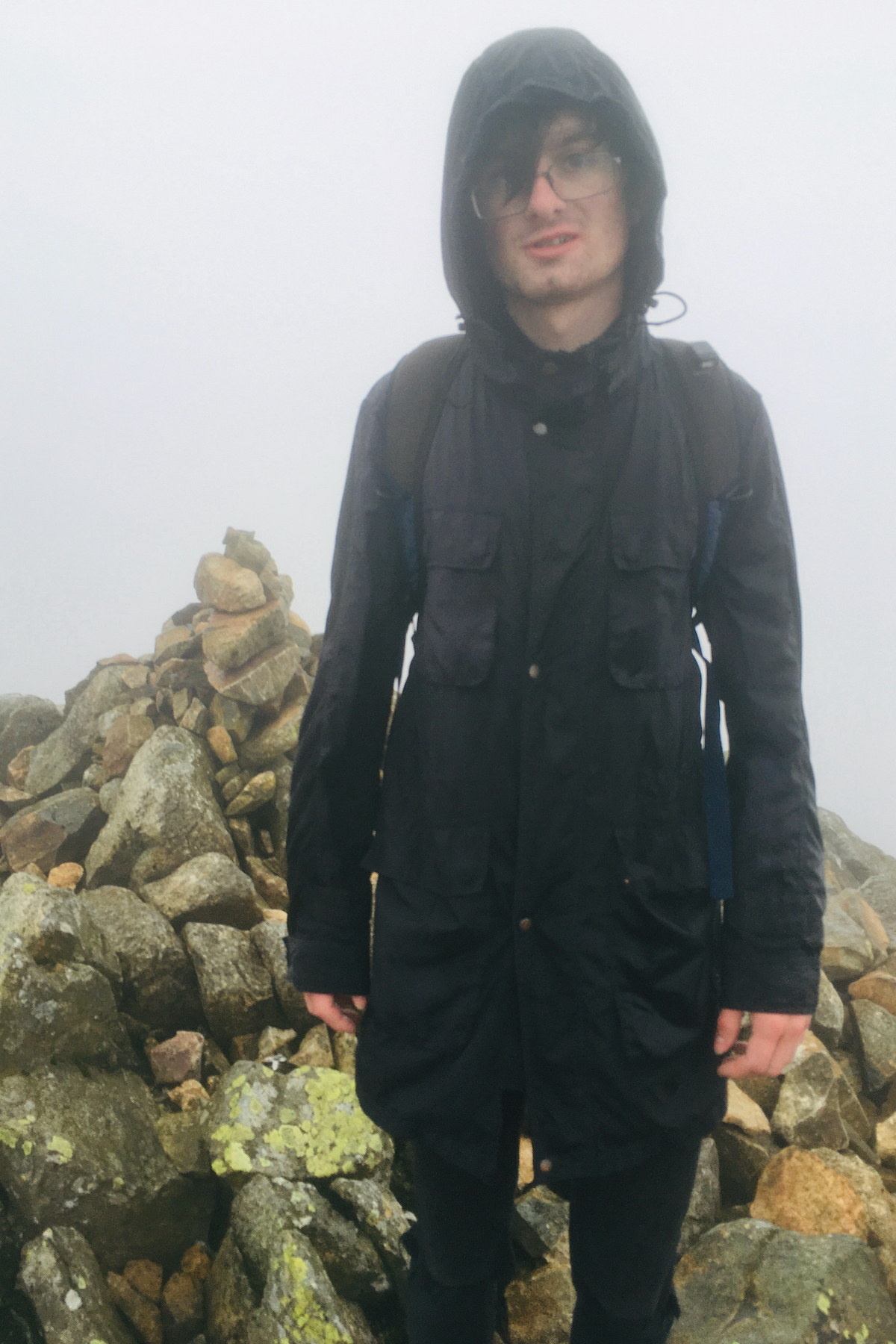
Great End, fifth highest and sixth in Ian’s top ten

We trudge back to the col, where it stops raining as abruptly as it began; Ian’s coat comes off, mine doesn’t. We begin the foggy ascent towards Scafell Pike. Almost immediately we meet the family, picking their way back down over wet stones. I ask if they made it to the top; dad says no. “How much fun can you have in one day?” he guffaws. They disappear back down into the mist. Ian and I proceed over big boulders; you could break your leg here, every step forward has to be eyed over and picked out. It’s tedious going, and nothing to see but more boulders. Time passes; how long, I couldn’t say. I lurch forward, aching. High ground to the right – are we there yet? Finally the mist parts briefly and we can see that we need to descend, then climb steeply again. This hurts all over again. Will it finally be the summit? At least the path is clear now. In the end, jubilant voices guide us: somebody must have made the top. Ian, ahead of me, veers off to the right, and shouts: here we are! I pull myself wearily up yet more shattered stones; a large, cylindrical, man-height stone structure looms out of the mist, topped by a group of young Scandinavians. The girls shriek at Ian in his t-shirt: “aren’t you cold? Where are you from?!” Ian grins, with his head down; I shout back: he’s a northerner! Which isn’t, actually, true; he grew up in the UAE and Thailand. They take our photo:
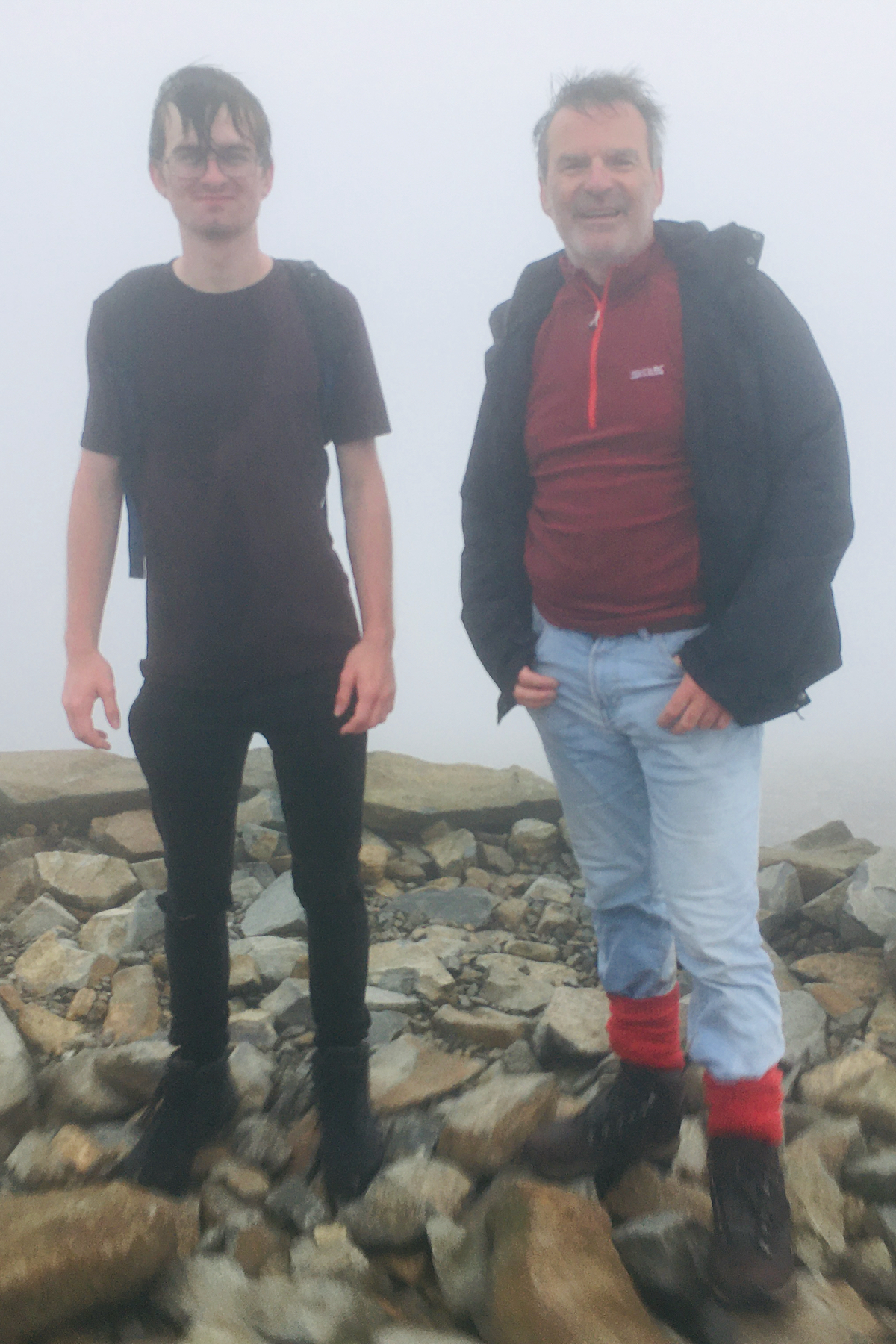
Scafell Pike, highest point in England and seventh of Ian’s top ten

Then they disappear into the fog.

Right, so how do we get down off this thing and to Mickledore, the col en route to Scafell? Yikes, we still have to do Scafell. I’m knackered already, and we’re on top of the highest fell in England. It must be somewhere in this direction, over these boulders – maybe a path will emerge? We pick our way gingerly towards where I imagine Scafell will be. The boulder field gets steeper, the boulders get rougher, no path appears. This is getting harder and harder. I’m worried now. How could I be so sloppy, so irresponsible, in care of my son? Then the mist suddenly rolls up and we can see downwards. The land falls away to the left, into Eskdale; we need to tack to the right. Mickledore appears in the distance, not far below us but a long way to the right. Step by deliberate step, grasping with our hands, we inch towards it. We reach the grass; not boulders but tussocks now. We have come down too far and need to climb again. We grapple our way back up to the ridge. We have been going seven hours and still hundreds of hard feet to climb; I am getting really tired now.

OK, I explain to Ian, we have to go down to the right here, sticking as close to the left-hand wall as we can, and look for the gully – Lord’s Rake – that we will need to ascend onto Scafell. Ian goes ahead, down fine and steepening passages of black scree that leave us clutching at the walls and manoeuvring on our behinds at the severity of the slope. My legs tense against the gradient, aching at every downward clench. The fellside tumbles away to the right; the temptation to take the easy way rises. Even Ian is finding this hard. We inch downward and finally achieve the grassy ledge that runs along the towering wall of Scafell. The steep stony gash of Lord’s Rake runs dead straight above us, 500 feet up and outstretched-arms wide.

“is that where the water comes down?” asks Ian.

“No, it’s where we go up”, I reply.

“What the fuck”, says Ian.

And then he starts. I can see him bracing above me, clinging to holds in the sheer rock walls, fighting with his feet to maintain balance, as I summon what feels like the last of my strength and push myself upwards. One lunge, one push at a time, sliding on the wet stones, seeking another precarious handhold. up and up and up into the mountain, the slope unrelenting. You probably won’t die; but actually, you could…

By the time we get to the top and clamber onto open fellside, we are back in mist. We push on upwards; every step is an effort. Finally we break the ridge, but I can’t remember where the summit is, left or right? We climb to the left, to the top of Symond’s Crag, before I recall that it’s the other way; a long, stony trudge through fog. But finally we have made it.
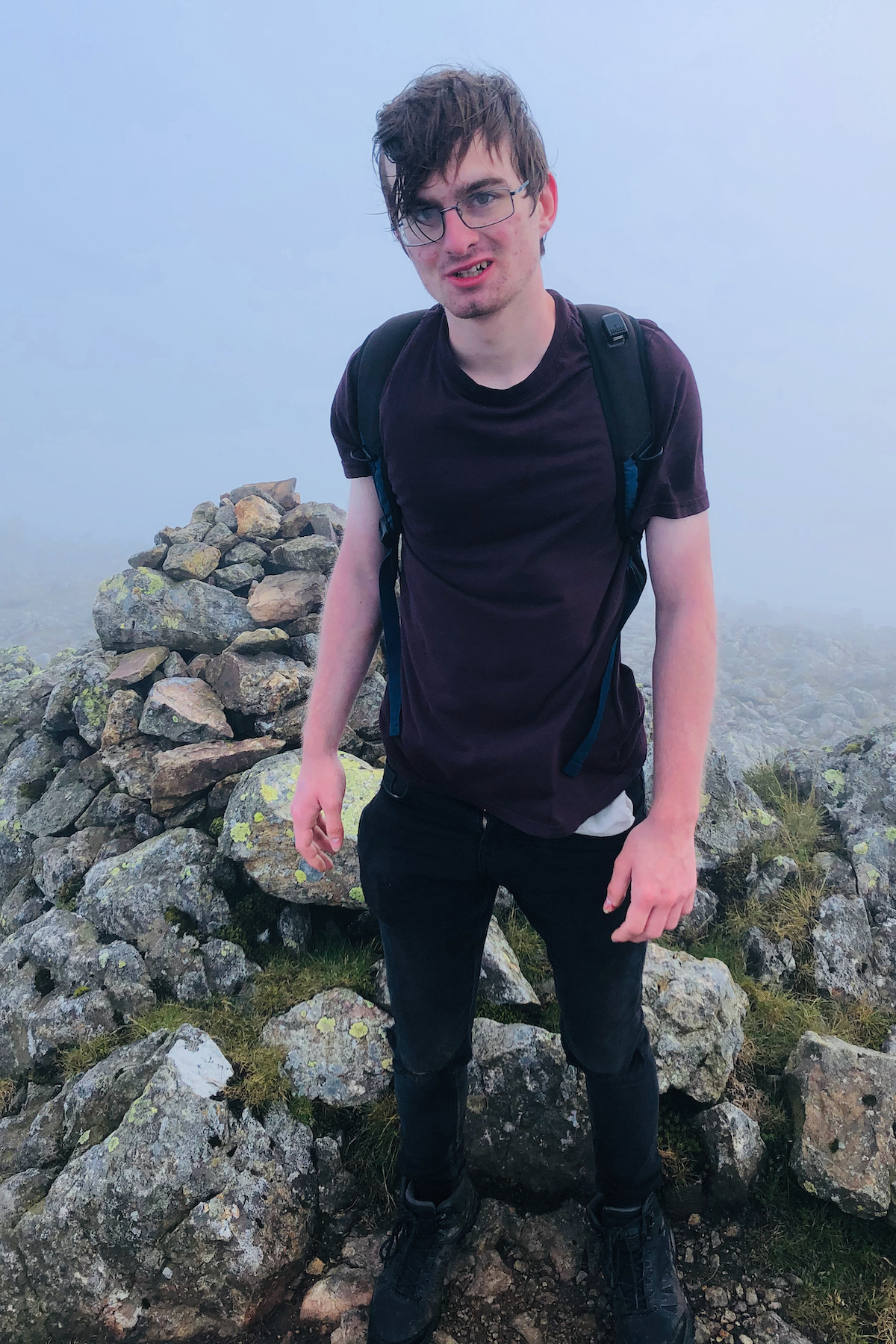
Scafell, second-highest and eighth in Ian’s top ten

And so, three thousand feet of descent. My legs are already jelly, and still I need to brace them against the rough stones; every step is laborious, and has its cost. We soon emerge from mist, but the stones go on and on. My feet are hurting, my legs unsteady – and still I have to brace. Ian is well ahead now, pausing occasionally for me to catch up, but I just have to keep going. Finally we reach the grass, but it’s just as steep, and I still have to brace with all my strength. Below us is a farm towards which we are descending; it never seems to get any nearer. The light is beginning to fade from the sky, and still we descend. I am stuck in a loop; the farm always the same size. Bracken eventually rises up to meet us, and suddenly the farm is right there. By the time we step onto the road I am at the limit of my endurance. But we did it.

Driving back to Keswick, the phone goes as soon as we hit a signal; it’s the police. Allison has reported us to mountain rescue…

In the morning my feet are sore and my legs ache with every step I take. I hobble to the car. We drive to Wasdale in pouring rain. Ian still doesn’t have a proper waterproof. I persuade him (finally) that he needs one and we stop in the shop by the Wasdale Head Inn to make a purchase. There’s no-one else around as we step out onto the fell and start the long traverse around the slopes of Kirk Fell, heading for Black Sail Pass. In spite of the fact that he absent-mindedly forgot his boots this morning and put on a pair of disintegrating trainers instead, Ian races ahead. The becks run torrential in heavy rain; the paths too are awash with water. Every step upward triggers a deep internal ache in my legs; my feet chafe against my boots. I plod on. It takes hours, but we make it to Black Sail, and turn left. There are long stretches across grassland; my feet chafe still more insistently. We hit the first wall of Pillar: one step at a time, I grind upward. More grassland; I stumble forward. More climbing, and then, somehow, we are there.
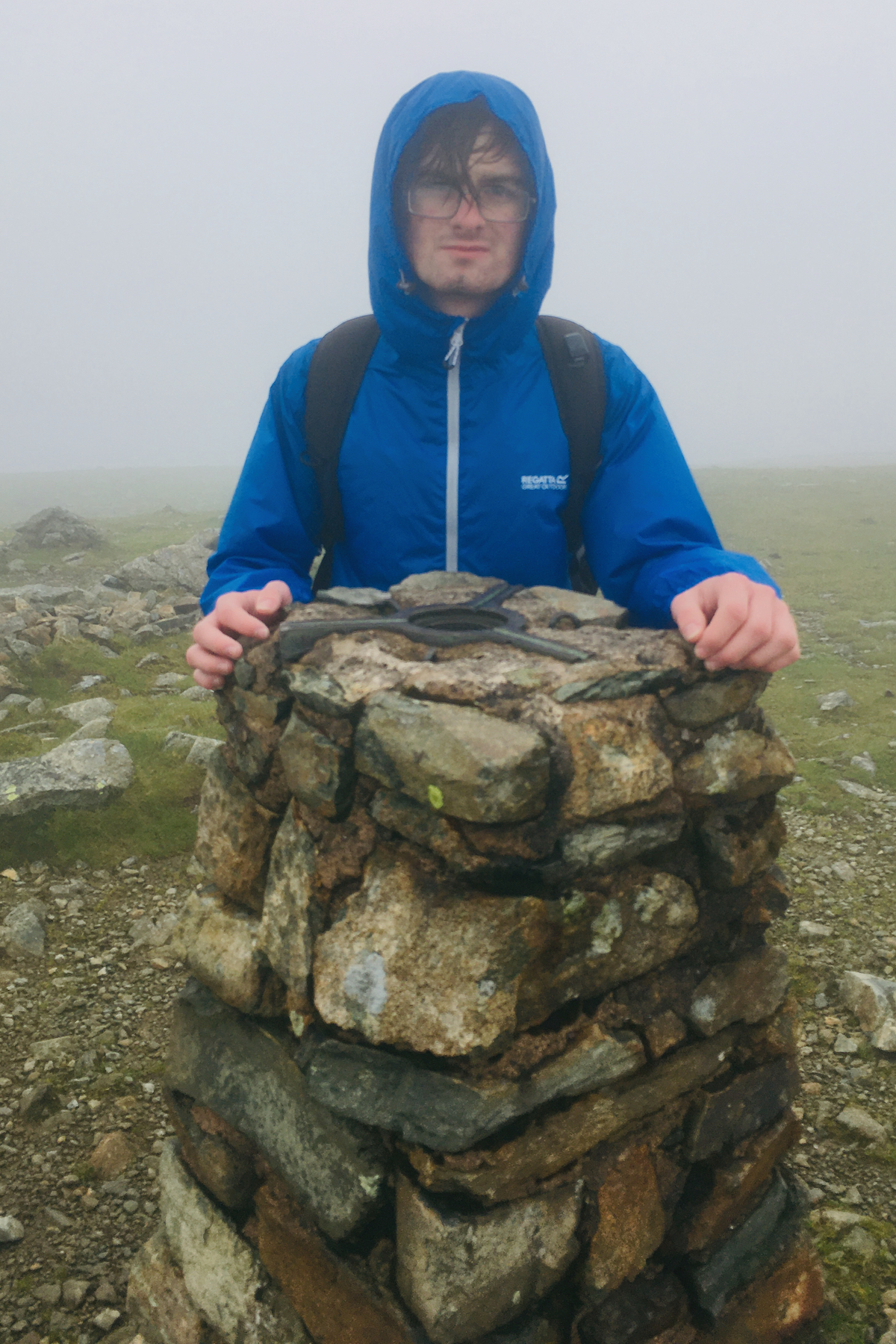
Ian finally dons a second layer: the summit of Pillar, eighth-highest and ninth in his top ten

We retrace our steps across grassland, down punishing stony trails. Back to Black Sail; Kirk Fell looms ahead. We begin climbing; there’s no obvious way forward. We are driven to the left around the mountain. The earth turns red. Just like yesterday, we are driven into a gully; the only way up the mountain.

“What the fuck”, says Ian.

Then he starts climbing. I follow. It’s not actually raining any more, but the wet earth slips under hands and feet. How do I get up here? I cling, and push, and shove. I work it out one step at a time. Body and brain are both overloaded; I am at full capacity. Just at the top, an overhanging boulder is wedged in the gully. Somehow, I swing round and pull; I am hanging over the abyss.

And then it’s done. We are back on tussocky grassland. The summit of Kirk Fell lies away to the right; fuck that. We take the straightest beeline over rough ground to the edge of the fell that faces Great Gable. Great Gable is capped with cloud.

We drop – for me, one agonising step at a time – to Beck Head. The stones hurt my feet all the way; my knees brace, my muscles grind. Just as the path begins to climb towards Gable, I signal Ian that I need a rest. We recline on a diagonal slab of rock, facing the sky. One more push, I think. One more push and I’m done. I wonder if I will lie there forever.

But I don’t. The time is past and I rouse myself. Ian ahead of me, we push on upwards. The ground is steep, and gets steeper. We zigzag upwards. Every step is a painful grind. The fog comes down. It gets steeper still, and now we are on boulders, clambering upward one leaden, targeted push at a time. There is no path; we peer through the mist for cairns. Anything could happen here; I could even almost give up. Then the slope lessens, the boulders get smaller and I stumble upwards to meet Ian at the summit.
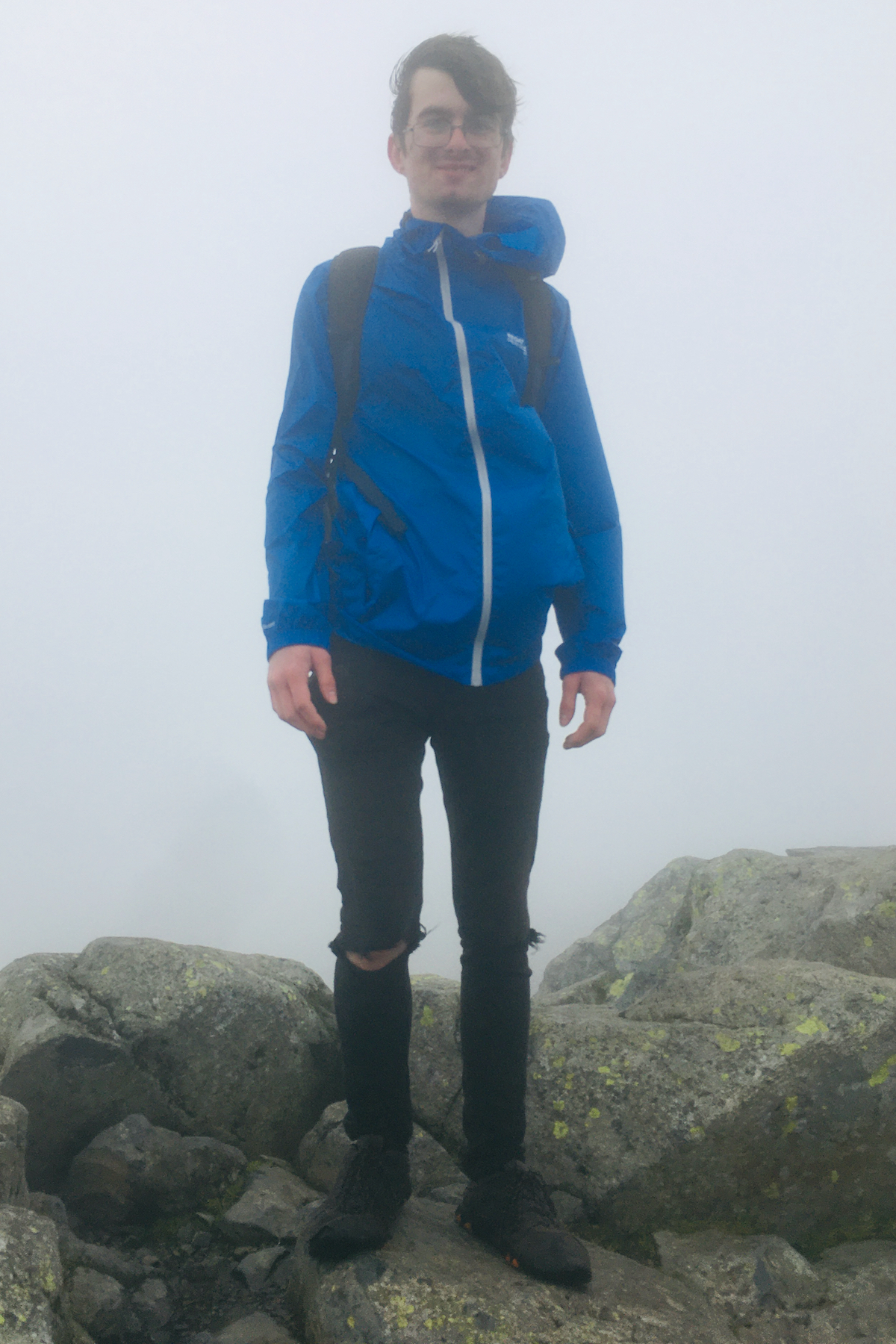
Ian completes his top ten, atop Great Gable, seventh-highest fell in Lakeland

It’s done. 

And now, the final descent. After yesterday’s fiasco dropping off Scafell Pike we are careful to use the compass on Ian’s phone (mine has died in the wet and cold) to make sure we are dropping to Sty Head. This time a path materialises in the mist, and in spite of a few nervy moments when it apparently heads off in the wrong direction, this time as we emerge from the cloud there is our target unmistakably below. We are both happy: we completed the mission, as father and son team. But my feet and legs are barely functioning, and even this final descent is physically excruciating.

As I hobble downwards in the afternoon sunshine – it has finally come out – a thought begins to form in my mind: never again. This has been a magnificent reprise, like some ageing rocker’s farewell tour of all his best songs, grinding it out like he used to in youth – but I can’t do this anymore. It hurts too much. Lakeland: there are too many stones. Clambering over the big ones, clinging to handholds in rocky gullies, the tiny ones skittering away below your feet as you slip and slide, the pebbles jabbing through your boots into your feet, the constant ache in the legs from pushing upward on rock. No, I’m retiring. Yorkshire from now on for me: long rolling grassy slopes and dozen-mile vistas. Back to my first love.

We regroup at Sty Head and begin the final descent to Wasdale. Still the stones keep coming. Still we have to brace and angle downwards against rock. Towards the bottom a patch of grass looms; for a few brief metres it cushions my feet, but breaks up again into stony shards. I stumble the final mile, then get in the car and drive.
Posted in daddymummybabyblog, older | Tagged , , | 3 Comments

The Skilled Labourer

The Skilled Labourer is the third volume of the husband-and-wife team J L and Barbara Hammond’s three-part history of the English working classes and their struggles to survive in the early decades of the industrial revolution, from 1760 up to the Representation of the People Act (also known as the Great Reform Act) of 1832. The first volume, The Village Labourer, was published in 1911; the second, The Town Labourer, in 1917; the third in 1919.

Their publication thus straddles the beginning of the modern age; it is much harder now than it was then to see back into what is now the distant past, before the Victorians began building the physical fabric of the world we live in today. There is much that has been generally forgotten. Which is a pity, because after 40 years of increasing inequality, with investor rights taking primacy over those of workers, and in the last decade the erosion of many people’s economic status towards subsistence level, it looks like, step by step, we’re on our way back to where we were 200 years ago. And it really wasn’t a nice place.

In the villages of what was still then an overwhelmingly rural society, the problem started with the seizure of traditional common land by local landowners seeking to increase their wealth. These actions were justified by academic theories about efficient land use and formalised through acts of parliament. For ordinary villagers, though, they were not just breaches of a centuries-old social contract; the loss of the right to graze animals or gather firewood on common land meant the difference between sink or swim. In order to survive, huge numbers of independent smallholders were forced into insecure short-term labour for the very landowners who had dispossessed them of the commons, under atrocious conditions and at atrocious rates set by those very landowners; while hundreds of thousands more were forced, destitute, off the land and into the destitution of the growing industrial towns. In the countryside, the notorious Speenhamland system (instituted in 1795) encouraged agricultural employers to pay their labourers as little as they could get away with, pauperising them while maximising profits, by shifting the burden of subsistence to “poor relief” from the local parishes. This relief was funded by all who paid rates, including those struggling just above the breadline (echoes here of 21st-century taxpayers having to top up via universal credit what employers won’t pay as a living wage?) The ultimate result was a large-scale rural uprising, the Swing Riots of 1830, which finally helped to force reform.

The second and third volumes look at those who were forced into the towns to try and make a living there. Conditions were no better. Families were seen as an economic unit, with children as young as four being expected to work in the mills to edge their parents’ income up to subsistence level. There are heart-breaking tales of small children being forced to work up chimneystacks and even dying there. In some trades some of the time employers paid a living wage or better, and there was relative prosperity; but in most cases, the pressure on pay was downward, with ratepayers again left to pick up the tab for keeping workers and their families sufficiently alive to continue their labours. Inevitably, workers began to unionise, but employers’ friends in parliament ensured the passage of the Combination Acts of 1799 and 1800, which outlawed trade unions and collective bargaining. (One of the prime champions of these laws was William Wilberforce, lionised in the history books for his role in the abolition of the Atlantic slave trade; it’s less well known that he was at the same time enthusiastically legislating large numbers of workers into conditions of near-slavery in England). The Acts were vigorously prosecuted by local magistrates, aided by a government spy network, and agitators were sentenced to jail terms and worse. Naturally the employers were not under any such constraint, and freely collaborated to cut wages. The result was not just destitution but unrest, culminating in the Luddite rebellion in Nottinghamshire, Yorkshire and Lancashire from 1811-17, the focus of which was the smashing of factory machinery which the Luddites held responsible for driving their income down. The government’s initial response to this was to send north an army of 12,000 men, a larger number than the future Duke of Wellington was simultaneously leading against Napoleon’s forces in Spain and Portugal. Some agitators did commit murders, but many more were executed or sentenced to long terms of transportation across the world for criminal damage and theft. The Combination Acts were repealed in 1824, but reimposed in 1825, and extreme conditions and destitution remained the norm for decades to come, as readers of Friedrich Engels’ The Condition of the Working Class in England, describing Manchester in 1842-44, will know.

All this happened in England. Could it happen again? Apart from a few linguistic flourishes and his now-defunct trade, could John Baines, a 66-year-old hatter from Halifax, be speaking of the state of the nation in 2023? “’Oh that the long suffering people of England,’ he cried, ‘would rise in their strength and crush their oppressors in the dust. The vampires have fattened too long on our hearts’ blood…by usurping the House of Commons, [they] have got the purse strings of the nation into their hands also. They have provoked wars and lived and fattened upon them…All the offices in the land are held by them and their friends; salaries and pensions are showered upon them from the national treasury, and still like the horse-leech they stretch forth the greedy, ravenous maw, and cry, “Give! give!”’” Certainly, things are far from being as bad yet as they were 200 years ago – we do still have public services – but the outlines, and the direction of travel, are clear…

There was another way of proceeding, though, and sometimes it even became real through parliamentary action. Notably, disturbances among the silk weavers of east London in 1769 and 1773 led to the Spitalfields Act, setting a fixed rate of renumeration for the trade which held for 50 years. During this time, the “weavers passed their leisure hours, and generally the whole family dined on Sundays, at the little gardens in the environs of London, in small rooms, about the size of modem omnibuses, with a fireplace at the end. There was an Entomological Society, and they were the first entomologists in the kingdom. They had a Recitation Society for Shakespearean readings, as well as reading other authors…a Musical Society…They were great bird fanciers, and breeders of canaries…Many of the houses in Spitalfields had porticos, with seats at their door, where the weavers might be seen on summer evenings enjoying their pipes.”

The Hammonds, in the conclusion to their third volume, remained optimistic: “it was easier to invent the spinning machine than to construct the human associations that could make that machine a help rather than a hindrance to human fellowship… In the greater moments of his history man has aimed at something more than outward order: he has aimed at a society in which men can live and work together in a spirit of freedom and mutual respect ; he has thought of the State, in the words of Aristotle, as a community of free men [sic].”

Posted in bleakdom: don't blink, England, someone's England, misery for the many, freedom for the few, read | Tagged , , , , , , , , | Leave a comment

smokeocalypse

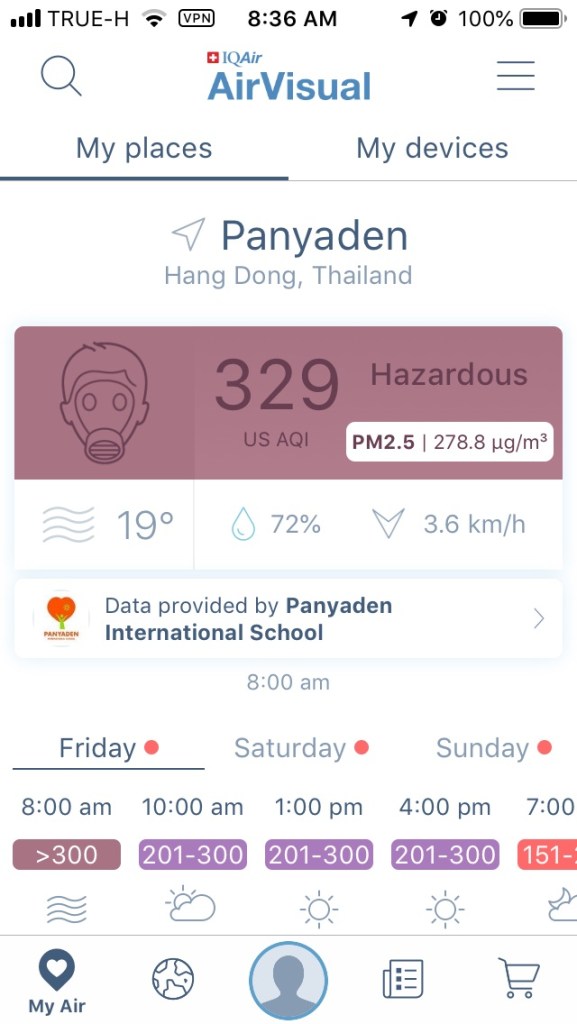
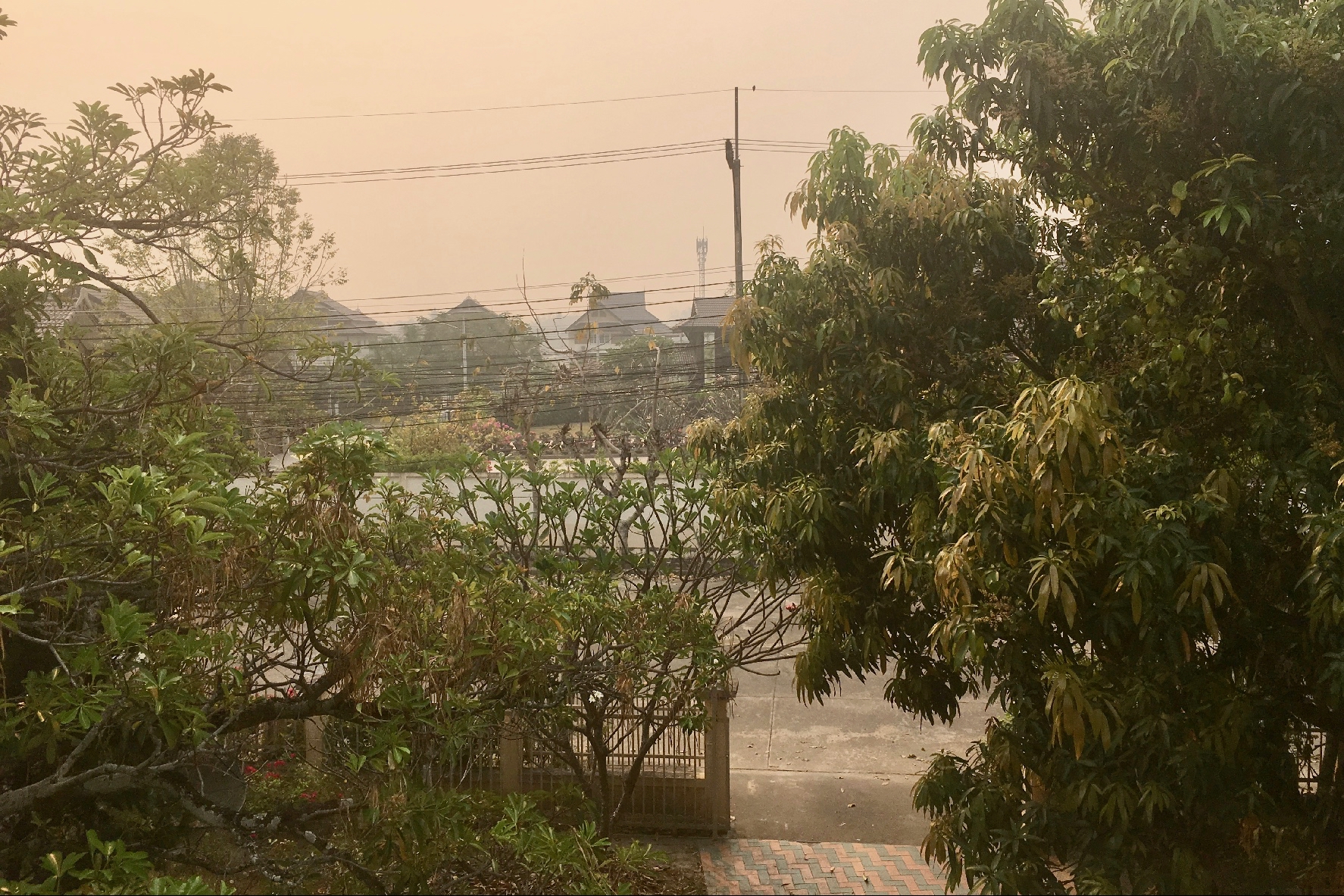
Today, and not for the first time this week according to the AirVisual app on my phone, Chiang Mai has the most polluted air of any city in the world. By a mile.

Image-1 (1)

Here is the view from our window:

15.3.19 smoke

And here is the report for the sub-station closest to us:

Image-1

The main figure, 329, is on a scale of 500 measuring overall air quality; anything above 300, according to the United States Environmental Protection Agency, constitutes “emergency conditions…the entire population is…likely to be affected by serious health effects.”

The PM2.5 figure (278.8) measures microscopic particles smaller than 3% the width of a human hair. These are so tiny that the normal dust-blocking mechanisms of the human nose and throat can’t stop them; they go straight into the lungs, and so into the blood. Completely safe levels for PM2.5 are considered to be up to 12; for levels over 250 the EPA warns, in the short term, of “serious aggravation of heart or lung disease and premature mortality in persons with cardiopulmonary disease and the elderly; serious risk of respiratory effects in general population.” We are cautioned to “avoid any outdoor exertion; people with respiratory or heart disease, the elderly and children should remain indoors.” In the long term, studies have found, PM2.5s can cause hardening of the arteries (hence increased risk of heart attack and stroke), and lung cancer.

This year is worse than most, but it happens every February and March: why? It’s tempting to lump it in with all the other ecological calamities of modern industrial civilization, but actually this is a really low-tech phenomenon: the country is burning. Part of it is accidental, but most is probably agricultural arson: burning rice stubble before planting again, burning forests to clear fresh land for planting, and even (it is said) burning underbrush to stimulate the growth of rare mushrooms which fetch a lot of money. Information about how long these farming techniques have been used is hard to find, but the only particular connection I can see with the 21st century is that there are more of us than there used to be – more mouths to feed, and so more encroachment on the forests.

So what is being done to stop it? In a nutshell, nothing. There have been tales of governments and NGOs providing tractors to farmers so that they don’t need to burn, but how many tractors would you need in an area the size of northern Thailand? There is even nominally a burning ban throughout March and April, but again, how do you enforce that effectively across such a huge area, even if there is the will to do so? Which, apart from a few show operations, there doesn’t seem to be: after all, the enforcement officers are often in the same communities, and may even be related to, the farmers who see no other way to maintain their crop cycles. On top of which, the level of burning is actually way less in Thailand than it is in neighboring countries like Burma and Laos, where there is lower awareness and even less effective government; and smoke is no respecter of national borders. Some of it may be coming from as far away as south China, where the government really is concerned about air pollution – but in Yunnan, the closest Chinese province to us, there is a saying that the hills are high and the Emperor is far away…

In response, some of the schools here are shut. Others (including our kids’ place) argue, correctly, that while parents are free to keep their children at home if they wish, schools have air filters in classrooms, all exercise is cancelled, students are told to stay inside and, when they do have to venture outdoors, wear masks; so they may be safer at school than in homes which don’t have proper air filtration (that includes ours – we could buy a bunch of air filters at $150 apiece, but then our windows aren’t sufficiently well-sealed that it would make all that much difference).

Me, I’m barely moving a muscle. Especially since this has now been going on for the best part of a week, and may continue for another month or more, until – we hope – the first seasonal rains arrive to put out the fires and wash the smoke to earth. Mildly streaming nose, slightly sore throat, low-level headache, gentle wheezing in the lungs, all of these are in a day’s sitting as still as possible. All this, it is said, adds up to the equivalent of smoking a couple of cigarettes a day. So I’ve put myself through far worse; but what’s more striking is the moodscape: the sense of living in a vast, inescapable, all-enveloping ecological catastrophe, land and sky alike permeated with smoke like the shadow that creeps out over the lands of the world as dark power crescendoes in Tolkien’s Lord of the Rings. Somewhere just over the horizon, it’s easy to believe, the world is ending in fire.


Posted in lemmingwatch, peak and decline, Thai time | Leave a comment

seven ahead, five to play

Leicester City. Earlier in the season, during their improbable run to the top of the table, they were – in sheer footballing terms, never mind what else they stand for – inspirational. Like when Riyad Mahrez (playing in Ligue II two years ago) did this to the plutocrat-funded EPL champions:

https://www.youtube.com/watch?v=t30QkwNhKGk

Or when Jamie Vardy (hero of Halifax and Fleetwood in his mid-twenties) stuck this belter (goal of the season?) on five-times-European-champions Liverpool:

https://www.youtube.com/watch?v=Lnncn1Hd3g8

Just two examples.

Declaration of interest: I am a neutral, a lapsed (hooliganism in the ’80s, not serial failure) Leeds fan. But how could anyone not want an unfancied team that play like Leicester to win the title?

Of course, it could never happen. Money in top-level football is a relative thing (after all, Leicester themselves are backed by the owner of the Thai duty-free monopoly, hardly a pauper), but the golden sacks of the big four will win out come May. The natural order: just like the free market, trickle-down economics and free-trade agreements, all that stuff we’ve been schooled to since Maggie won in ’79. Forget what you knew in the ’60s and ’70s; no first-timers had been champions since Brian Clough’s Forest, straight off the back of promotion, in 1978. But Clough was a certified genius fit for the movies, right? And that was in the days before squad rotation; that was almost black-and-white TV.

Of course, you could argue, here are Leicester, just like the teams of 40 and 50 years ago, turning out (and winning) the same way every week: Schmeichel; Simpson, Morgan, Huth, Fuchs; Mahrez, Drinkwater, Kanté, Albrighton; Okazaki, Vardy. Something about team spirit and discipline, maybe? Well, that helps of course; but it must be a blip, without the big money to back it.

Clever, plucky little Leicester. So entertaining while it lasts.

And then, about a month ago, it began to look serious. Top of the table in February? Here’s a challenge the big boys – Arsenal’s turn this time – will surely pass, and Leicester will fail. But instead Leicester changed their game; they stopped being routinely impressive, and instead clung to it. Vardy stopped scoring, Mahrez virtually disappeared, but they kept grinding it out: 1-0, 1-0, 1-0. It was beginning to look like they knew what they needed to do to win. Last week they kicked off against Southampton five points clear, and were outplayed for large stretches of the game. Mahrez looked tired, Vardy went missing; Southampton could – maybe should – have had two penalties. But the central defence of Morgan and the “ever-growing Huth” (as a commentator called him yesterday) were right on the spot when it mattered. Leicester rode the luck of potential champions, and all it took, in 90 minutes, was one perfect cross and one spectacular header:

https://www.youtube.com/watch?v=GOFoqAR5ka8

1-0, again.

Yesterday at relegation-threatened Sunderland, the unbelievable seemed, once again, unbelievable. Kanté was functional as always, but Vardy was driven wide and Mahrez hardly there; even when he woke up in the second half, he kept losing the ball. Drinkwater was trying to pick up the attacking slack; but, let’s face it, he’s not a striker. Sunderland outplayed them at times; survival, again, was down to Morgan, Huth and Schmeichel. Well into the second half, here comes a draw – or even, breathe it, a 1-0 loss. They could still win the title that way.

And then this happens:

https://www.youtube.com/watch?v=BwkiRHw50b0

So it became another 1-0, clinging in there for the last 20. Except that right at the end, after lots of messing around by the corner flags, lightning struck twice:

https://www.youtube.com/watch?v=wn45PP4S614

If you’re not a Spurs fan, how can you argue with that?

But for all of that class, the moment that illustrates why they deserve to be champions came in the 78th minute, with Sunderland attacking. A cross came in, and the Sunderland striker on the end fluffed it. Any self-respecting multi-million asshole from the big teams (why am I visualizing Diego Costa?) might have stuck it in the loser’s face for psychological advantage; but instead the Leicester defender (I didn’t spot which) patted him on the back, as if to commiserate: “I’ve been where you are, and I feel it. You may be playing a division lower next season, but I will be there with you, because that’s where I came from. You dream, so do I, and we both give all we have; we’re footballers. But in terms of success, that guarantees nothing. And maybe in a few years – months, even – our positions will be reversed.”

Can Leicester really do it? It’s still not guaranteed. Claudio Ranieri, who used to be styled the tinkerman (he seems to have got over that), could also be called the nearly man: he has been second with Chelsea, Juventus, Roma and Monaco, but never won. There are still four teams in with a mathematical chance, of whom Tottenham, the other underdogs, are (pleasingly) the most likely. Leicester still have to win three of five, or win two and draw three; that’s not easy. It has often been pointed out that for them even to have come this far is a triumph, but that no longer seems enough, at least for those not affiliated to a big-money club: by mid-April, they’ve been doing it so well for so long that it will really only satisfy if they go the whole way.

Now if only Bernie, on a more important scale, can pull the same honest trick in 2016…

Posted in England, someone's England, round ball | Tagged | 6 Comments

Blue Homepage

Yesterday was the final day of the F/28 month of photography in Chiang Mai, so I spent a few hours running around trying to catch what I hadn’t already before it all came down. Highlights:

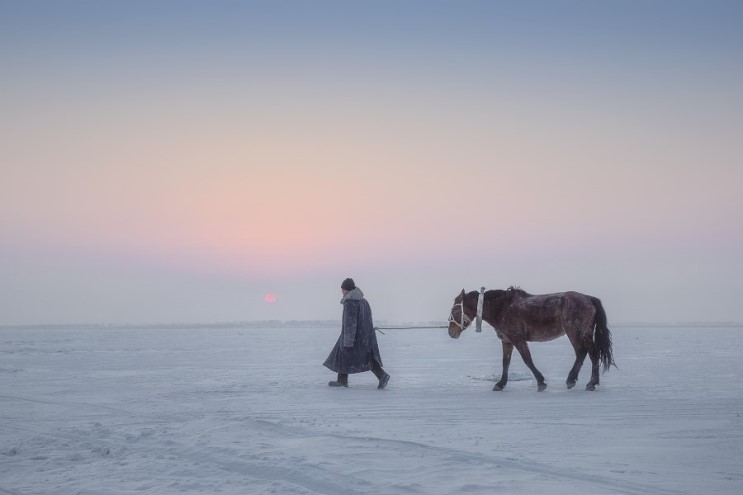
  • colour images by Shin Jeseop of a frozen lake in the Manchuria where Mongolian locals drill holes in the ice to cast nets for fish (this is the only image I could find online):

chagan-lake

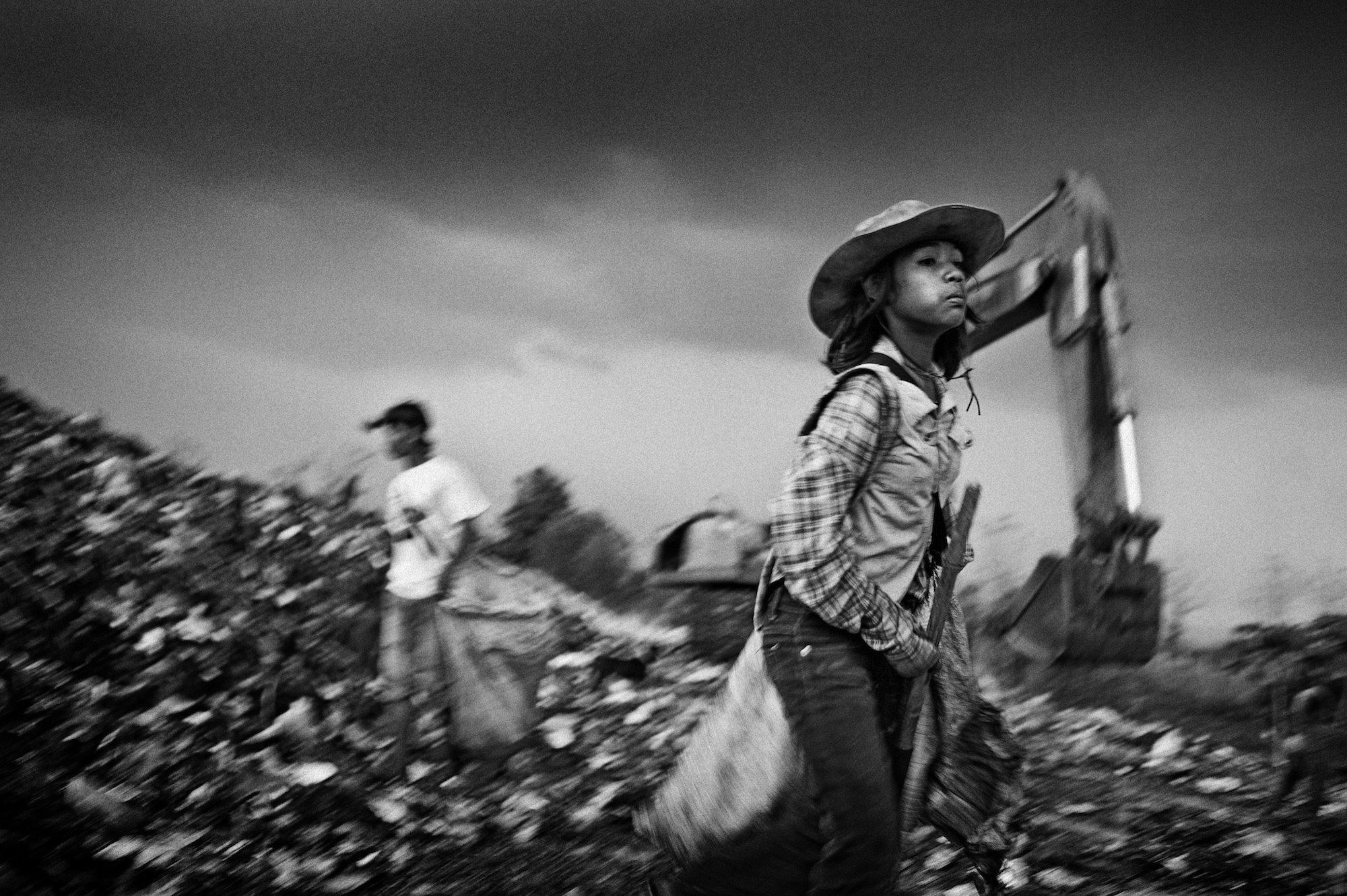
  • disturbing shots by Vincenzo Floramo of Burmese migrants (including children) who scratch their survival by picking through a landfill in the Thai border town of Mae Sot for recyclables that they can sell for 2 eurocents a kilo (there is supposed to be a gallery here, but none of the images load for me in either Firefox or Chrome):

recyclers_clem1

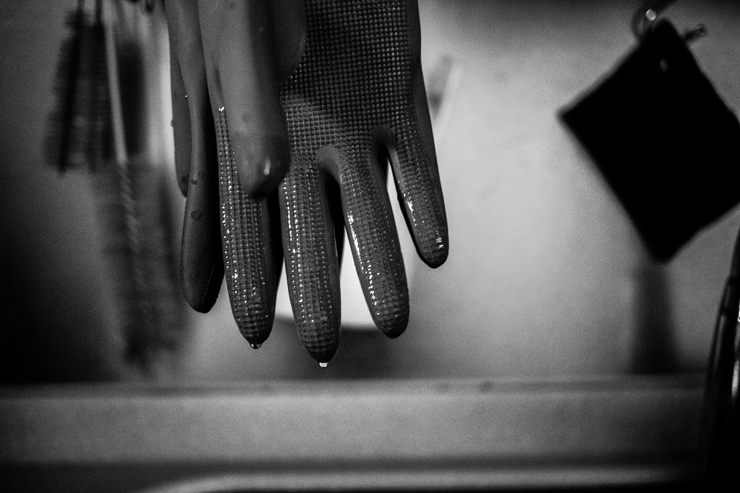
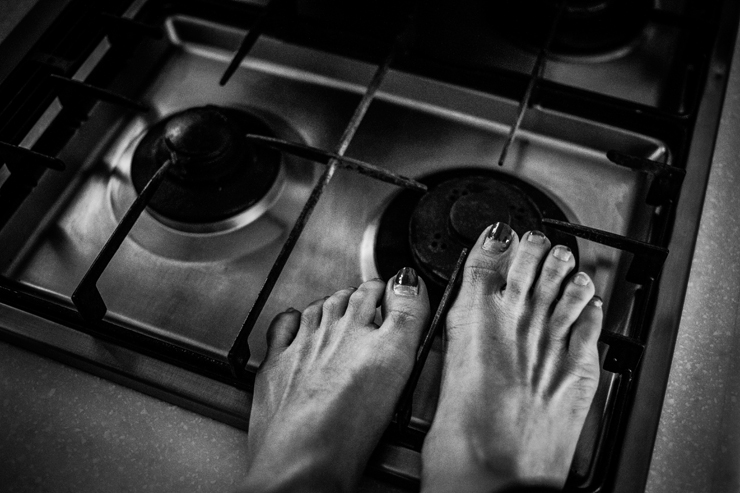
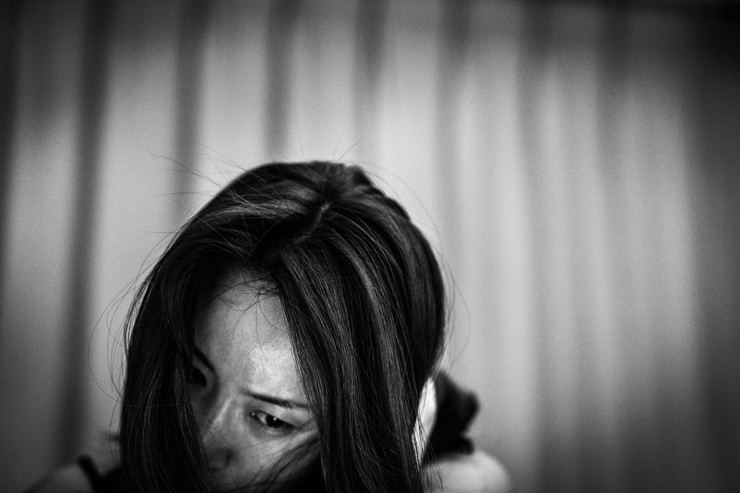
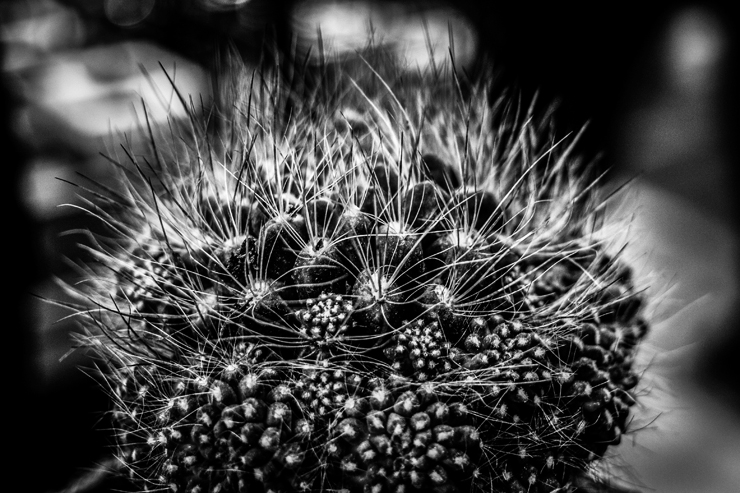
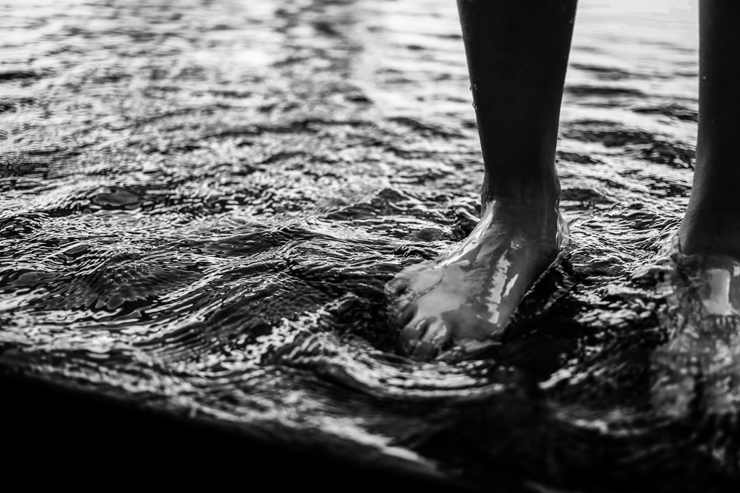
But the absolute standout for me was Blue Homepage, the super-sharp black-and-white work of Julia Kook, a Korean photographer who describes herself as “A mom of two kids and an identity seeker searching for her ego.” A pair of rubber gloves hanging dripping at the kitchen sink; a pair of bare women’s feet, nail polish chipped, resting on a spotlessly clean gas burner; the top half of a scowling woman’s face, mobile clamped to her ear, against a backdrop of drab grey curtains;simple folds of cloth; a micro-detailed close-up of the top of a potted cactus, its thin spiky hair waving from what looks terrifyingly like carbuncles atop a deformed head; two lower legs, one cropped in half by the edge of the photo, standing in the sharply frozen wavelets of a large puddle. I have rarely seen the mundane domestic look so bottomlessly doom-laden.

Worth quoting her artist statement in full:

8:00 A.M. – Wake the kids and get them ready for school.

9:00 A.M. – Go to bed again.

3:00 P.M. – “Mommy! Mommy! I’m home. Guess what? In school today…”
Shit, can’t get up.

7:00 P.M. – Should make dinner.
Pick up the phone. “I’d like a large, deluxe pizza. My address is…”
.
.
Lazy bitch!
Got married at 26.
13 years passed.
Got the blues.
Can’t sleep without the pills.
Have two kids.

Make meals everyday.
Look at their homework, clean the house and do the laundry.
Every morning, I’m just a normal housewife, starting a normal day.

My husband? He goes to work at dawn.
And comes home the next day at dawn; wasted.
Can see him before going to bed if I’m lucky.
Can’t remember the last time we had sex.
We are a married couple sleeping in separate rooms.

8:00 A.M. Again…
.
.
It’s been 13 years since I’ve been alone.

glovesstovecall

clothcactusfeet

Posted in bleakdom: don't blink, sound and vision, Thai time | Tagged | 1 Comment

no more next day

Seven weeks now since they took Bowie’s passport and shoes, and with them a fair number of, umm, older people’s youthful sedatives too (boo! death comes to everyone. boo-hoo…) In return: a scary and intriguing answer to a question that probably not too many people were asking before January 10th: what did happen to Major Tom after he cut circuits and sailed off into space, beyond the word at the end of his 1970s heyday that he had turned junkie ?

It’s difficult to think of any artist of anything approaching Bowie’s stature (not that there were, or are, many) who can have so effectively blown off such a large slice of their own original fan base as he did with the slick commercialism of Let’s Dance in 1983. Before that he was a cult, albeit probably the most successful one in the western world; but he was a cult of weirdness, difference, alienation, in whom anyone who felt even slightly that way could feel themselves represented, in almost as many ways as he had listeners. In 1983, suddenly he was mainstream, and massive with it: 10-million-sales massive. Well on his way to net worth 70 million quid. But once he had taken that road hardly anybody I knew, at least – though he undoubtedly kept on selling to someone – paid much attention to anything he did again. Yes of course there were the die-hards who would keep touting each latest as the best since, what, Scary Monsters? But they generally got humoured, filed in the same box as Zappa obsessives who couldn’t stop raving in midnight bars about their hero’s every tedious guitar lick. His iconography spread far and wide, into the strangest places: on the November 2012 cover of Thai Vogue, the ideal living room features a shaggy-haired Hours-era portrait high up on the wall. But all through his commercial car crash of the 1980s and his (on the face of it) has-been struggle in the 1990s to make up lost ground, how many really knew – or cared – what had happened to Major Tom?

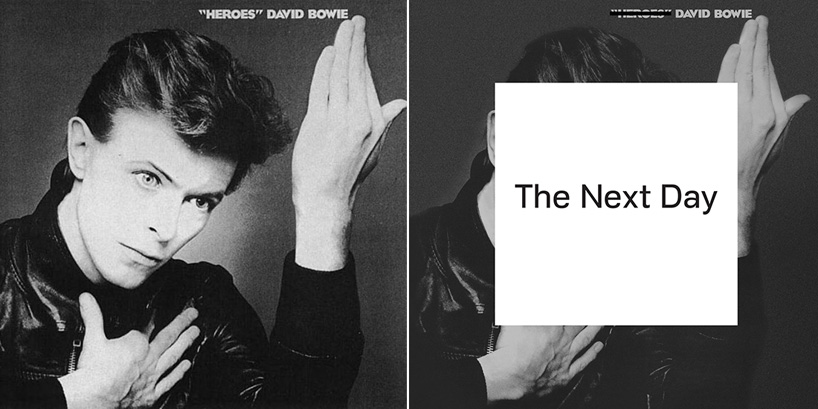
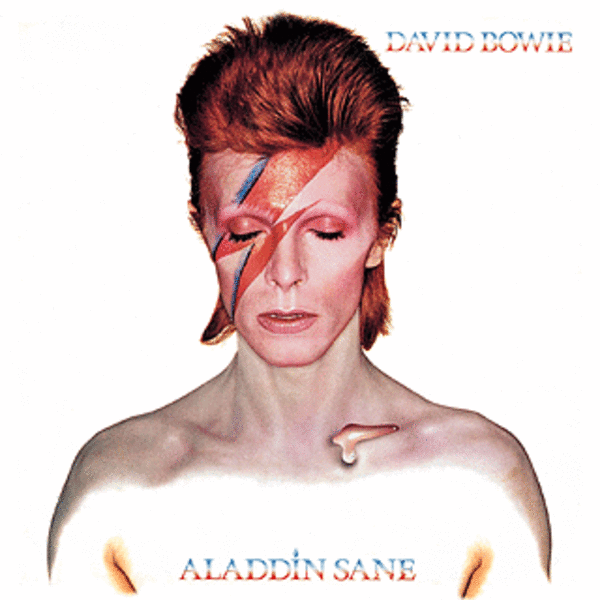
Meanwhile, without really noticing, you got old enough that young was something which, although it still felt like you ought to be, you could no longer pretend that you were; the world had changed in ways you never expected, and a lot of what was going on around was so much less intelligible than where you had come from. Way less intelligible than Bowie had been, even at his most cryptic, in the ’70s. But then, out of the blue: here was the ultra-cool cover to “Heroes” again, except this time with a blank white box in place of Bowie’s head:

bowie_barnbrook06

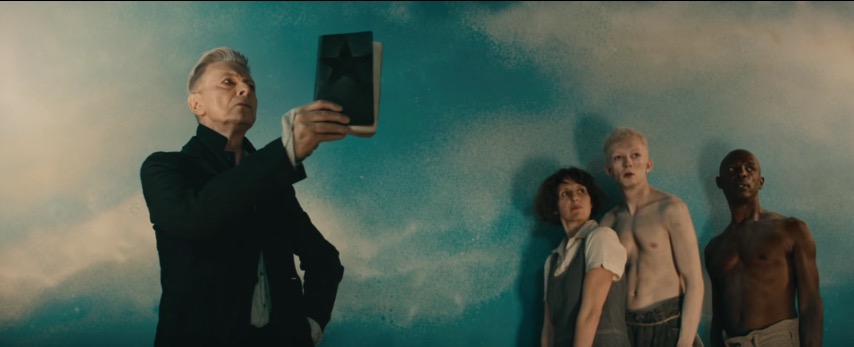
And a well weird – almost Scary Monsters weird – video of a poignant song about how what had once been was no more:

Hitherto in the 21st century Bowie had apparently been content to, if not exactly rest on, then at least give a breezy airing to his rock god laurels (and after he had achieved in a single decade what most couldn’t hope to given millennia, who could have begrudged him the right to be comatose on them if he chose?) Read reviews of Heathen and Reality, and a word you’ll find to describe those albums’ relationship to the rest of his oeuvre is “coda”. And then, after ten years’ silence, The Next Day, a patchily intriguing comeback: a vague waft of nostalgia, like listening to a revered old uncle who always has something interesting to say and some great stories, always welcome on the basis of the awesome heroics of his youth, but hardly likely to do anything surprising or fresh.

But then, unbeknown to anyone, the clinic called: the x-ray was not fine; there were scars that could not be seen. The first hint (for those who were listening) that he was turning again to face the strange came in late 2014, with the original, single version of Sue (Or In A Season Of Crime): out of the static swirls a dark summary rewrite of a sinister Jacobean tragedy, an eerie, Scott Walker-esque vocal line drifting unevenly over an edgy brass arrangement, and ending with the lingeringly held word “goodbye…” Panting to keep up was the equally strange b-side ‘Tis A Pity She Was A Whore, blessed with a lyric of poetic compression and finesse (if an altogether muddier and more tentative delivery than its later incarnation on Blackstar).

Another year, and the album landed. For two days, a musical adventure, and a lyrical puzzle worthy of The Bewlay Brothers: what the hell is he on about? Came the shock, and everybody knew him now: not the next, but the last day. Nothing left to lose. It sounded like it too: in another context the last few songs on Blackstar might almost have gone down as fillers, but not here. The poignancy of the English evergreens he’ll never see; the knowledge that something is very wrong, that he’s “dying to”; the wistful harmonica quote – moving on again – from A New Career In A New Town, as he drifts away protesting, over a backdrop of yearning Fripp-esque guitar, that he can’t give everything away…

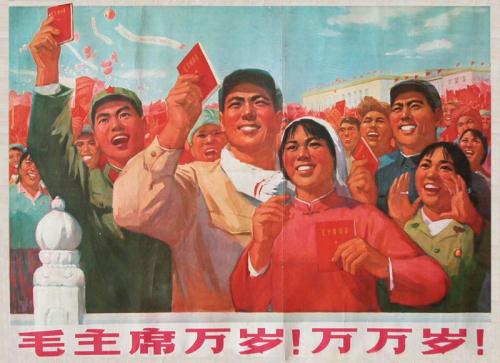
So he wrote his own requiem. And not in a tried-and-tested idiom, as the flailing saxophones and key shifts of ‘Tis A Pity She Was A Whore attest – not to mention the sheer strangeness of the title track. And now we know what became of Major Tom: he fetched up dead in his 1970s spacesuit on an alien world where girls have tails, his jewel-encrusted skull discovered during a (permanent?) eclipse to be installed as the venerated relic of a cult of trembling people. As his earthly remains spiral into the black star that (as Elvis sang) every man has over his shoulder, it is Bowie himself, lazarized, who leads the worship, posing with a holy book in iconography that mocks – or apes – another, darker, cult leader and cultural revolutionary:

blackstar bookred book

And so the process of canonization begins: the tribute concerts, the cover versions at awards ceremonies, the thoughtful reminiscences, the irony-proof rock stars lining up to relate how honored they were that he refused to work with them because he thought their music was crap. It’s all over the papers: he was not just a great artist, but a great man too – so kind, polite, considerate, always brought out the best in people, never a harsh word for anyone. Ah yes Gary Oldman, “He was the very definition, the living embodiment of that singular word; icon.”

Meanwhile, back in the video: here we are on the day of execution, in the villa of Ormen – or was that all men? And what’s this: everyday fellas crucified in agony – what, on the wooden details of their own ordinary lives? – as some rough beast of ill intent slouches towards them; yet still with enough life left to gyrate their hips like Elvis, and defiantly poke their tongues out at fate? Wait a minute, how distant is this planet we’re on?

So right at the death, when few suspected he had it in him any more, he fooled us again, pushing musical boundaries and backs against the grain just like he did throughout the ’70s; and he got us bang to rights while he was at it. There he was once more, in the Lazarus video, still getting educated and frantically writing it down, even as the fantastic voyage of this fabulously stylish and creative south London gent was drawing to an end. Back then he was our generation’s guide to living; in 2016, our guide to his own death and sanctification.

Now that’s a proper coda. What (as Tony Visconti said) a parting gift; what a final wham bam. For the last time, thank you man.

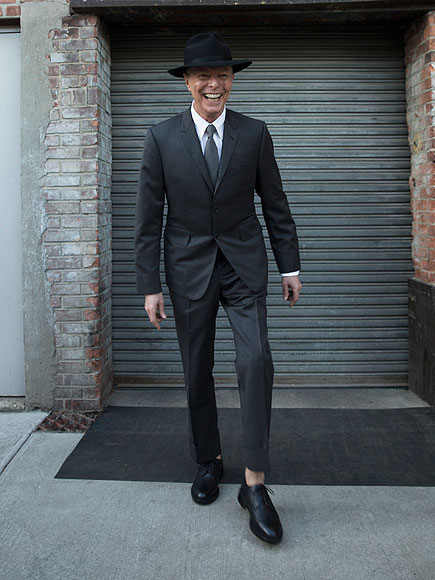
david-bowie-a-435


Posted in older, sound and vision | Tagged , , , | 2 Comments

a crash course for the ravers

as_front_300k

“So who was this dude”, ask my kids, “and why are all the middle-ageds so upset?” Why did the principal of my daughter’s school (born somewhere dahn sarf, 1962) approach me in the playground at pick-up time, to commiserate and reminisce? And what about that other one that died a couple of weeks ago, the black leather type with the big moustache? Why didn’t the principal talk to dad about him?

Yes, kids (and with all respect to the headbanger tribe), this death, though no more or less unexpected, is culturally a much bigger deal than Lemmy’s. And yes, it has really got to the grownups –at least those of a certain age, the unacknowledged demi-generation stuck in the middle: too late to be “Baby Boomers” (with all their hippie gear) but to whom “Generation X” icons like Kurt Cobain were a tardy footnote to what was really going on. Let’s call us (thanks to Richard Hell) the Blank Generation. On Facebook, my old schoolmate Huw says he “had a bloody great lump in my throat on more than one occasion today…a big part of my youth, and a constant companion throughout my life, is gone forever”; the ever-creative Julian (who I didn’t even know in Bowie’s heyday) called him the “single most important musician and influence on my life. The most important person in my life that I don’t know”. Andy said, simply: “time takes a cigarette.” My wife, who grew up an ocean away, and whom I didn’t meet until more than 20 years after Scary Monsters (the last great Bowie album, at least until this year), has been raving about Space Oddity and Let’s Dance. My own moment came yesterday morning with Cracked Actor: a dirty, snarling song about a dirty-minded Hollywood has-been bloating his greedy, savaged ego with a chew-her-up-and-spit-her-out hooker, lurching under an orgiastic and genuinely frightening riff – and suddenly the fragility breaks through, Bowie pleading “oh stay, please stay”, and the tears rolling down my face….

This is the first time I’ve been inspired to blog for over two years; let’s just say it has reminded me not just that time is limited, but that I’m still getting educated, and I’ve got to write it down…

So how to explain this outpouring? Huw thinks “it must be the timing of his death – its recency highlighting the beautiful poignancy of his final work”. There is something to that: the way he so jaw-droppingly turned his own departure into an audiovisual tour de force was all of a piece with his heyday, and with the impulses that made him such a creative giant in the first place. But it’s also circular logic: only Bowie could have done something so, well, Bowie, shuffling backwards into the cupboard to become his own skeleton there for all of us to keep; and he couldn’t have done that if he hadn’t been what Bowie was in the 70s, and we didn’t all know, and love so much, what that was.

Myself, I think there are three things I have to tell my kids about why we are crying now. First, there’s the astonishing music. They listen to Imagine Dragons, Jake Miller, Sara Bareilles, all fair so far and decent enough; but – call me an old fart – what depths of iconoclastic individuation are they missing out on, at the age of eleven, by not being basted in something with the imaginative license of The Jean Genie, Panic In Detroit, Lady Grinning Soul? How, as adults, will they be kookie too (and consciously strive to stay that way) without, at thirteen, having their zeitgeist saturated with a music of this sophistication, sass and wit, and being able to take that totally for granted:

So for them I made a playlist. It had to be fairly short; no sense in being comprehensive to the point where, in the car or over the dinner table, accusations of generational imperialism begin to fly. It was a personal compilation of what inspired me; I managed to keep it under three hours by omitting some of the songs that almost everyone else will say should be in there: Life on Mars, Diamond Dogs, Young Americans (that “president Nixon” reference would have been just too much like a 1970s blimp going on fogeyishly about Churchill and Hitler), Station to Station, Fashion. My wife has already objected to my selection of the stripped-down 1979 re-recording of Space Oddity over the string-soaked original. Almost nothing before Hunky Dory, and nothing after Scary Monsters. That I can make and justify these idiosyncratic choices, while admitting that nothing is definitive and there could – should – be others for others, only goes to show the almost endlessly creative strength-in-depth of Bowie’s oeuvre, and illustrates that he was many different things to different people while still being important to everyone (of which more in a minute). So here (probably better shuffled than played in a straight line) is my playlist:

  • Space Oddity (1979 version – b-side of Alabama Song)
  • After All (The Man Who Sold The World)
  • Changes (Hunky Dory)
  • Andy Warhol (Hunky Dory)
  • Bewlay Brothers (Hunky Dory)
  • John I’m Only Dancing (single)
  • Five Years (Ziggy Stardust)
  • Starman (Ziggy Stardust)
  • Lady Stardust (Ziggy Stardust)
  • Ziggy Stardust (Ziggy Stardust)
  • Suffragette City (Ziggy Stardust)
  • Rock’n’Roll Suicide (Ziggy Stardust)
  • Aladdin Sane (Aladdin Sane)
  • Drive-In Saturday (Aladdin Sane)
  • Panic in Detroit (Aladdin Sane)
  • Cracked Actor (Aladdin Sane)
  • Jean Genie (Aladdin Sane)
  • Lady Grinning Soul (Aladdin Sane)
  • Rebel Rebel (Diamond Dogs)
  • Golden Years (Station to Station)
  • Stay (Station to Station)
  • Wild Is The Wind (Station to Station -the only cover version on the list)
  • Speed of Life (Low)
  • Breaking Glass (Low)
  • Sound and Vision (Low)
  • Always Crashing In The Same Car (Low)
  • Be My Wife (Low)
  • Subterraneans (Low)
  • Heroes (Heroes)
  • Blackout (Heroes)
  • V-2 Schneider (Heroes)
  • Sense of Doubt (Heroes)
  • Secret Life of Arabia (Heroes)
  • Fantastic Voyage (Lodger)
  • African Night Flight (Lodger)
  • Move On (Lodger)
  • Boys Keep Swinging (Lodger)
  • Repetition (Lodger)
  • It’s No Game no. 1 (Scary Monsters)
  • Scary Monsters (Scary Monsters)
  • Ashes To Ashes (Scary Monsters)
  • It’s No Game no. 2 (Scary Monsters)

Second, there’s shared memory. Those of us who were that age in the 1970s have reference points with friends, regions, tribes: for me, Telegram Sam, the 1972 FA Cup Final, Pretty Vacant, Led Zep at Knebworth. For others, maybe, Deep Purple, Dennis Law sinking Man United, Genesis, Dr. Feelgood, Brian Clough, Lemmy – even Brain Salad Surgery! But Bowie did enough, from Space Oddity to Life on Mars to Ziggy to the Thin White Duke, Berlin and the New Romantics that, in some way and at some time, he touched everyone. There is a sense in which Bowie was the 1970s.  Different facets of the diamond glittered for different people at different times; but all of us, in some way or another, were dazzled and believed all the way, at one time or another. And with the passing of time (which no longer, in these measured days, falls wanking to the floor), we have that in common. At least for those moments heaven loved us, the clouds parted; Bowie was on the radio, on the stereo. His death triggers grief at those formative days that live on but will never come again, as we shuffle backwards, more or less knowingly, towards the cupboard in which we will all one day be skeletons.

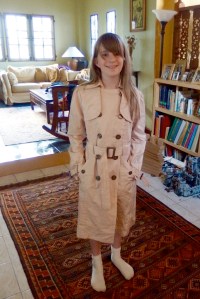
But while we remain here (and this is the third thing) there’s more than that. What it is was signaled by something you could almost call a “Bowie moment” yesterday morning, while I was taking my little girl to school. Ten years old, a few weeks ago she bought herself her first grown-up coat – her own choice, and gorgeously stylish it is too. It almost looks like something Bowie might have worn himself in his Young Americans phase. The weather was warm, so she had no call to wear it until the temperature dropped this week. But when she rolled up at the school gate, her courage faltered: “what if”, she worried, “the teachers don’t like it? they won’t let me?”

“If you need to keep warm”, I said, “why should you have to wear something dull just because other people are? Go on, tell them you’re the Thin White Duchess – they’ll know what you mean.” So she strode into school with her head held high, and the teacher at the gate said “Whoah! Look at you!”

12.1.16 Kyria coat

One small example, but what I was trying to tell her was: don’t be scared; be yourself and stick at that, the best you can. I learned that from Bowie, though it seemed to come more naturally to him than it did to anyone. He was the master. All the glorious road from Hunky Dory to Scary Monsters, through all those ch-ch-ch-ch-changes, he remained relentlessly, uncompromisingly, uniquely himself; and not just one self, but all the twists and turns of his own evolution, with us in his wake. Yes, the quiet heroes of the 1940s had courageously bequeathed a western world more or less free of tyranny and the kind of lethal racism that Donald Trump is now trying to bring back into fashion. Their noisy inheritors of a quarter century later – Lennon/McCartney, Dylan, the Glimmer Twins, Hendrix (among others) – took the next step: be unafraid to be who you are, whatever society tells you. But Bowie, using their shoulders as a launch pad, made his own leap: who you are is constantly evolving, and to that protean self be true. The 1960s broke down the door: now be what you’re going to be, and don’t get stuck with any fixed definition of what that is. The ripples change their size, but never leave the stream.

With hindsight, Scary Monsters was the far end of that high water mark; by that time you could almost hear the tide draining out. But the ground those pioneers won is still the ground on which to play, and what I want my kids to inherit. Isn’t that what the starman told him: let the children lose it, let the children use it, let all the children boogie?

Draw the blinds on yesterday, and it’s all so much scarier. Gimme your hands.

Posted in daddymummybabyblog, England, someone's England, older, sound and vision | Tagged , | 2 Comments

in-flight fundamentalist

I board the Qatar flight from Luxor to Doha, on my way back to Dubai. I am in the aisle seat; next to me, a black man in a hat. The plane takes off, reaches cruising altitude; the flight attendants come by and serve lunch. “What would you like to drink, sir?” A white wine, thank you. I unscrew the top, pour a glass, sit back and tuck into my meal.

The man next door taps me on the shoulder. “Stop drinking”, he says. I’m sorry? “Bad smell. No drink wine. Stop drinking.” I’m not going to stop drinking, I say; you booked a ticket on Qatar Airways, and they serve alcohol. If you don’t like it, choose another airline. “No English”, he says.

I continue eating, and take another sip. He pokes my shoulder again. “Bad smell”‘ he says, “no drinking”. Stop bugging me, I say; your religion forbids alcohol, and that’s your choice, but mine doesn’t, and that’s mine. Leave me alone. “No English”, he says.

I carry on. He jabs me in the shoulder again. This time I call the flight attendant, apparently a Filipino. Perhaps this has happened before; he has a spiel. “Qatar airways is an international airline”, he explains to my fundamentalist neighbor, “and we serve alcohol on board to those who request it.” “No English”, he replies.

Can you put him somewhere else? I ask. Happily the flight isn’t quite full, and they find a seat somewhere where he can be happy, next to a similarly abstemious passenger. I am left momentarily shaken at the arrogance of this self-important zealot, who feels he has the right to impose his religious dogma on others in a context where it is not appropriate. But at least I have the pleasurable consolation of a glass of wine; I take another sip, and a deep breath, and calm down. I did suggest to another flight attendant that Qatar consider having a no-drinking section on the plane, but she just wrinkled her nose; “too difficult to organise,” she said.

Posted in road | Tagged | Leave a comment

Luxor Temple

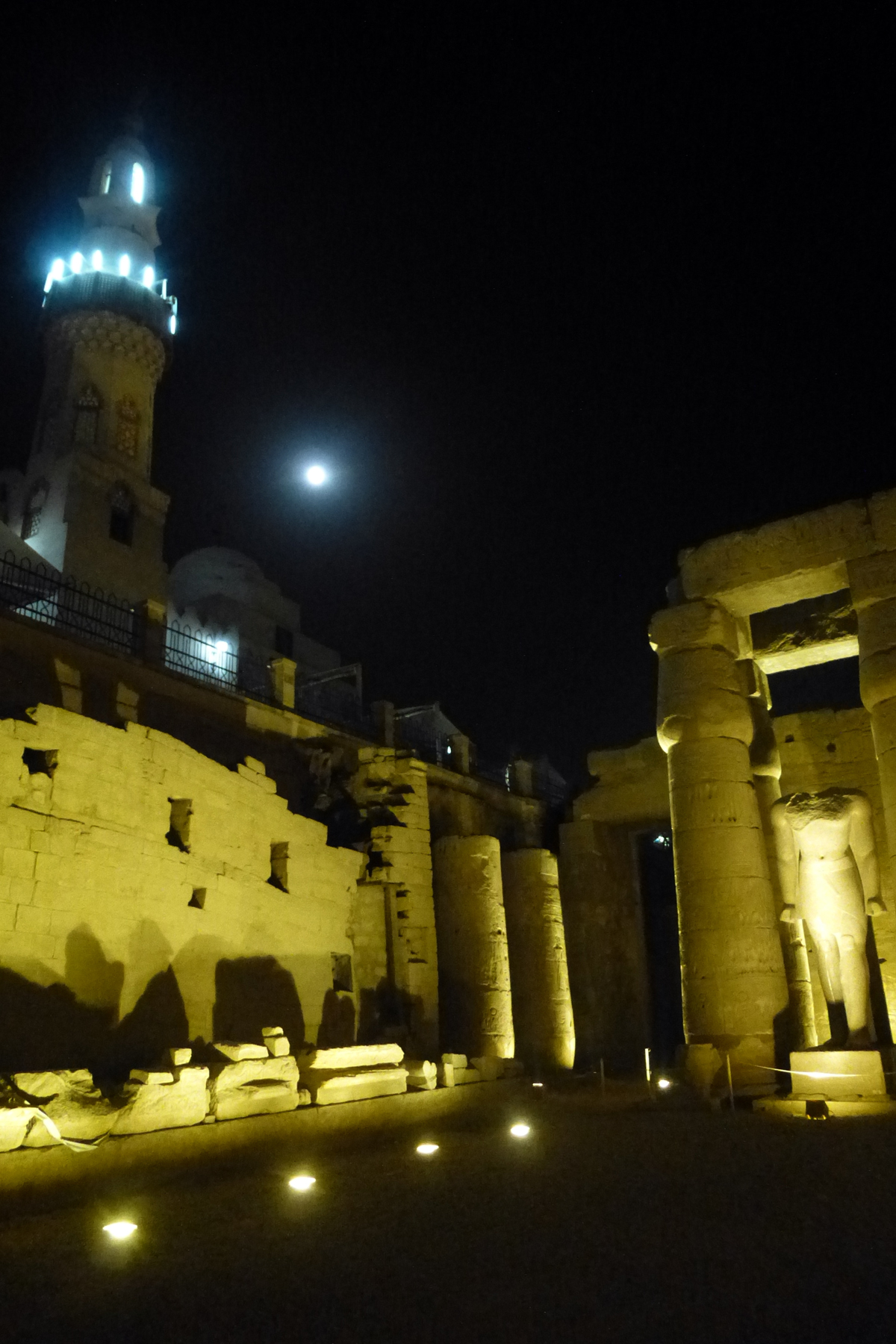
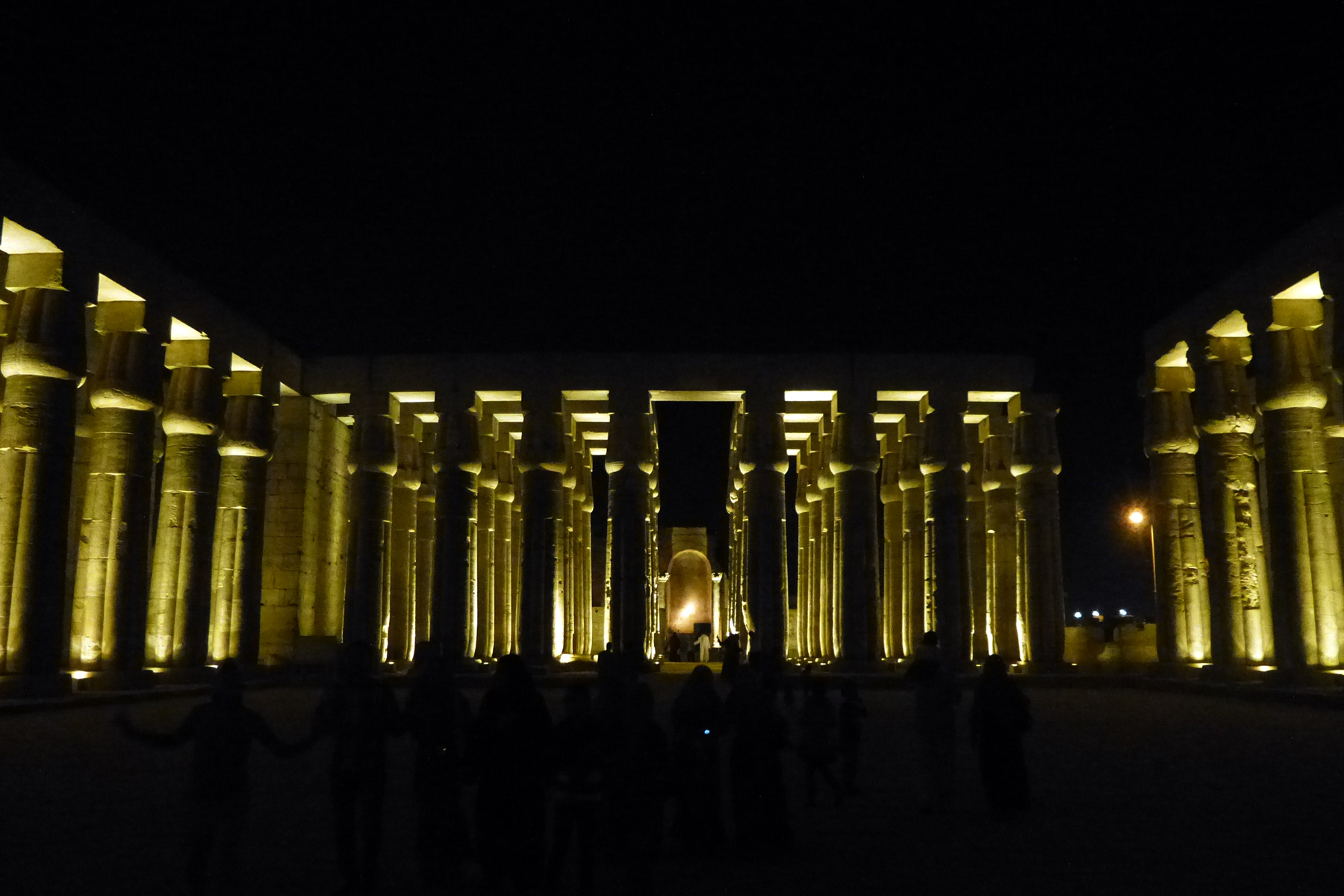
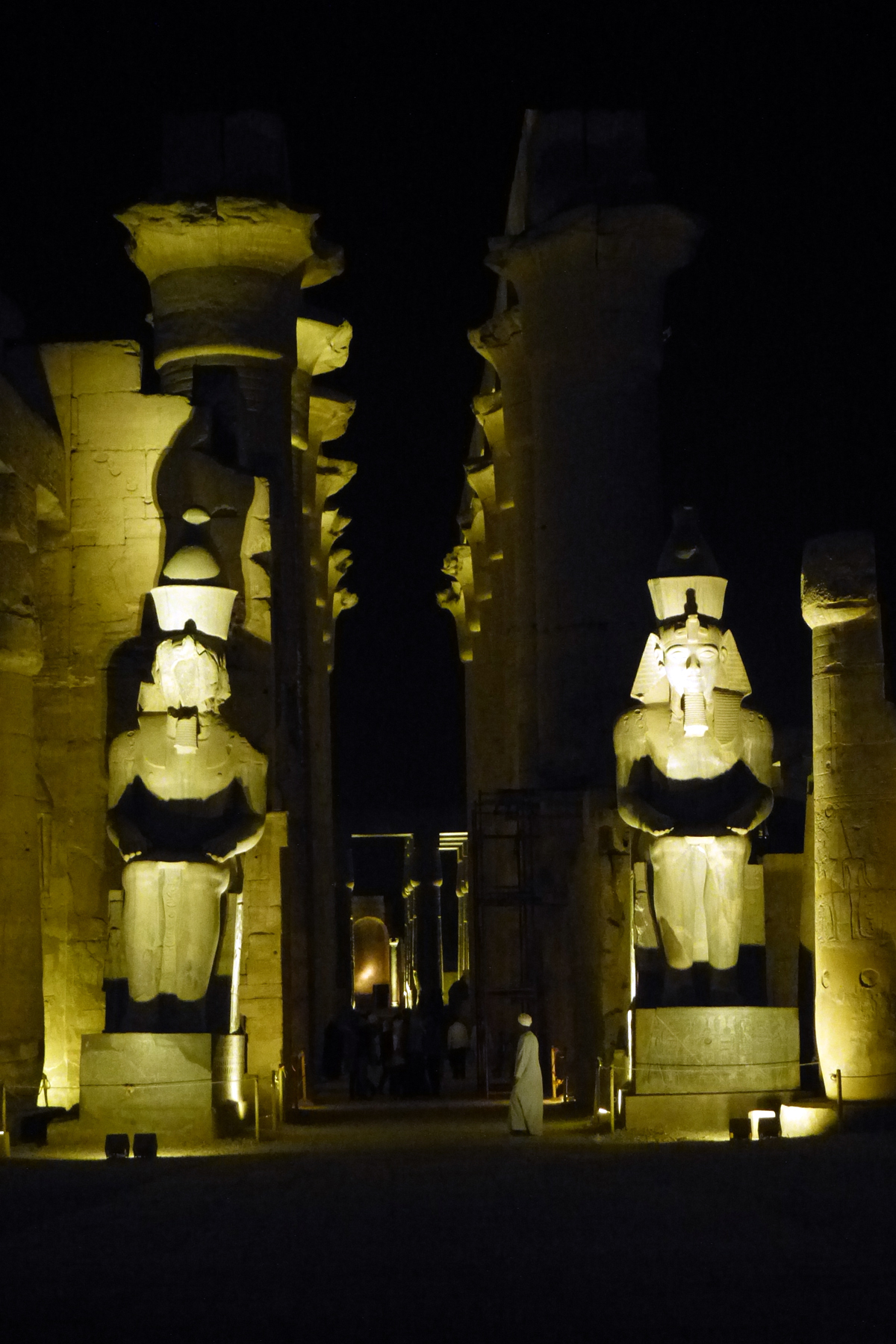
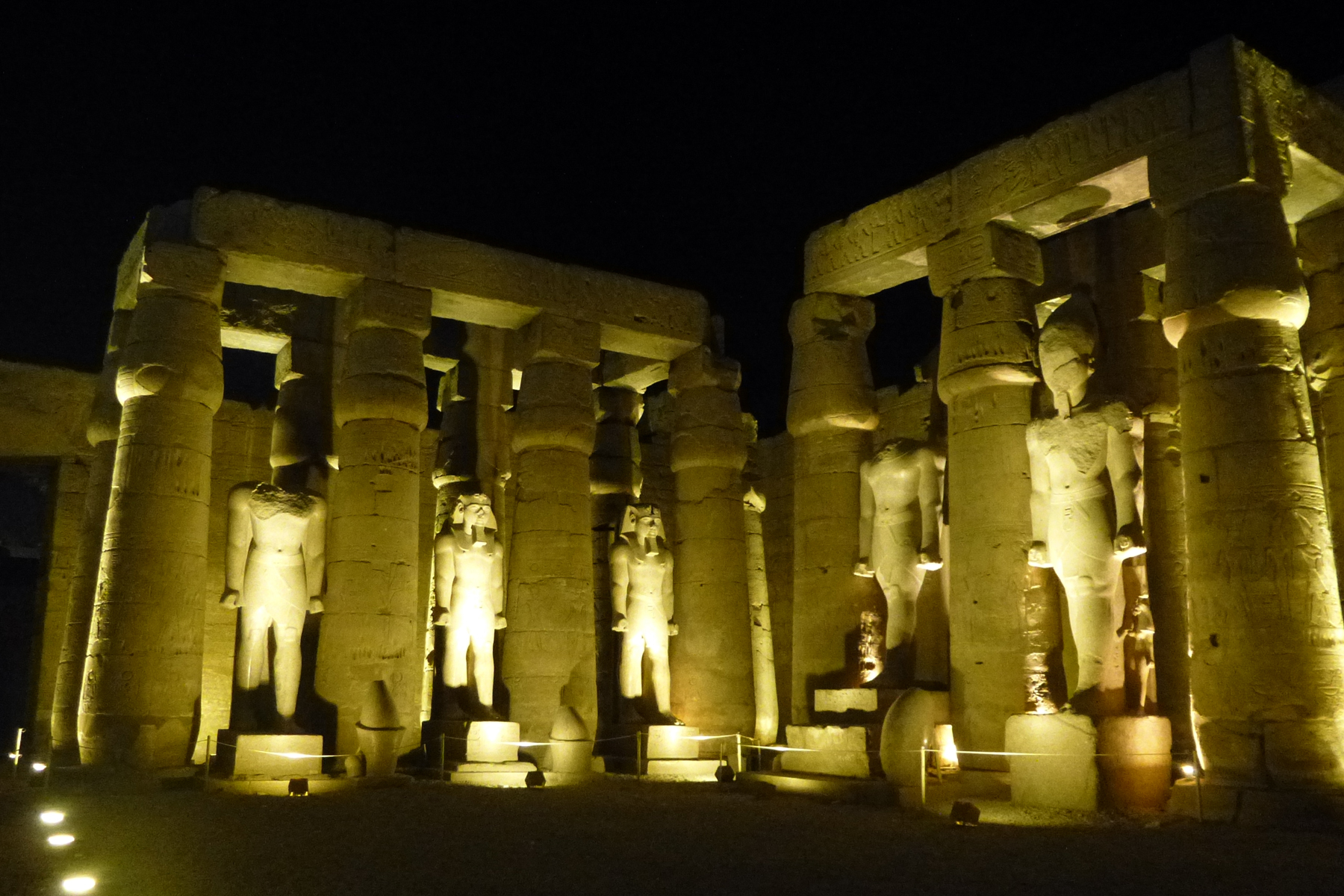
Luxor Temple sits in the middle of the town of Luxor. When you are inside of it looking out, through the pillars of the colonnades and hypostyle halls you can see the crappy apartment blocks of the city. There used to be a village within it, but they cleared it about a century ago; there is still a mosque. So the monumental extravagances of Rameses, Ozymandias the King of Kings, came to rub shoulders with goats and chickens, and with the common folk.

 Image

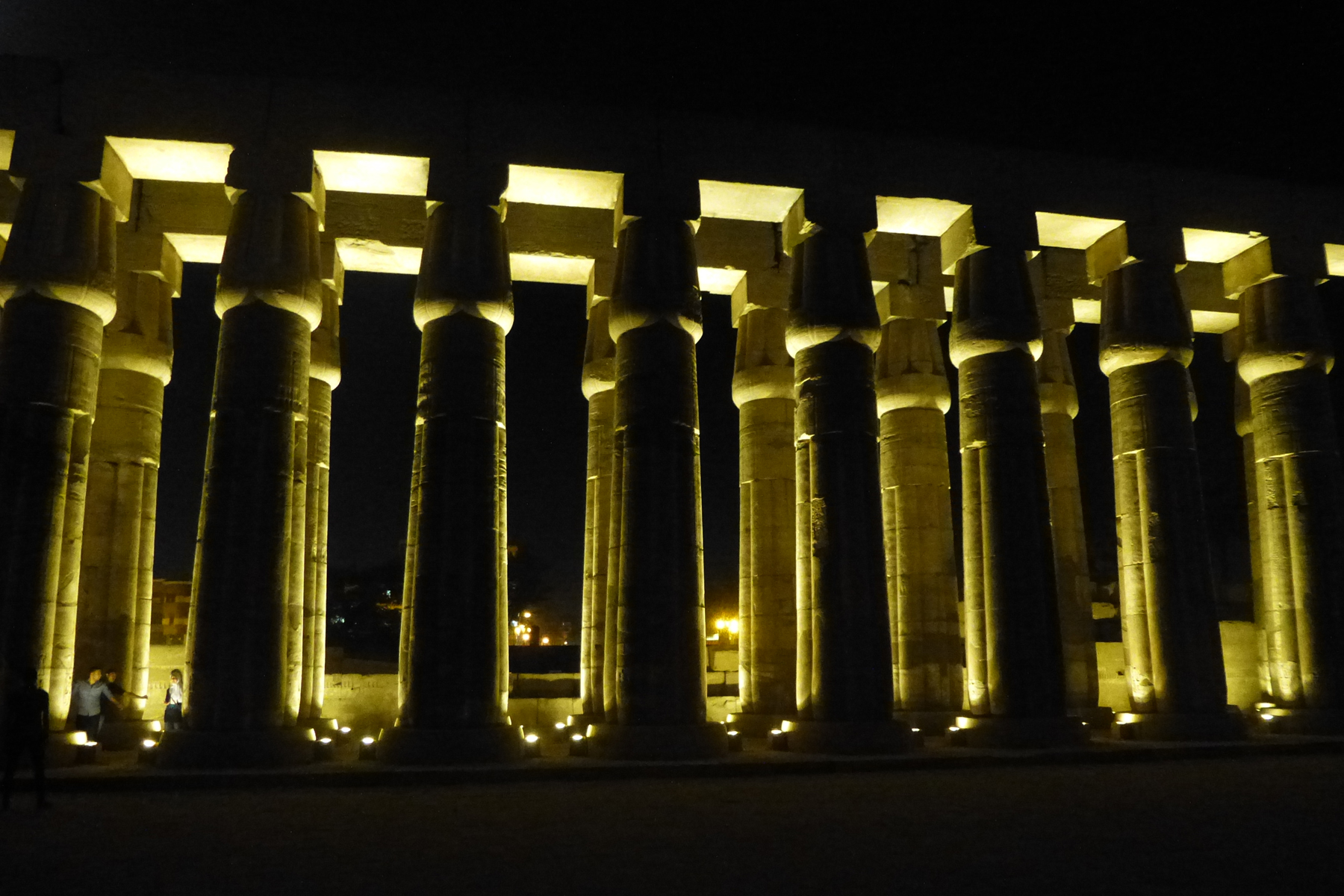
I have been twice now, both times floodlit under a full moon. Both times, I have been blown away. I have been to the Pyramids and to the Valley of the Kings, but this is the best thing in Egypt; only Karnak comes close. The lush stone forests of columns, each with its carved bole like a palm tree: simple, elemental, connected.

ImageThe setting they form by their arrangement around courtyards, almost the definition of a setting for sacred theatre, and the origin from which most holy and dramatic architecture since derived, down to the Gothic cathedrals.

ImageThe avenues of pillars, not quite symmetrical because of the leftward kink in the ground plan.

ImageThe mighty stone guardians before the doorways.

ImageNot much to touch this….

Posted in road | Tagged | Leave a comment

the road to Luxor

My driver smokes in the car, plays Quranic chants, and slags off the Muslim Brotherhood. His brief history of modern Egypt, in basic English: Gamal Abdel Nasser not good, Anwar Sadat not good, Hosni Mubarak good. With Mubarak not Muslims one side, Christians other side: we all Egyptians. Morsi bad, Qatar bad, Al Jazeera bad: they blah blah blah blah blah blah Egypt not safe, tourist not come. We like tourist, we safe, we friendly, we kind, Egypt beautiful. England good, America good, Barack Obama good! Emarat good, Saudi good, Kuwait good. Morsi not good, say: Christians go out of Egypt. They burn 40 churches! But Muslim, Christian, all Egyptian – my friend Christian, last week his wedding, I go in his church, good!

I agree with him that Egypt is beautiful, that religious tolerance is good, and burning churches not good. More than that, I don’t feel qualified to say.

He drives like Sebastian Vettel too; they all do.

18.10.13 Kom Ombo entrance-2

Kom Ombo temple

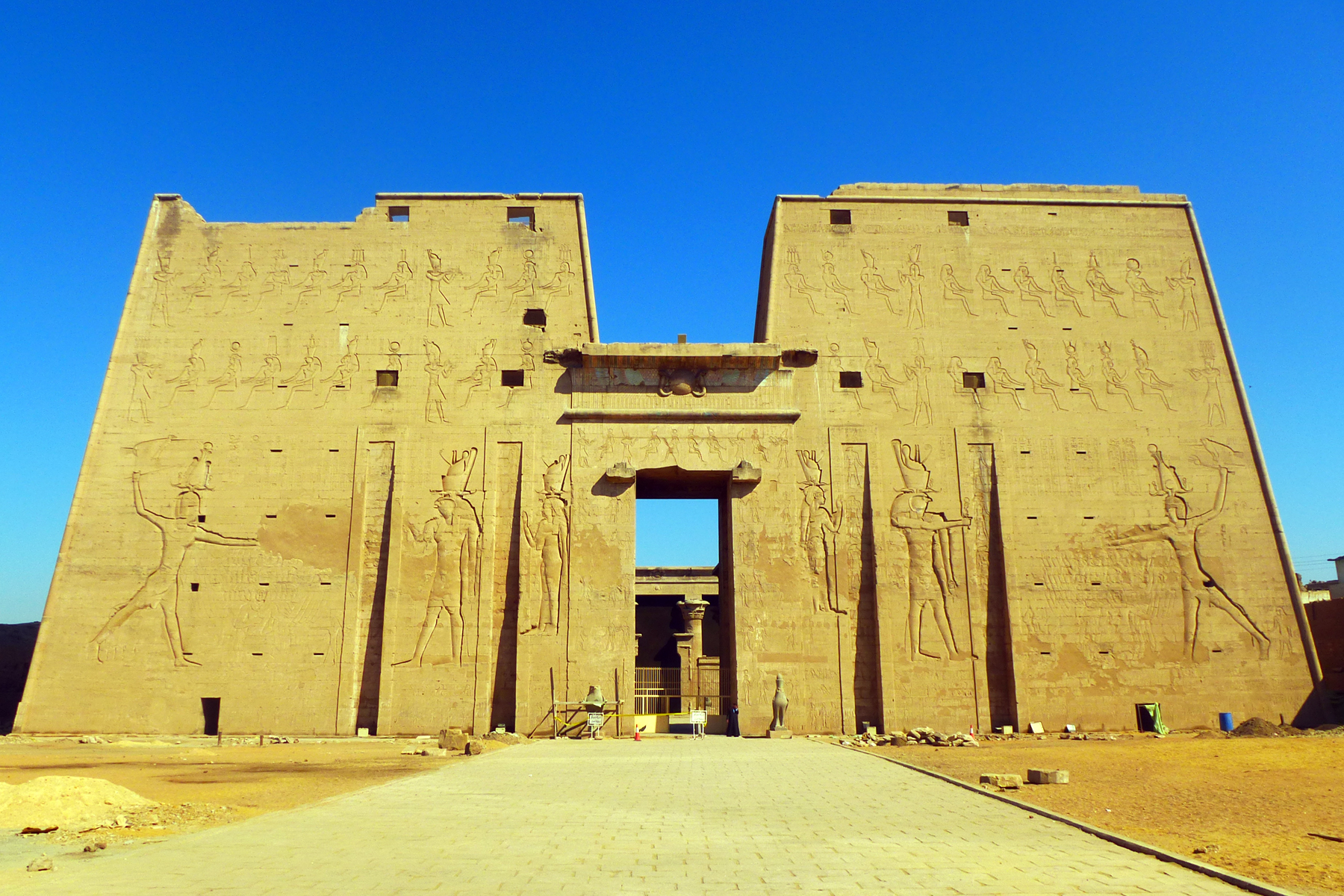
He takes me to Kom Ombo, a Ptolemaic temple by the Nile, where there is an Italian tour group fresh off their boat. Then to Edfu, a glorious Ptolemaic extravagance, at which a few French people.

18.10.13 Edfu pylon

The pylon of Edfu temple

I take photographs, give baksheesh, and fight off those who want to sell me trinkets. In Luxor, I swap drivers. My plan – as I’ve made clear – is to see the Ramesseum and Seti temple, and then to be dropped at Luxor temple. A couple of miles into the drive, we stop to pick up an agent. Why do we need an agent?  Amber lights flash. The agent assures me of his hospitality; my defensive armor locks into place. Hospitality, translate: I want to waste your scarce time pretending to look after you by subjecting you to experiences you don’t want with the goal of extracting from you as much money as possible for goods you will carry uncomfortably home and later regard as clutter. I get them to drop me at the Ramesseum – which happily coincides with Friday prayers, so they leave me alone for the duration – and then at Seti.

18.10.13 Ramesseum Ozymandias-2

The Ramesseum, Luxor. The fallen statue is Ozymandias, King of Kings, as in the Shelley poem.

Afterwards, the offers start flowing: “I show you alabaster!” No thanks; I did that last time (I lie; I was never interested in the first place). Please take me to Luxor. “You want see Valley of the Kings?” No, I did that last time. “How long you stay in Luxor?” I am leaving tomorrow morning, by plane. “Where is your hotel?” I can’t remember (subtext: I know perfectly well but I’m not telling because otherwise I will find you sitting unwanted in the lobby later pestering me to buy alabaster I don’t want). “You want taxi to airport?” No thank you, I arranged that already (precisely to protect me from people like you). Smiles turn to loud grumbling in Arabic on the mobile: I can just imagine the conversation. “You told me this guy tipped generously and he was a dead cert – but I can’t take him for anything at all! He won’t even say where his hotel is!” At Luxor Temple, one more inquiry about whether they should wait: no, I don’t know whether I will go now or later when it’s cooler. And one final desperate pitch for my hotel’s name – “we take you there!” Oh man – I think but don’t say – I have legs and a map; now go away and leave me alone! But my tone is sufficiently brusque that they back off; I tip the driver but not the agent.

But I know why they do it: they’re hurting. When I get to my hotel, the co-owner, a Belgian woman married to a local, says to me: it has never been this bad. There was the Hathshupseth massacre, and there was 9.11, but after these the tourists came back within six months. Now it has been two-and-a-half years. I have seen real hunger in Luxor, she says, among those who used to make their living from the tourist trade…

And for me, sitting in a café in the garden of the Luxor hotel, all this – temples and touts – is just a memory. But I have been there – to Abu Simbel and to the head of Ozymandias, and looked on his works without despair. And I will remember this to my dying day, most likely without hunger.

Posted in misery for the many, freedom for the few, road | Tagged | Leave a comment