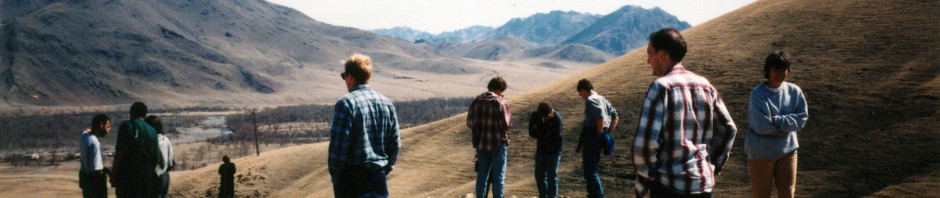
The fells of Lakeland have been in my life for almost half a century. In 1974, my (considerably older) boomer brother was living the hippy dream, working at the giant Waterhead youth hostel on the north-eastern shore of Lake Windermere, Zappa moustache and hair halfway down his back, rock-climbing in Borrowdale by day and playing tenor by night in a jazz-rock band. In the week that Richard Nixon finally choppered off the White House lawn into the history books, my dad (world-war-two veteran bomber pilot turned textile executive) sped us up from Yorkshire to Cumbria, twisting his tank-like Mercedes through the winding lanes of Langdale, windows wide open in the sunshine and blasting Count Basie Big Band full volume. I have a photo of him standing on a hummock of fell above Wrynose with the valley open behind him, hands in the pockets of his beige business trousers, pale pink open-necked shirt, navy jacket with red handkerchief nestled in the breast pocket, and aviator shades. Meanwhile my brother stood in the hostel kitchen with his hair down (1970s food hygiene standards!) over a cauldron in which 150 eggs could be boiled simultaneously.
I began hiking, and the ridges of Lakeland became as familiar as the streets of my town. In 1977, on a school trip, we raced shouting up Striding Edge to Helvellyn. In December that year, alone, I repeated the climb in bright sunshine, wondering at the wisps of mist that spilled over the ridge ahead and through the col of Grisedale Tarn away to my left. As I crested the mountain – no-one else in sight – a revelation: the western slope descended ahead of me perhaps a hundred metres to the shore of an ocean of cloud, extending as far as the eye could see, with only a handful of Lakeland’s highest peaks raised above the mist as islands rising from the sea – a vision similar (except in daylight) to Wordsworth’s on Snowdon, which sparked one of his wilder nature meditations. All day long I walked the ridge northward, catching the light on the shining sea of mist, pausing to sun myself in my t-shirt (in December!) on the tops of the Dodds, while the Lake District beneath me laboured under cloud. It seemed a moment that would never end; yet time moved on.
In the late 1980s, amid shattering heartbreak, a friend of my mother’s lent me a caravan on the Windermere shore to which I would retire alone for weeks to wish I was a fisherman, seeking solace for my wounded heart in the craggy landscapes of Bowfell and the Scafell range.
My children, as toddlers, clambered up the kiddy peaks of Helm Crag and Catbells, and later – higher – Fairfield; in 2019, returning to live in England after three decades, our first expedition (with my sister and her boy Joseph) was to Eskdale, from where we scrambled up Great Gable and Bowfell, staring out over dozens of miles of windblown sun-and-cloudscape from the summits of high fells.
In 2023, as my son Ian’s first year at Lancaster University came to an end, we were figuring out how to get his stuff back to Sheffield for the summer. I said I’d hire a car; he suggested a few days’ walking in the Lake District while we were at it. This became four days, five nights, with Joseph joining us for the first. I planned a couple of leisurely hikes, and a medium day up Helvellyn; Ian said he wanted to climb Scafell Pike, as the highest there is, and to throw in Bowfell (2019 revisited), which made for one strenuous walk. We were staying at Scales, so Blencathra, right behind our accommodation, would be a good first day warmer.
Then Ian’s brain began to whirr. If we were to climb the highest (Scafell Pike), and the second highest (Scafell) was right next door, we should throw that in too. The same day could include the sixth highest (Bowfell), and a small detour en route would bag us the fifth (Great End). Another day we were doing Helvellyn (third), but that left the fourth (Skiddaw) – could we somehow fit that in? Top six.
Well, yes, I said, we could make Blencathra a big day and take in Skiddaw too.
Ian went away and came back with his iPad showing Wainwright’s list of the ten highest fells in Lakeland: dad?
OK, Catstycam (tenth) and Nethermost Pike (ninth) can go together with Helvellyn; and for the leisurely fourth day I had planned, we could substitute another tough one: Pillar (eighth) and Great Gable (seventh). So yes, it’s doable.
From that moment on – father and son – it’s going to get done.
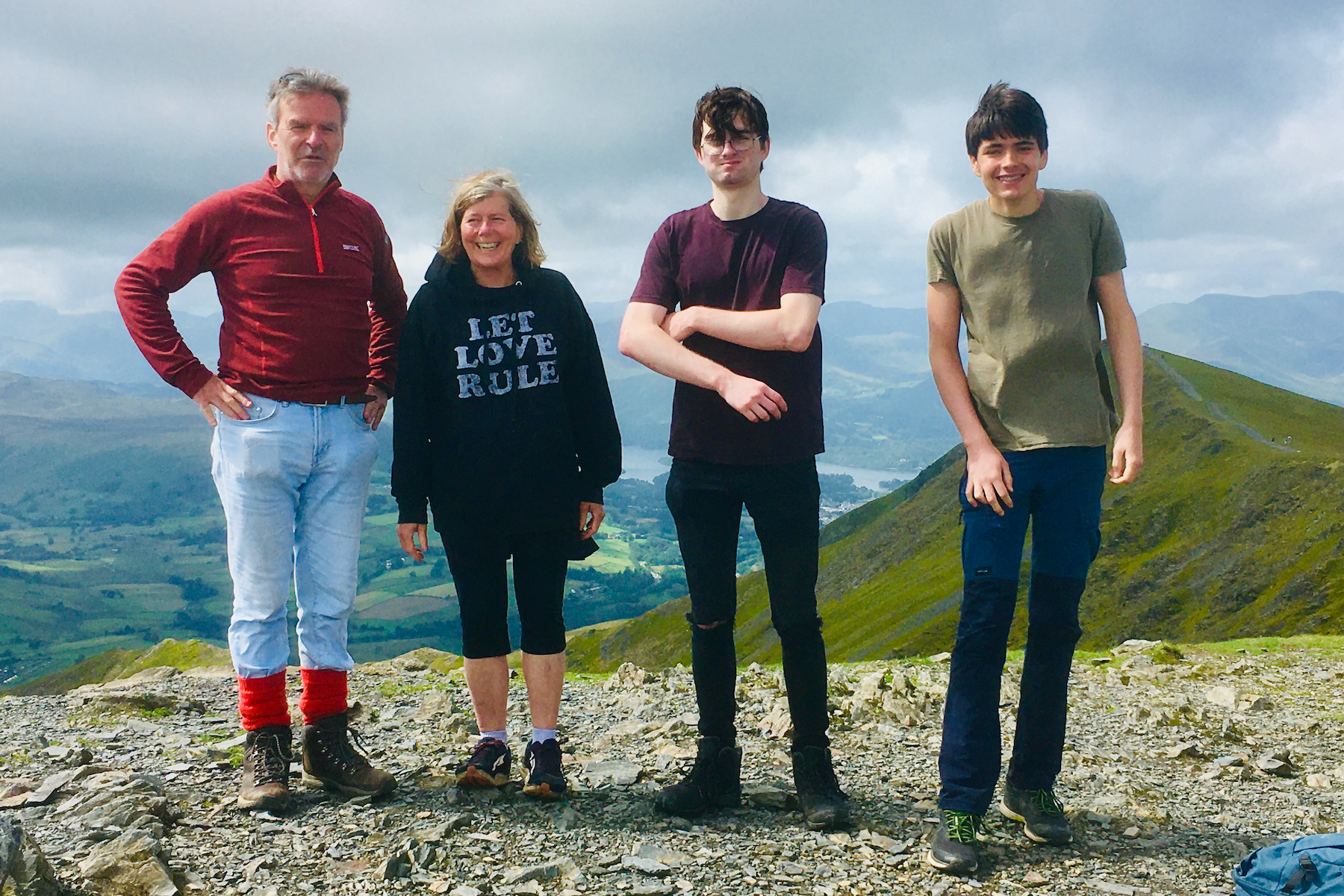
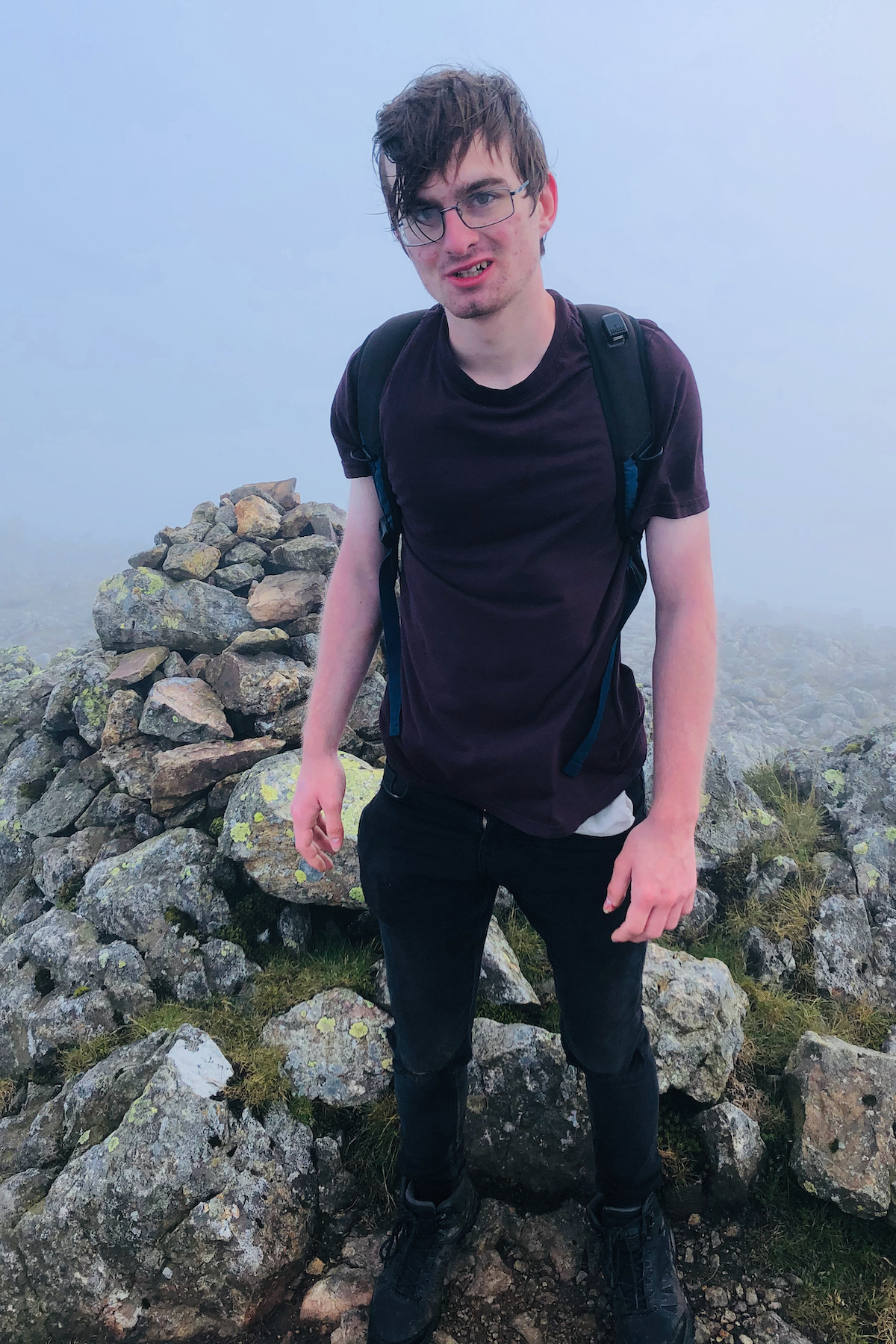
We set out the first morning fresh and early, with Ian and Joseph charging ahead up the slopes of Blencathra. Ian’s mother Allison was always going to drop out after the first peak; some rough scrambling up Halls Fell, which terrifies the life out of her, only reinforces that conclusion. We get to the top and take our snap:
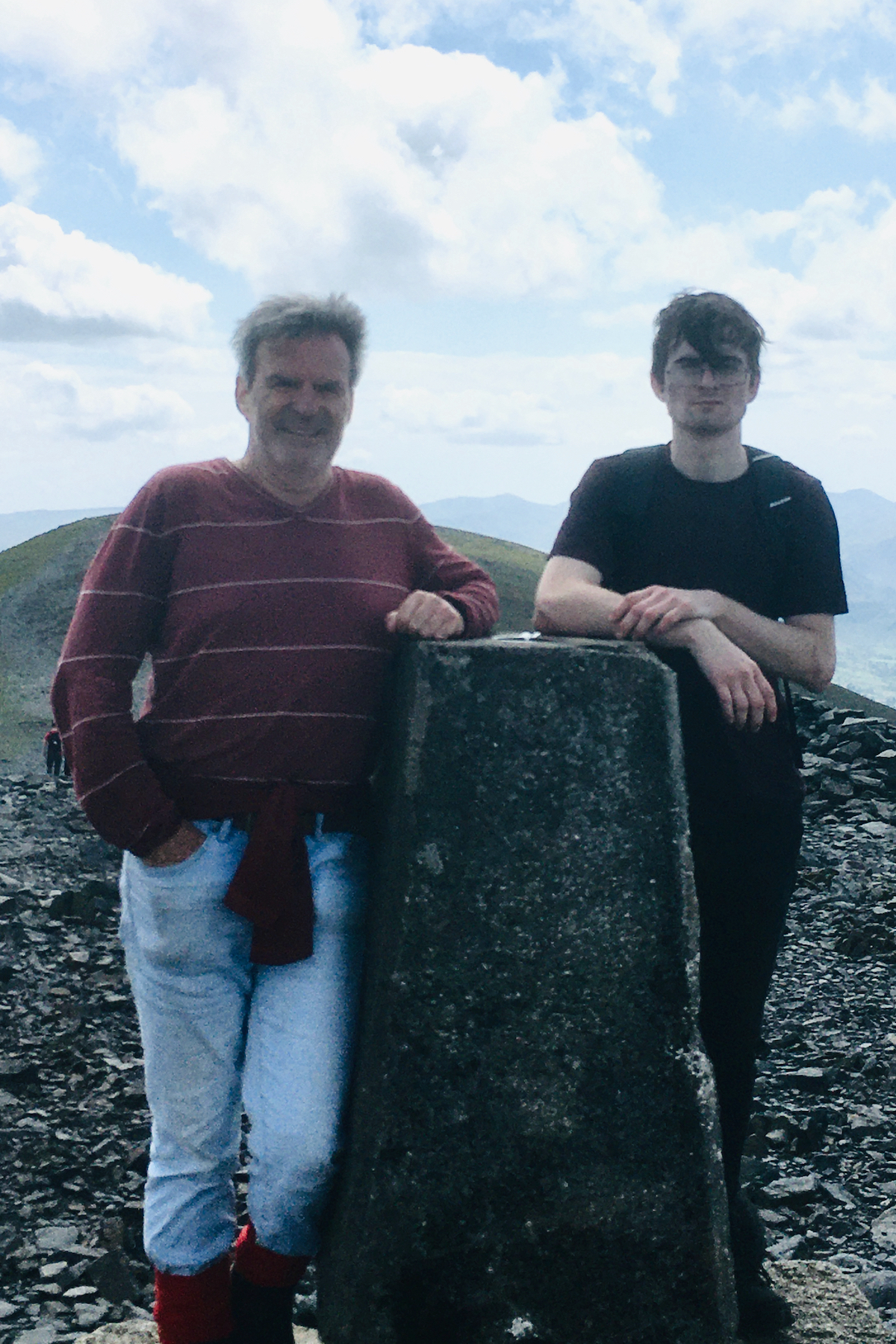
Then the serious stuff starts. Ian and Joseph and I strike out across bare fellside, no paths, towards the distant top of Skiddaw. Spongy tussocks and tinkling becks; line-of-sight free hiking. It’s easy getting to the low point; now Skiddaw looms ahead. Joseph, fifteen-year-old muscles pumping, becomes a dot in the distance; Ian slows down to keep me company, then races ahead again. I step ahead at a steady sexagenarian pace: one foot in front of the other, we’ll get there. Showers and sunshine.
After an age of climbing we hit the ridge. Joseph sits waiting idly by the fence. The higher slopes are peppered with dog-walkers, Sunday flaneurs and other tourists. Man, this hurts. How long have we been going? Before Ian and Joseph become dots on the horizon again, I admonish Ian: be careful, the summit is not the first one you come to, it’s further along. Oh, he retorts – you mean it’s the highest point?
We clatter down the fellside towards Keswick, puzzled by the eastward detour the path takes, discoursing in the sunshine on the limits of scientific endeavour. Twigging that it’s touch and go whether we make the bus, we run leggily downhill through shady woodland, and now being well ahead of time, saunter through the family-jammed streets of Keswick. After seven-and-a-half hours on our feet, we loll in the bus shelter for quarter of an hour. When the bus comes, Ian doesn’t notice he’s left his coat on the bench. “Ian”, I say, “don’t forget your coat.” Dad mode still active. But man, do I feel tired.
Next day we drive up Ullswater to the village of Glenridding. Allison peels off to shop and visit waterfalls. Ian and I stride up the valley past old mines and onto open fell. It’s a long way up. Missing the junction to the path up Catstycam, we have to dogleg back across open fell, over springy tussocks and damp marsh. Recovering the stony path, we press up the fellside. Man, this is beginning to hurt again. Trudge to the pinnacle of Catsycam in stiff damp breeze: take the photo.
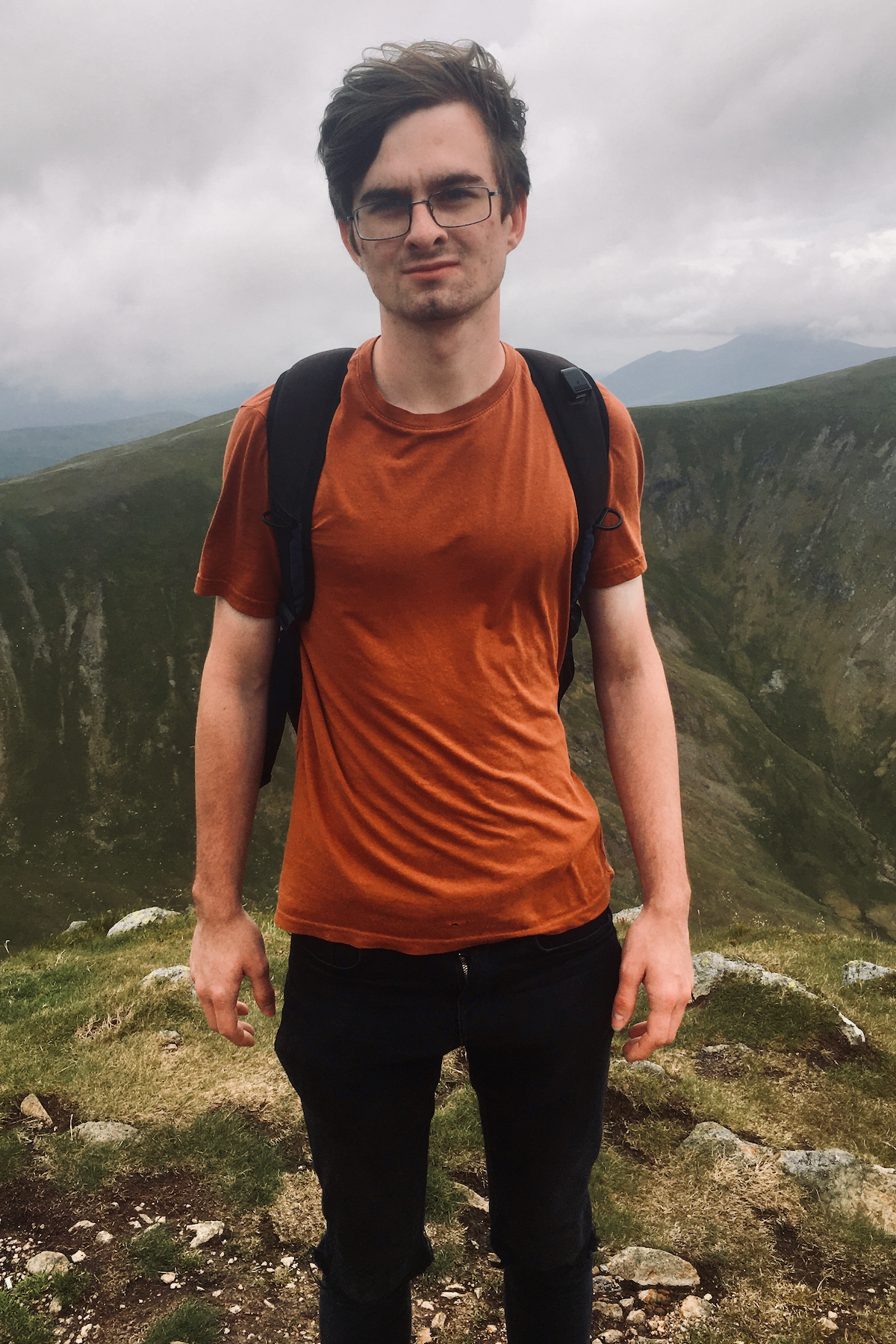
Down, and up again, relentless scramble. Ian beelines straight up whilst I dogleg, fighting scree, line of least resistance. Just when the struggle steepens most we are on top of Helvellyn, heading for the cairn.

Now it all seems easy, except for the rough ground and fatigue. We traverse indistinct ridge to the featureless top of Nethermost Pike.
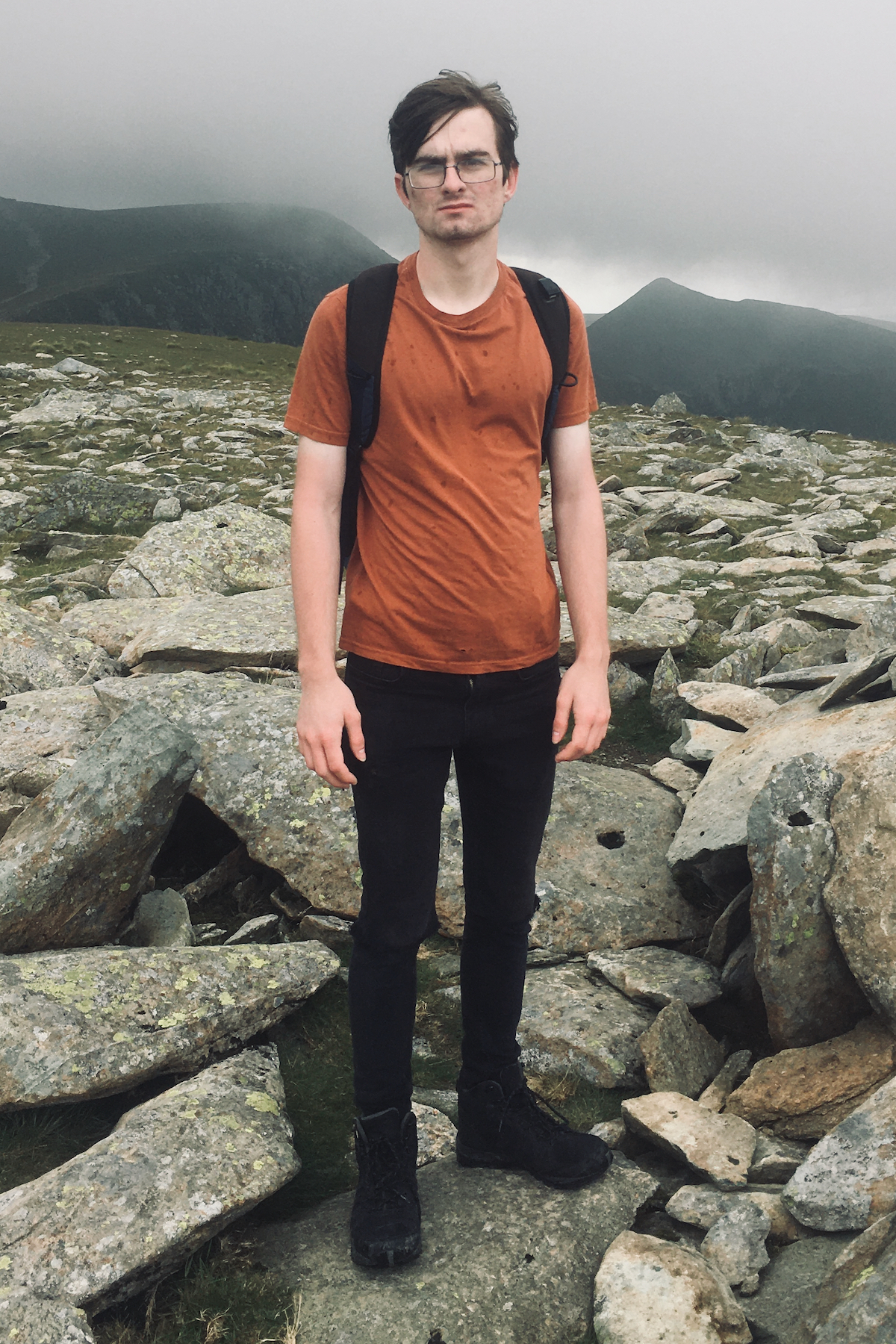
Manoeuvring across Dollywaggon Pike, we start the zigzag descent to Grisedale Tarn: stones and more stones. I begin to feel like I’m hobbling. Halfway down we pause to eat sandwiches, watching the wind rippling on the surface of the water. Afterwards, I expect, the roughness will ease as we approach the valley; it doesn’t. The stones keep rising up to meet us, all the way down Grisedale, legs bracing for impact. By the time we trudge the last mile into Glenridding, I am weary.
Day three is the big one. We drive an hour and a half to Wasdale Head, and park in the National Trust car park. Five minutes along the valley path, my legs already ghosting with yesterday’s fatigue, I realise I have left my Wainwright in the shop and trudge wearily back to fetch it. After that the first two or three hours pass smoothly: past the tiny parish church, through the farm, right onto the valley route to Sty Head; gentle ascent to the sound of rushing waters, crossing and re-crossing the beck. Up grass to the tarn, turn right: a complaisant path up the narrowing dale to Sprinkling Tarn, under the looming crags of Great End. Barely noticing the climb, we are soon at Esk Hause: 2500 feet, getting up there!
The ease ends here. As we work our way up the rocky slopes of Esk Pike, the mist snaps down. We fumble our way across rocks to what we take to be the summit; anyway, it doesn’t matter, it’s only number eleven. A stony path leads obscurely down to a boggy col; then a faint trail onto Bowfell. In clammy cloud, this way or that? Clinging to cairns, we forge our way through the mist until the clarity of the path disappears into fumbling boulders: here a boot mark, there an erosion of lichen. We creep to the summit of Bowfell, at least we think it is: in barren mist we half-recognise its rocky features from the clear sunshine of four years before.
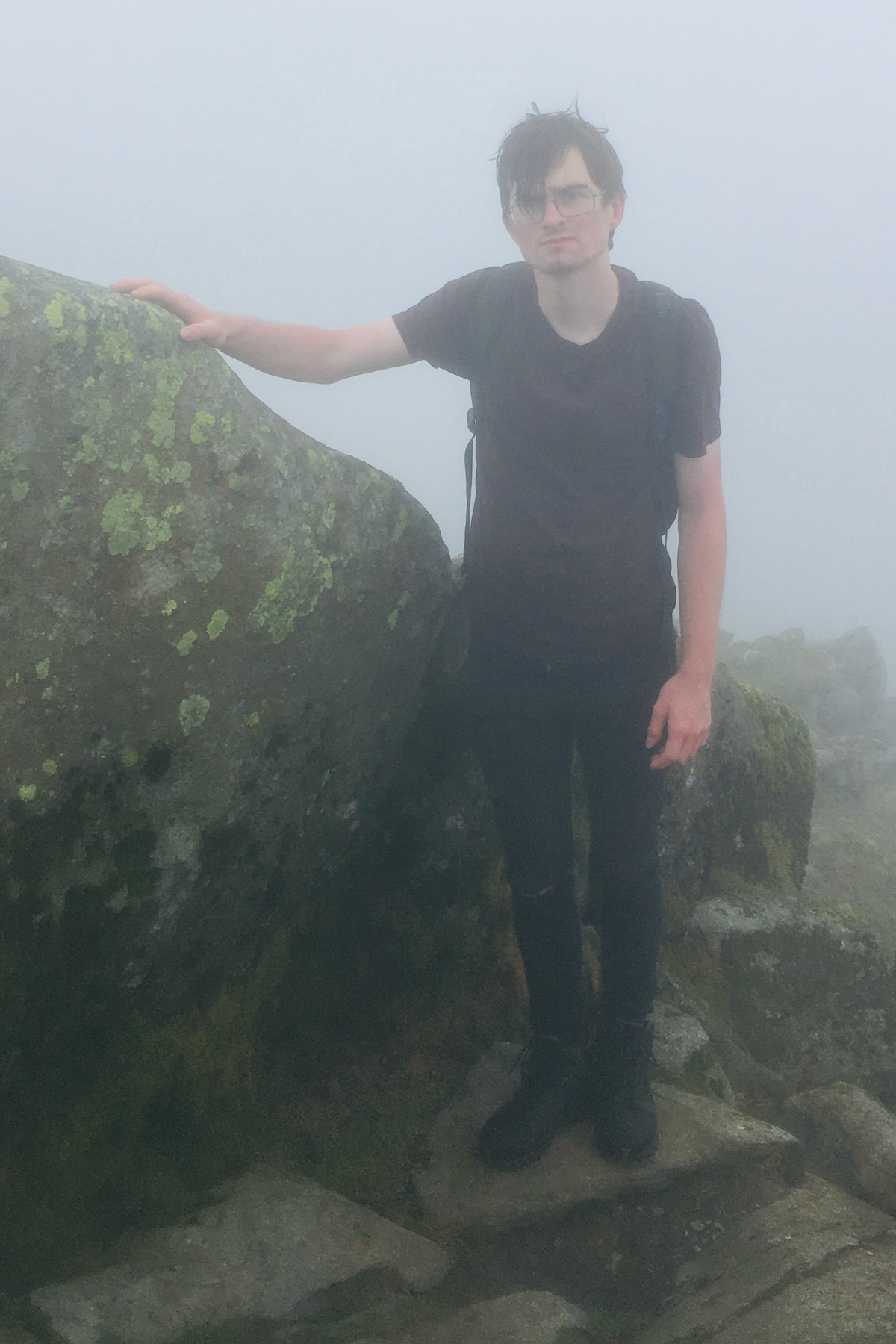
Retracing steps is easier than tracing them, even in cloud. Esk Pike the second time, the summit bypassed, pains the feet, the muscles, the thighs. Back at Esk Hause, we begin the grind up Great End. We pass an older couple with a younger couple, beating their way up the slope, and nod to them; how is this working as a family outing? As we enter the mist again, they head left towards Scafell Pike. Ian and I make the right turn to Great End; immediately it begins to rain. We tramp across dismal terrain, dampening. I pull my waterproof on; Ian concedes and dons his ragged coat. When we reach the summit, we see nothing around. But we have it, our sixth; four to go.
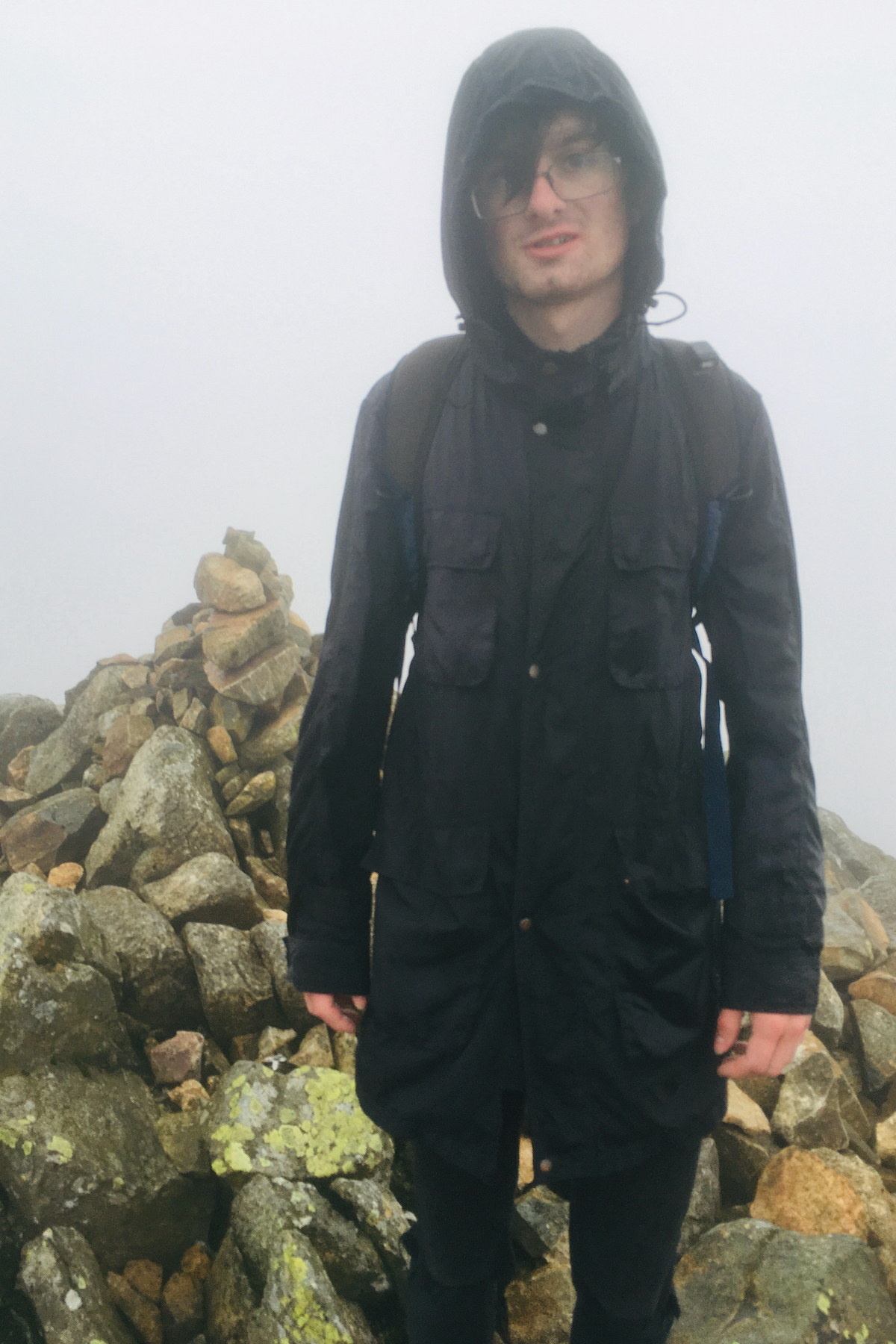
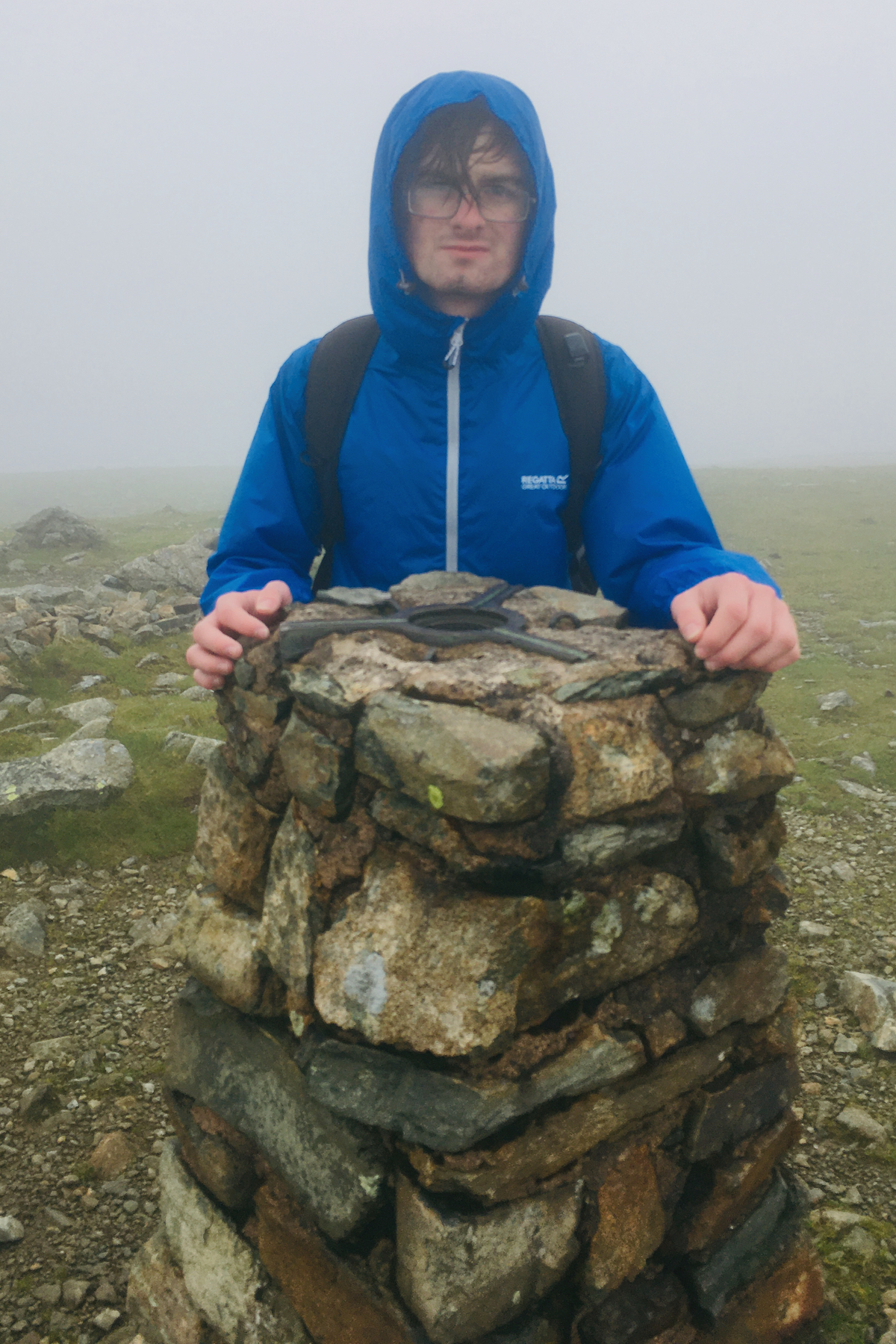
We trudge back to the col, where it stops raining as abruptly as it began; Ian’s coat comes off, mine doesn’t. We begin the foggy ascent towards Scafell Pike. Almost immediately we meet the family, picking their way back down over wet stones. I ask if they made it to the top; dad says no. “How much fun can you have in one day?” he guffaws. They disappear back down into the mist. Ian and I proceed over big boulders; you could break your leg here, every step forward has to be eyed over and picked out. It’s tedious going, and nothing to see but more boulders. Time passes; how long, I couldn’t say. I lurch forward, aching. High ground to the right – are we there yet? Finally the mist parts briefly and we can see that we need to descend, then climb steeply again. This hurts all over again. Will it finally be the summit? At least the path is clear now. In the end, jubilant voices guide us: somebody must have made the top. Ian, ahead of me, veers off to the right, and shouts: here we are! I pull myself wearily up yet more shattered stones; a large, cylindrical, man-height stone structure looms out of the mist, topped by a group of young Scandinavians. The girls shriek at Ian in his t-shirt: “aren’t you cold? Where are you from?!” Ian grins, with his head down; I shout back: he’s a northerner! Which isn’t, actually, true; he grew up in the UAE and Thailand. They take our photo:
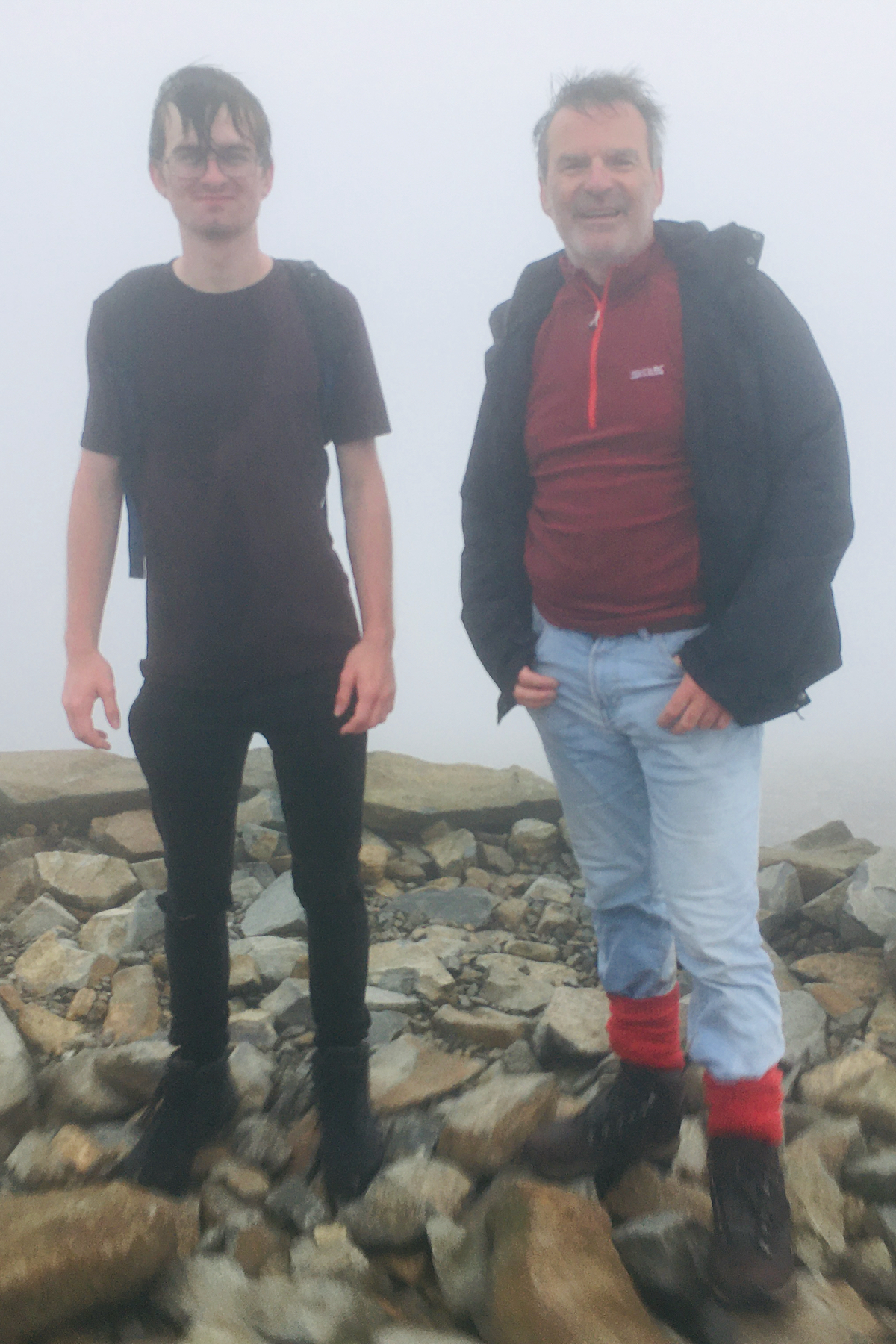
Then they disappear into the fog.
Right, so how do we get down off this thing and to Mickledore, the col en route to Scafell? Yikes, we still have to do Scafell. I’m knackered already, and we’re on top of the highest fell in England. It must be somewhere in this direction, over these boulders – maybe a path will emerge? We pick our way gingerly towards where I imagine Scafell will be. The boulder field gets steeper, the boulders get rougher, no path appears. This is getting harder and harder. I’m worried now. How could I be so sloppy, so irresponsible, in care of my son? Then the mist suddenly rolls up and we can see downwards. The land falls away to the left, into Eskdale; we need to tack to the right. Mickledore appears in the distance, not far below us but a long way to the right. Step by deliberate step, grasping with our hands, we inch towards it. We reach the grass; not boulders but tussocks now. We have come down too far and need to climb again. We grapple our way back up to the ridge. We have been going seven hours and still hundreds of hard feet to climb; I am getting really tired now.
OK, I explain to Ian, we have to go down to the right here, sticking as close to the left-hand wall as we can, and look for the gully – Lord’s Rake – that we will need to ascend onto Scafell. Ian goes ahead, down fine and steepening passages of black scree that leave us clutching at the walls and manoeuvring on our behinds at the severity of the slope. My legs tense against the gradient, aching at every downward clench. The fellside tumbles away to the right; the temptation to take the easy way rises. Even Ian is finding this hard. We inch downward and finally achieve the grassy ledge that runs along the towering wall of Scafell. The steep stony gash of Lord’s Rake runs dead straight above us, 500 feet up and outstretched-arms wide.
“is that where the water comes down?” asks Ian.
“No, it’s where we go up”, I reply.
“What the fuck”, says Ian.
And then he starts. I can see him bracing above me, clinging to holds in the sheer rock walls, fighting with his feet to maintain balance, as I summon what feels like the last of my strength and push myself upwards. One lunge, one push at a time, sliding on the wet stones, seeking another precarious handhold. up and up and up into the mountain, the slope unrelenting. You probably won’t die; but actually, you could…
By the time we get to the top and clamber onto open fellside, we are back in mist. We push on upwards; every step is an effort. Finally we break the ridge, but I can’t remember where the summit is, left or right? We climb to the left, to the top of Symond’s Crag, before I recall that it’s the other way; a long, stony trudge through fog. But finally we have made it.
And so, three thousand feet of descent. My legs are already jelly, and still I need to brace them against the rough stones; every step is laborious, and has its cost. We soon emerge from mist, but the stones go on and on. My feet are hurting, my legs unsteady – and still I have to brace. Ian is well ahead now, pausing occasionally for me to catch up, but I just have to keep going. Finally we reach the grass, but it’s just as steep, and I still have to brace with all my strength. Below us is a farm towards which we are descending; it never seems to get any nearer. The light is beginning to fade from the sky, and still we descend. I am stuck in a loop; the farm always the same size. Bracken eventually rises up to meet us, and suddenly the farm is right there. By the time we step onto the road I am at the limit of my endurance. But we did it.
Driving back to Keswick, the phone goes as soon as we hit a signal; it’s the police. Allison has reported us to mountain rescue…
In the morning my feet are sore and my legs ache with every step I take. I hobble to the car. We drive to Wasdale in pouring rain. Ian still doesn’t have a proper waterproof. I persuade him (finally) that he needs one and we stop in the shop by the Wasdale Head Inn to make a purchase. There’s no-one else around as we step out onto the fell and start the long traverse around the slopes of Kirk Fell, heading for Black Sail Pass. In spite of the fact that he absent-mindedly forgot his boots this morning and put on a pair of disintegrating trainers instead, Ian races ahead. The becks run torrential in heavy rain; the paths too are awash with water. Every step upward triggers a deep internal ache in my legs; my feet chafe against my boots. I plod on. It takes hours, but we make it to Black Sail, and turn left. There are long stretches across grassland; my feet chafe still more insistently. We hit the first wall of Pillar: one step at a time, I grind upward. More grassland; I stumble forward. More climbing, and then, somehow, we are there.
We retrace our steps across grassland, down punishing stony trails. Back to Black Sail; Kirk Fell looms ahead. We begin climbing; there’s no obvious way forward. We are driven to the left around the mountain. The earth turns red. Just like yesterday, we are driven into a gully; the only way up the mountain.
“What the fuck”, says Ian.
Then he starts climbing. I follow. It’s not actually raining any more, but the wet earth slips under hands and feet. How do I get up here? I cling, and push, and shove. I work it out one step at a time. Body and brain are both overloaded; I am at full capacity. Just at the top, an overhanging boulder is wedged in the gully. Somehow, I swing round and pull; I am hanging over the abyss.
And then it’s done. We are back on tussocky grassland. The summit of Kirk Fell lies away to the right; fuck that. We take the straightest beeline over rough ground to the edge of the fell that faces Great Gable. Great Gable is capped with cloud.
We drop – for me, one agonising step at a time – to Beck Head. The stones hurt my feet all the way; my knees brace, my muscles grind. Just as the path begins to climb towards Gable, I signal Ian that I need a rest. We recline on a diagonal slab of rock, facing the sky. One more push, I think. One more push and I’m done. I wonder if I will lie there forever.
But I don’t. The time is past and I rouse myself. Ian ahead of me, we push on upwards. The ground is steep, and gets steeper. We zigzag upwards. Every step is a painful grind. The fog comes down. It gets steeper still, and now we are on boulders, clambering upward one leaden, targeted push at a time. There is no path; we peer through the mist for cairns. Anything could happen here; I could even almost give up. Then the slope lessens, the boulders get smaller and I stumble upwards to meet Ian at the summit.
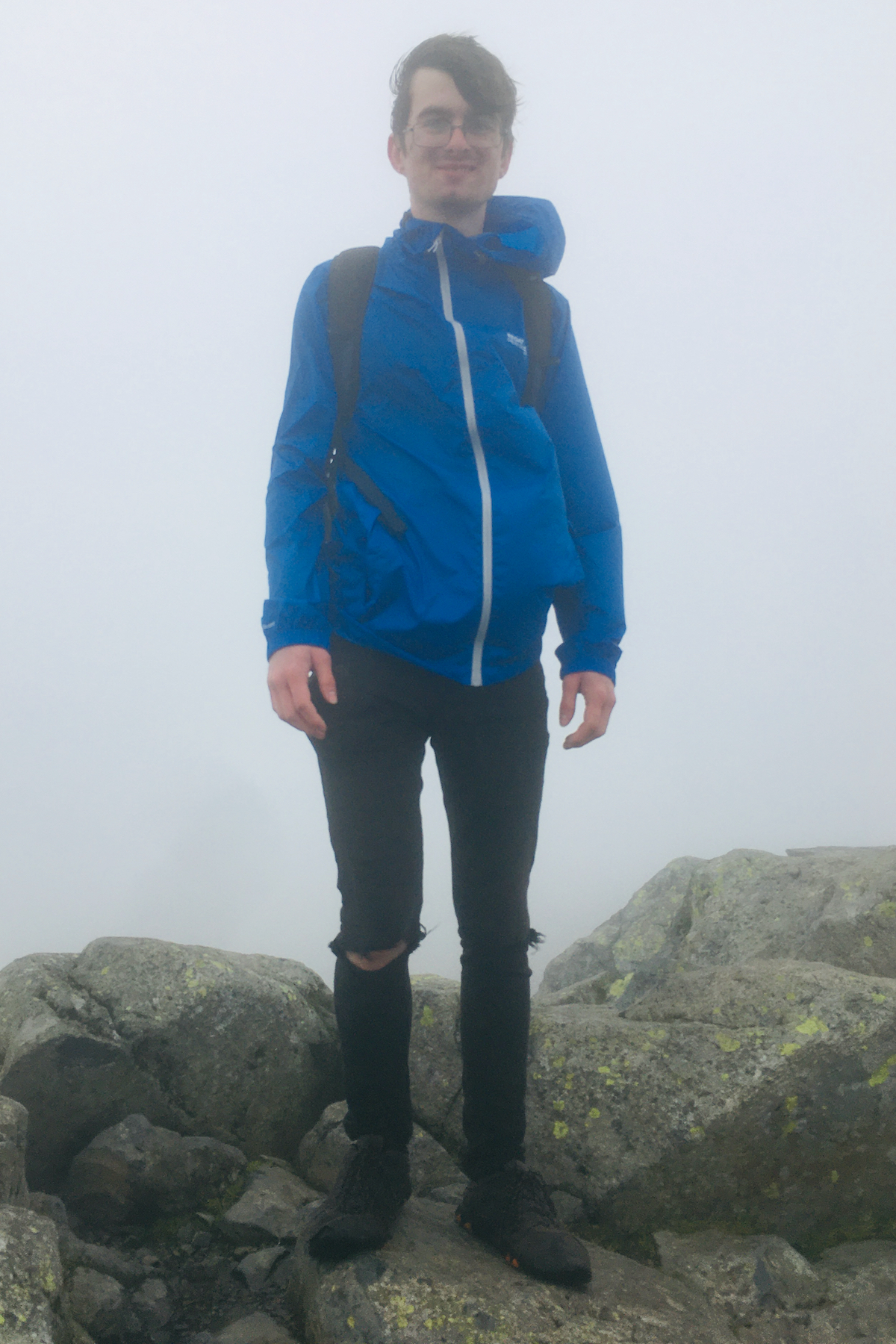
It’s done.
And now, the final descent. After yesterday’s fiasco dropping off Scafell Pike we are careful to use the compass on Ian’s phone (mine has died in the wet and cold) to make sure we are dropping to Sty Head. This time a path materialises in the mist, and in spite of a few nervy moments when it apparently heads off in the wrong direction, this time as we emerge from the cloud there is our target unmistakably below. We are both happy: we completed the mission, as father and son team. But my feet and legs are barely functioning, and even this final descent is physically excruciating.
As I hobble downwards in the afternoon sunshine – it has finally come out – a thought begins to form in my mind: never again. This has been a magnificent reprise, like some ageing rocker’s farewell tour of all his best songs, grinding it out like he used to in youth – but I can’t do this anymore. It hurts too much. Lakeland: there are too many stones. Clambering over the big ones, clinging to handholds in rocky gullies, the tiny ones skittering away below your feet as you slip and slide, the pebbles jabbing through your boots into your feet, the constant ache in the legs from pushing upward on rock. No, I’m retiring. Yorkshire from now on for me: long rolling grassy slopes and dozen-mile vistas. Back to my first love.
We regroup at Sty Head and begin the final descent to Wasdale. Still the stones keep coming. Still we have to brace and angle downwards against rock. Towards the bottom a patch of grass looms; for a few brief metres it cushions my feet, but breaks up again into stony shards. I stumble the final mile, then get in the car and drive.
 Curved World
Ye daft bat that could’ve been dangerous 😆
Indeed! Like a bit of recklessness in my old age I do 😁
Quite some achievement and great to share with your son 👍