Leipzig

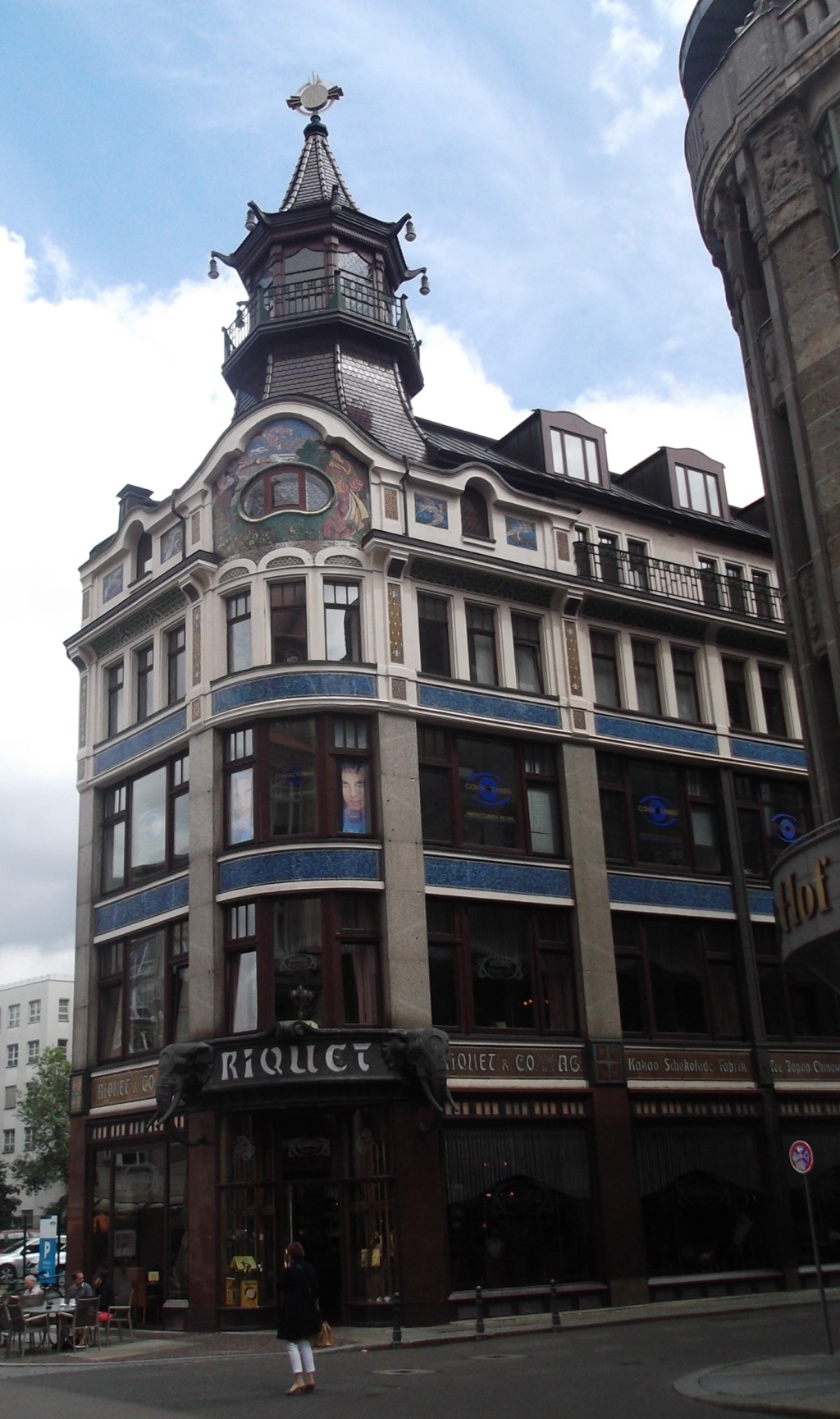
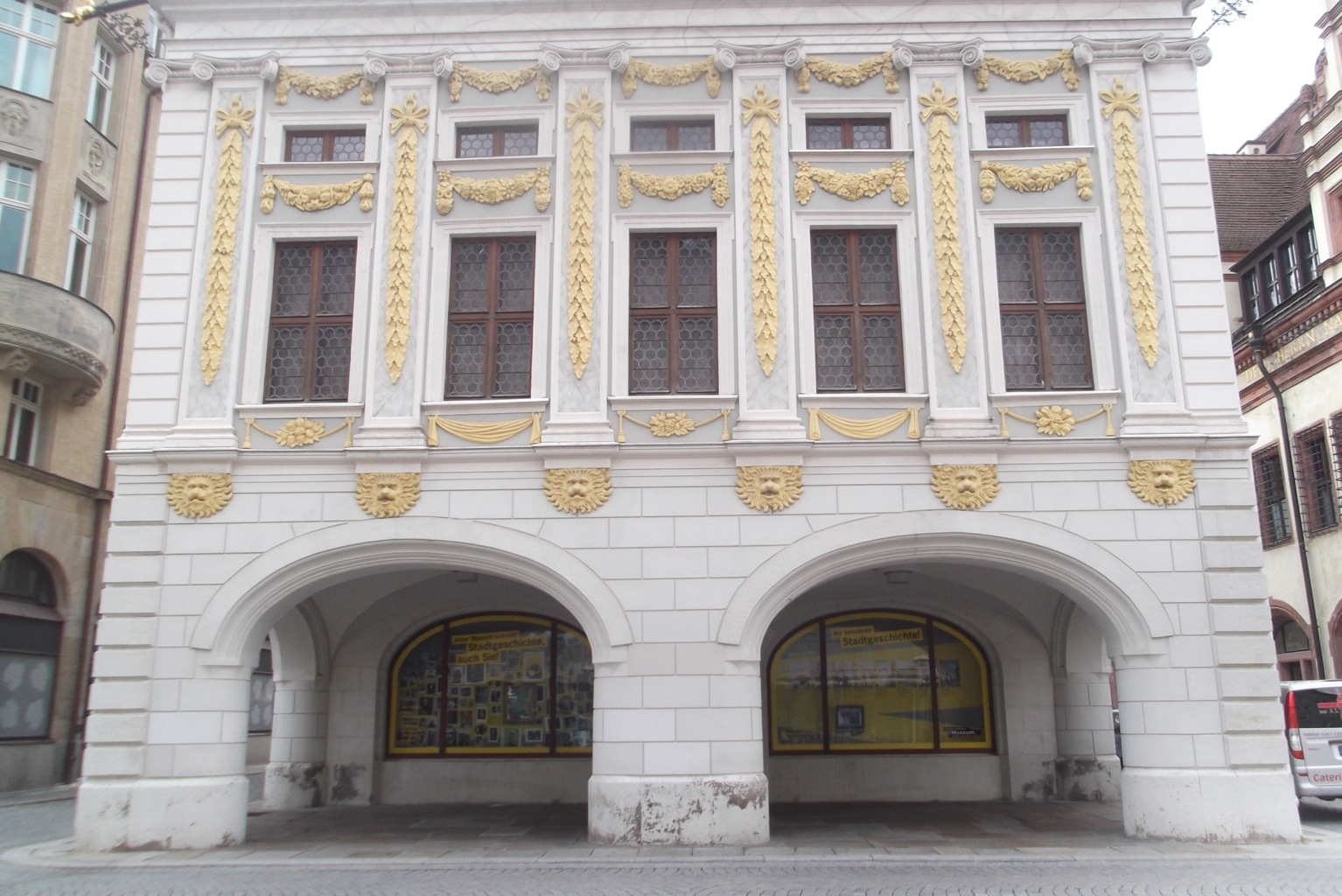
Sunday lunchtime, grey sky, almost no-one in the streets. a young nutter sat on the pavement, cheerfully declaiming. An entire Russian brass band busking, and all the other buskers within earshot playing along; later, a six-piece English rock band with full amplification, including the fiddle. Flat overgrown spaces opened by Bomber Harris a lifetime ago interspersed with the square construction that in some places filled them, and pre-1914 buildings kitted out in loving architectural detail:

20120715-202119.jpg

20120715-202146.jpg

20120715-202206.jpg

20120715-202230.jpg

As you can probably tell from the last photo, in Germany it’s as if 2008 never happened. People sitting in pavement cafes ordering to their hearts’ content, jammed into sushi restaurants, carrying steins of beer about while the bands play in the streets…

I went to the art museum, which was full of pretty much the whole gamut of European art of the last half-millennium: Renaissance and post-Renaissance religious paintings, Dutch seascapes, 18th century portraits, a whole bunch of beautifully executed Italianate Romantic landscapes, a couple of Manets, weird colourful misshapen modernist pieces, some garish contemporary stuff, a basement gallery with mostly drab but also some surprisingly cheery products of 1980s DDR. But only a couple of things really to write home about:

20120715-203428.jpg

That’s the cool crisp clarity of Caspar David Friedrich – The Stages of Life. 1834. The other one is a lot older:

20120715-203712.jpg

That’s Cranach the Elder, early 15th century, painting the King of Denmark. What I especially like about it is the way you can see the stress of the job in his hands…

apart from that, the thing I liked best in the museum was in one of the massive darkened wooden stairwells, a simple white neon sign all on its own asking, in English: Will I be missed?

which segues nicely into the next stop: the Stasi museum, located in the old Stasi headquarters in Leipzig, invaded by the revolutionaries in December 1989 to prevent further shredding of documents. They left the decor exactly as it was, and set up a series of explanatory displays. So it’s grim, badly lit and tawdry – pretty much like what it commemorates. What a way to spend a life – secretively compiling incriminating information on the lives of perfectly ordinary people who just wanted to be able to speak their minds. Yet in saying that, I also demur: how easy it must have been to get sucked into that, to lose the sense of what, overall, was important, in a grim society where there must have seemed few alternatives if you had any ambition. How easy to slowly become a petty monster without even realizing fully what was happening to you. Back then, no-one knew 1989 was coming, of course. There must be quite a few people out there who are still living with that. Easy to say it was wrong (which it was) when you have lived all your life without those pressures…
Posted in road | Tagged , , , , , , , , , | 1 Comment

the Pharaoh’s fist

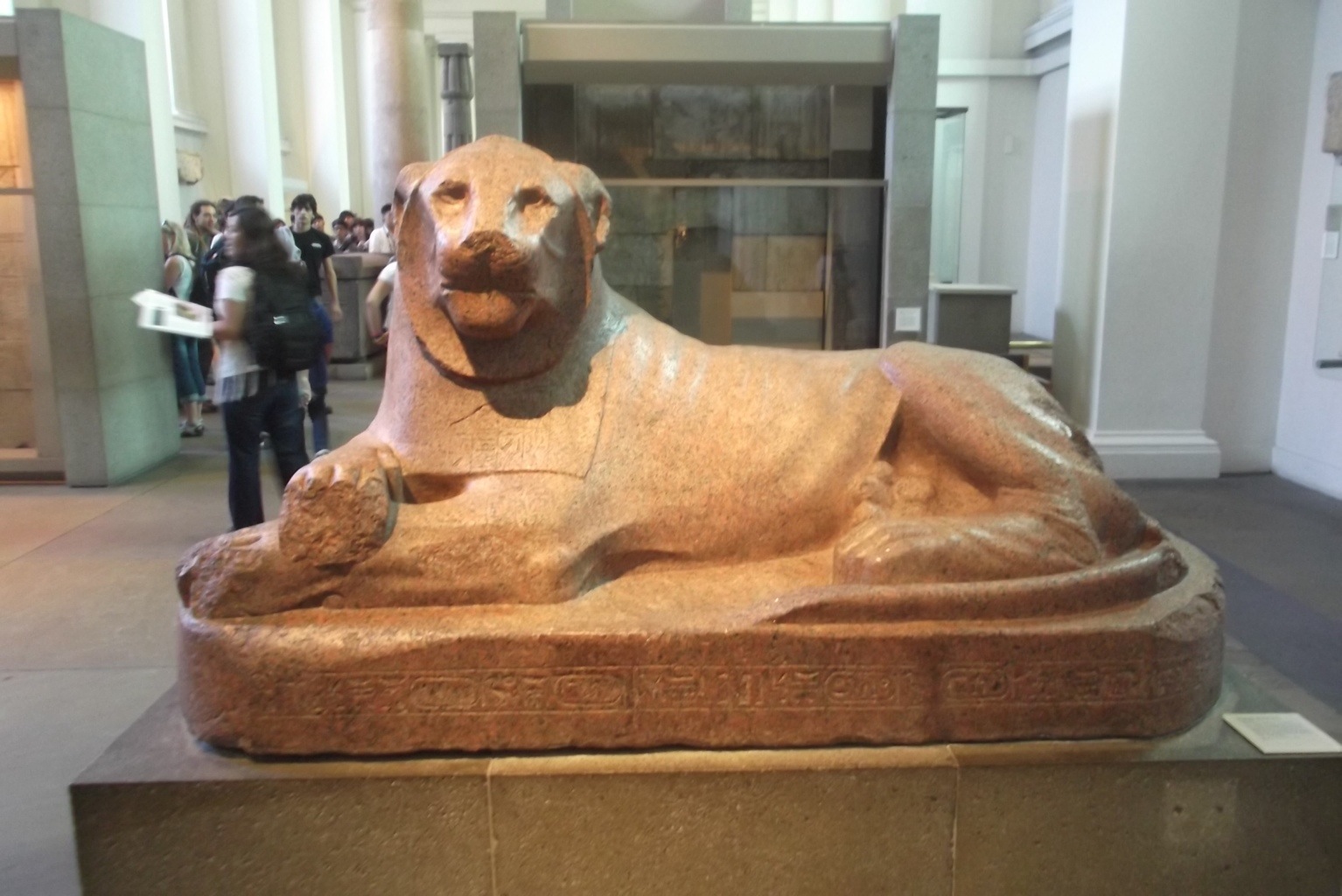
a chill Sudanese lion from the Pharaonic period, in the British Museum:

20120715-112315.jpg

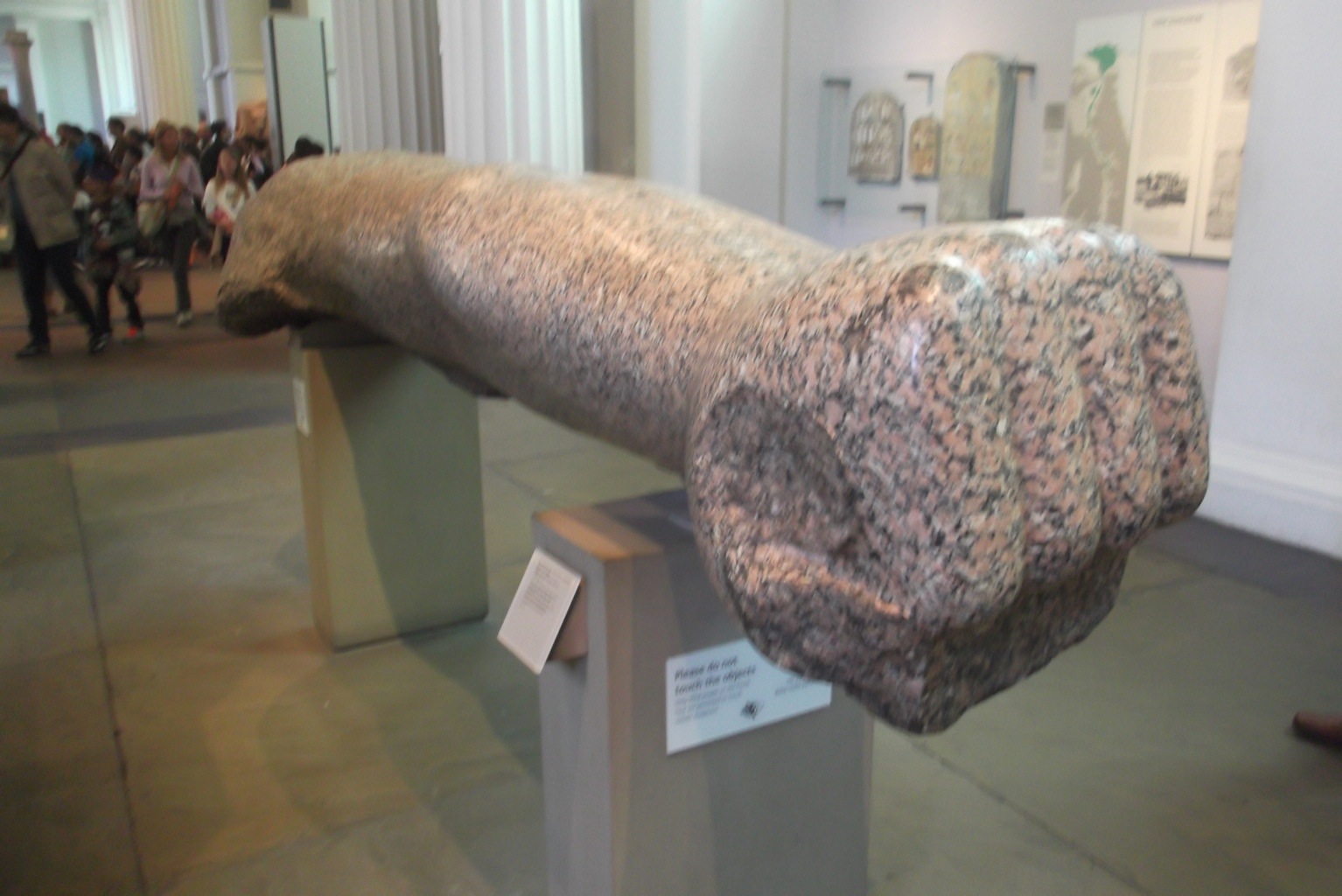
but check out this Pharaoh’s fist, from the Egyptian Middle Kingdom, a little over 3000 years ago:

20120715-112502.jpg

and if you didn’t much fancy being subject to that, your chances might not have been too much cleverer around 2800 years ago with the Assyrians, based near Mosul in northern Iraq. I discovered this lot in the Louvre a year ago, and they seemed like they were from another planet – but there is much more of their stuff in the British Museum, and familiarity somehow breeds, well, familiarity. Their message is way more sophisticated in execution than the Pharaoh’s fist, but equally crude in intent:

20120715-113001.jpg

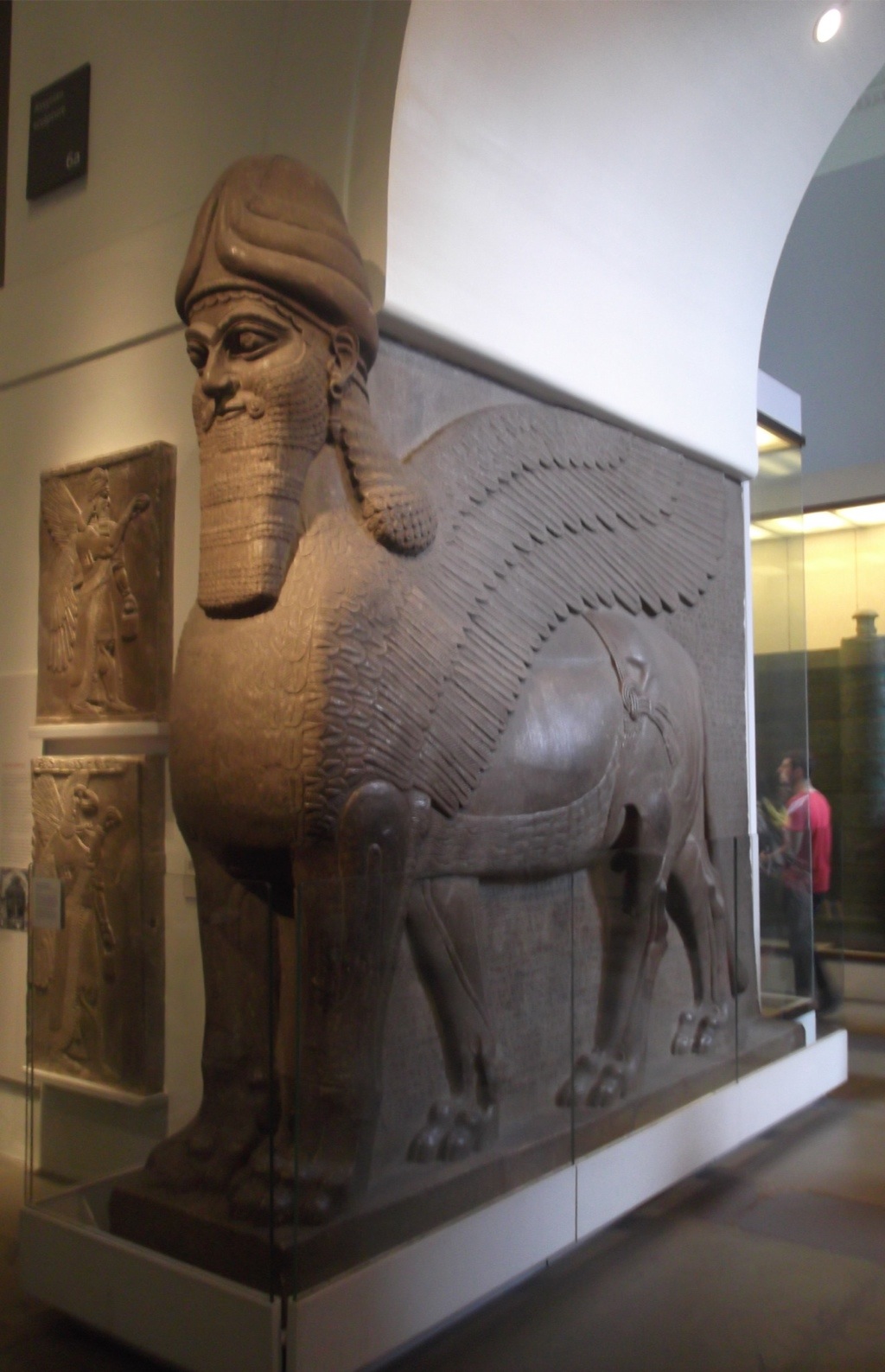
these things are also called lions – guardians of the gates – but to me they look more like horses, precursors of the Centaurs but with turbans and ‘taches:

20120715-113334.jpg

20120715-113507.jpg

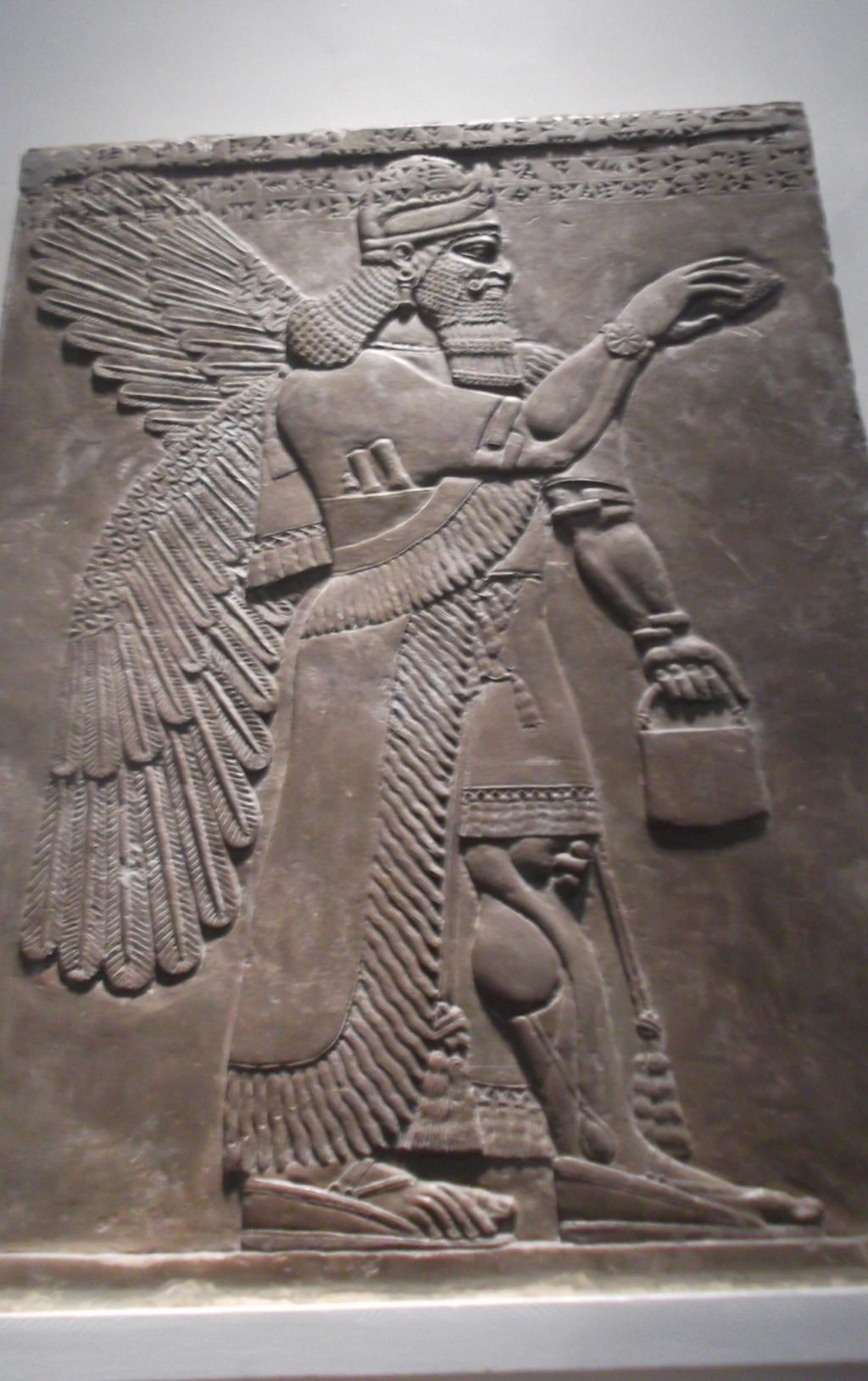
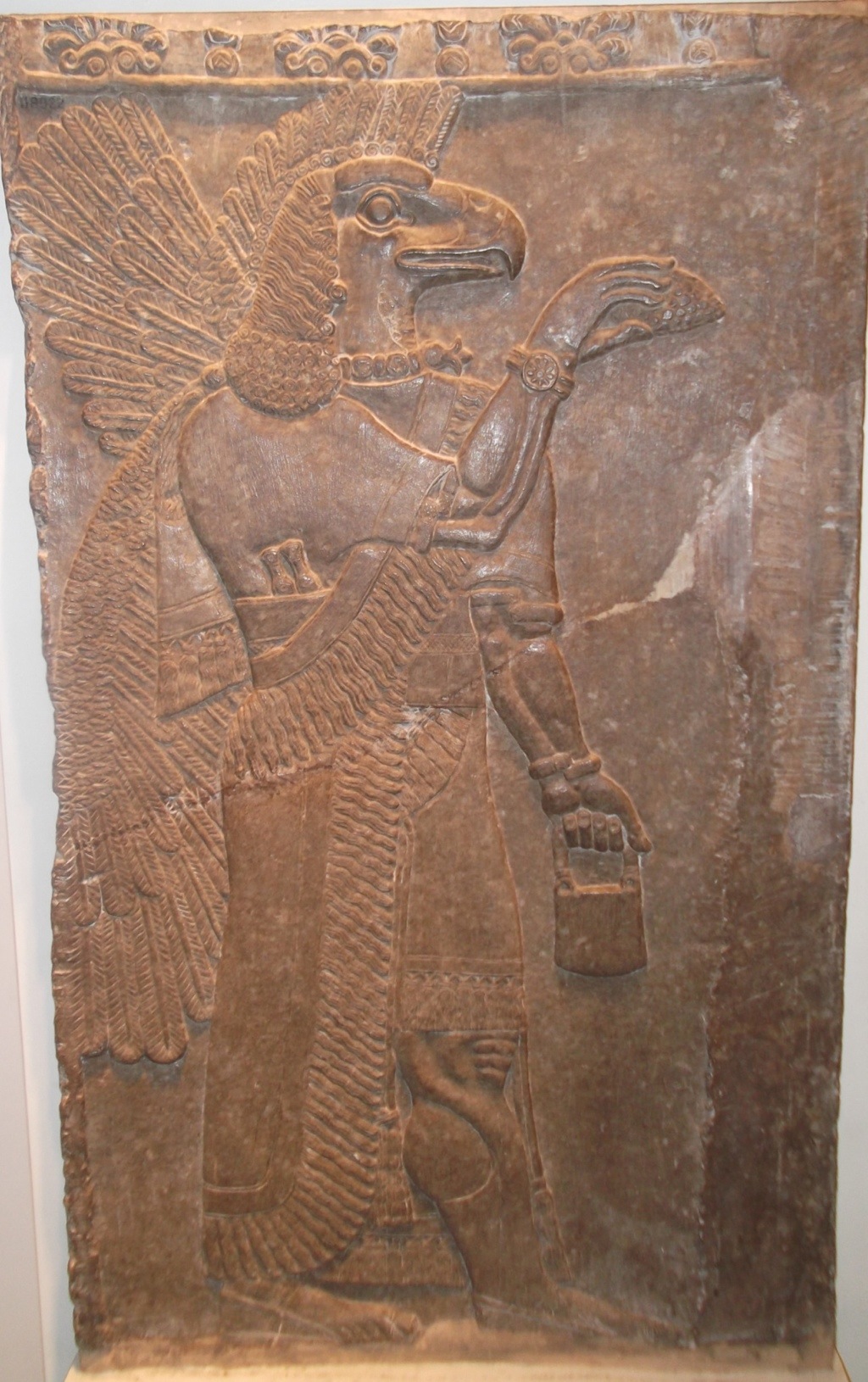
Note that you are not supposed to look at these from the angle I took these photos, where they have five legs; they’re supposed to be seen either head on (static) or in profile (dynamic) – either way considerably imposing. And those wings! The Assyrians seem to have gone for wings all round, and you can see where the Judaeo-Christian seraphim arose from:

20120715-113742.jpg

20120715-113824.jpg

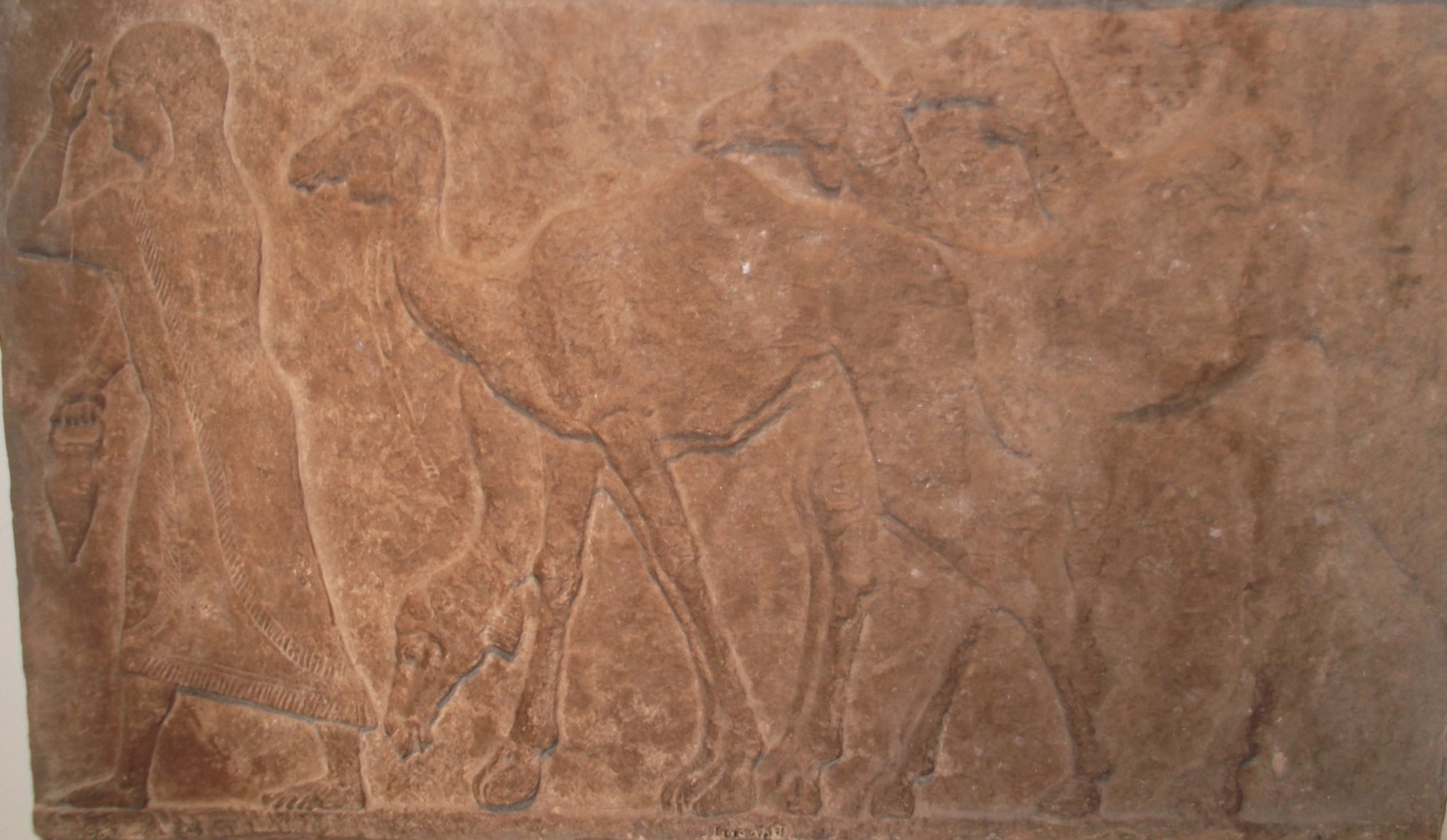
they did some beautiful bas reliefs too. This one of a camel train gives me a sense of looking down a long tunnel into a vivid – you can almost feel the sand – but vanished historical world:

20120715-114018.jpg

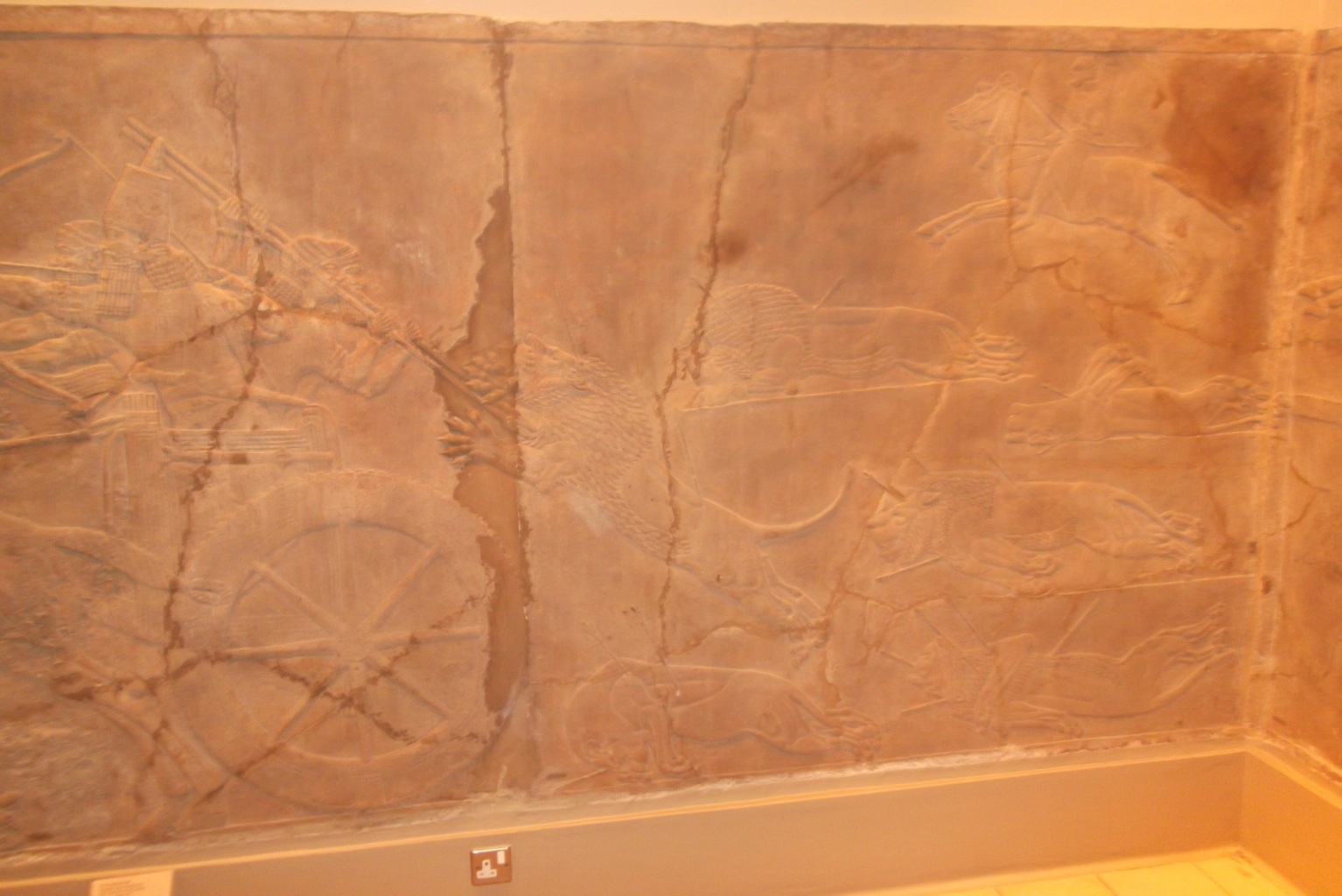
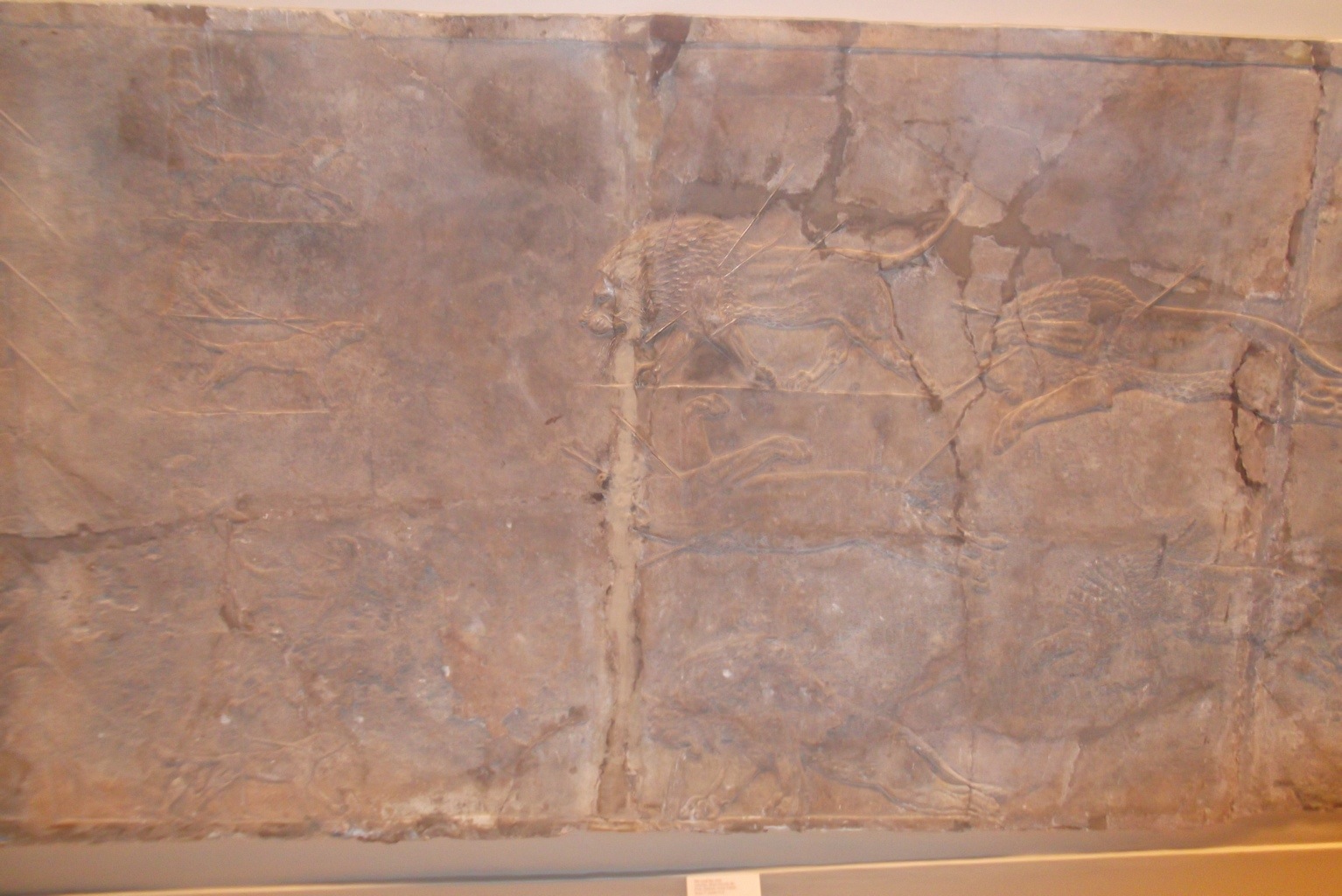
but many of them celebrate power, domination, ultraviolence. The sport of kings in this lost world was lion-hunting: how many lions stuck through with arrows and spears, vomiting to death from their wounds, does it take to get the point across?

20120715-114309.jpg

20120715-114356.jpg

Posted in road | Tagged , , , , , | Leave a comment

home soil

I landed in London at 6 in the morning. People are really friendly. Everything moves slowly, and there seems so much space and time between objects.

Almost nobody employed in London, apart from the guys with the green fluorescent waistcoats who are digging up the roads, is of English origin. Not that it matters – in fact it’s probably a good thing, it has always been one of the fascinations of London that you can walk 100 metres down the street and hear 10 different languages spoken. And the English “sense of humour” is still so parochial and nasty – advertisements on the tube based not on making gentle fun of certain social groups, but actively sneering at them. Fulham girls, for example, with their social aspirations (to Chelsea, I assume). I probably used to think that was funny, but it’s a turnoff now.

I went to Eve’s cafe in Great Russell Street. I used to go there in the 80s, for their prawn and crabstick sandwiches, and their egg mayonnaise. The same guys – of Italian origin – still run it, even though they have been greying and losing hair at an even faster rate than me. That was heartening. They didn’t have any prawn and crabstick or egg mayonnaise, so I had an omelette and chips instead. It wasn’t very good, but the staff were friendly, and it was nice to celebrate being back in England by slathering my chips in brown sauce.

Outside, it was impossible to get comfortable. I’d put my jacket on, and the sun would come out, so I’d have to take it off again. Then it would start raining, so I’d have to pull my brolly out, but by the time I’d got cold enough to put my jacket back on, the rain would have stopped. And so it went on.

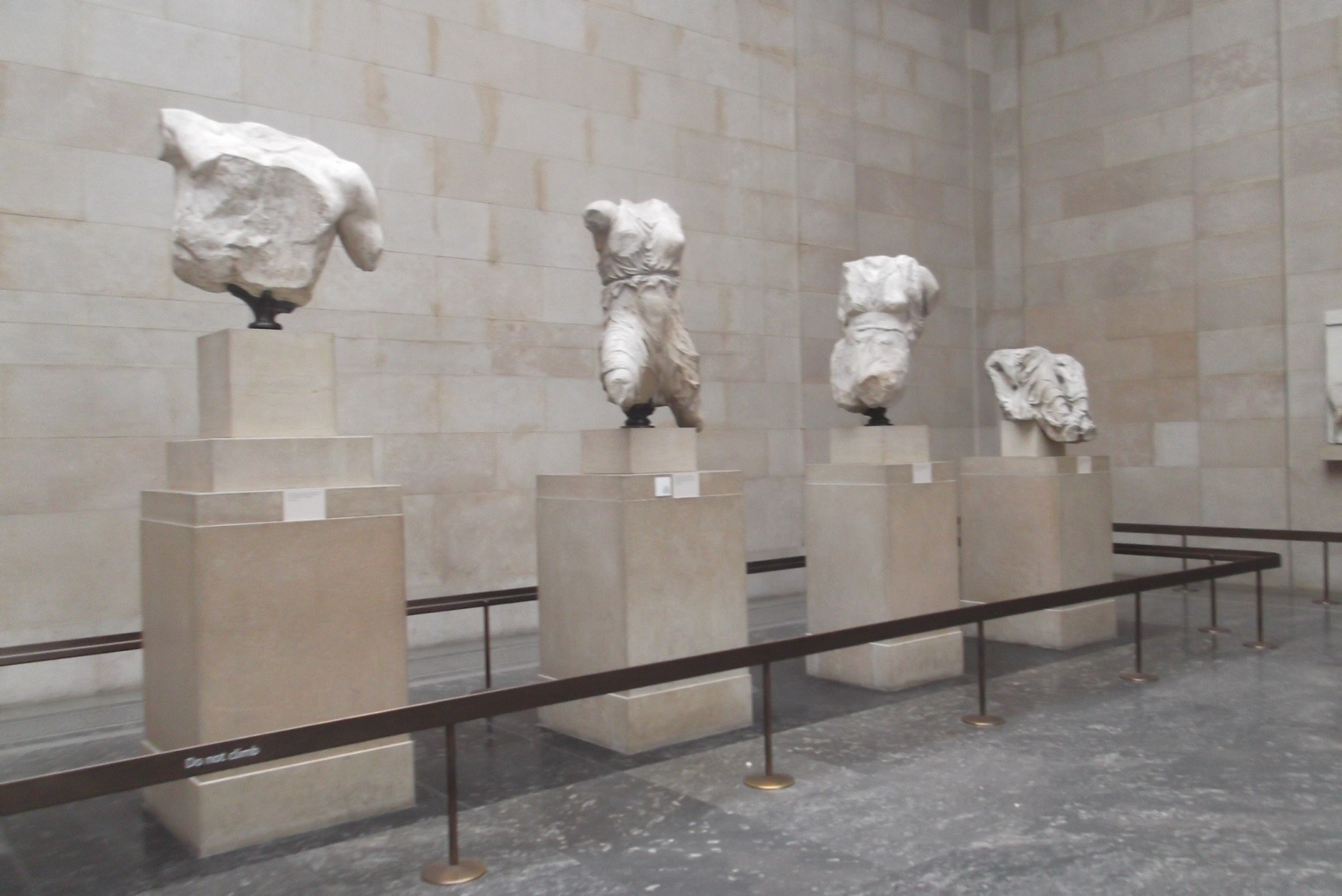
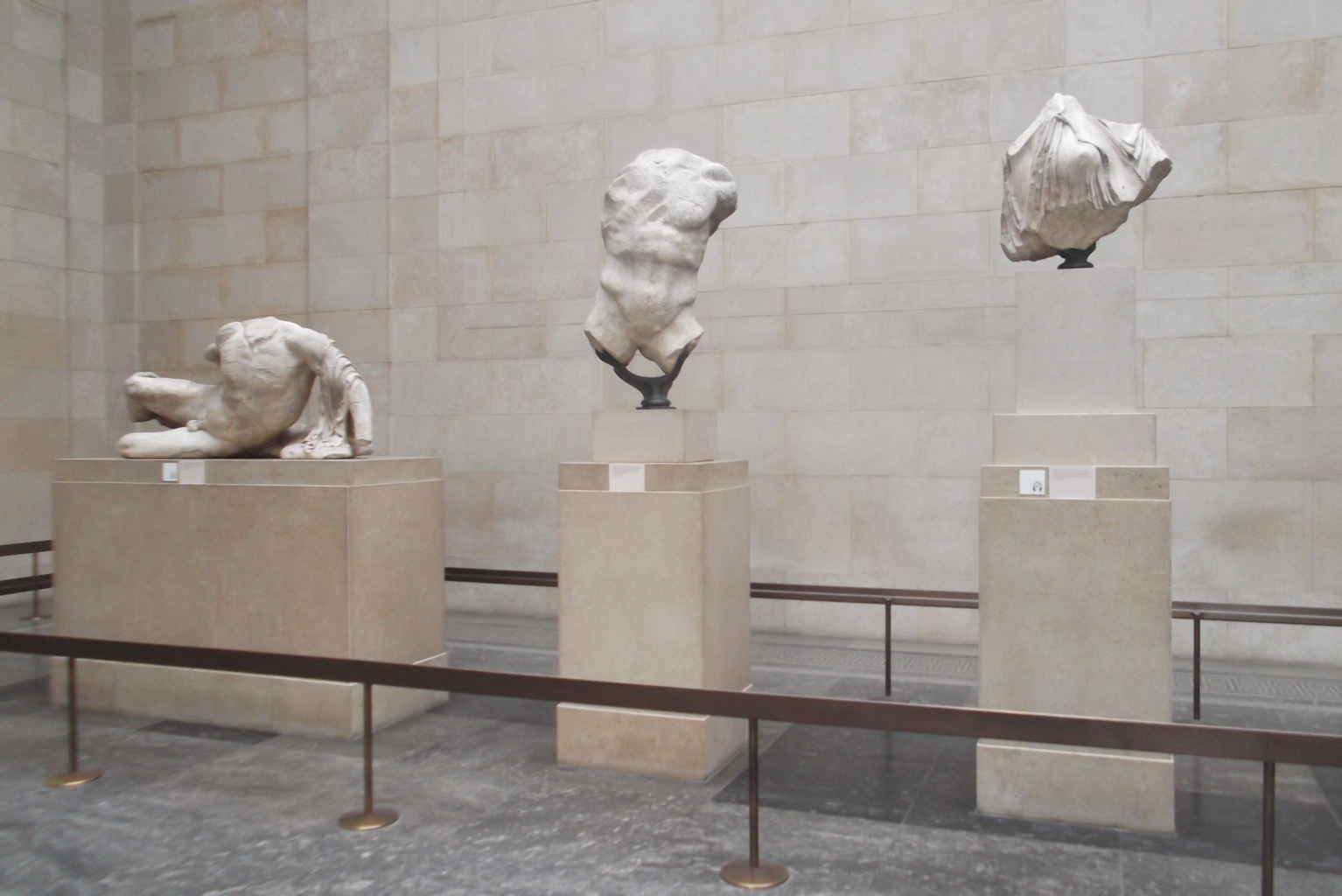
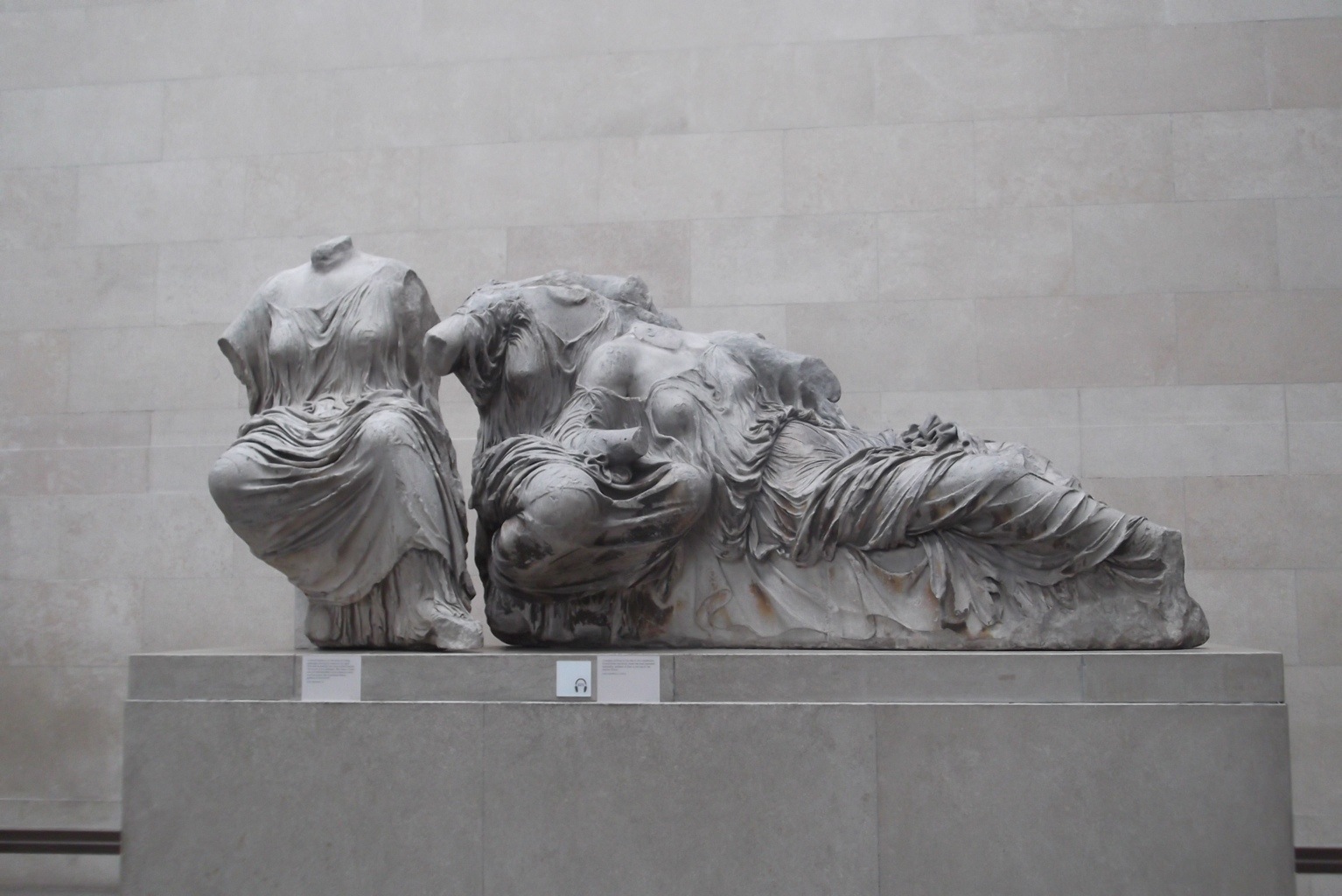
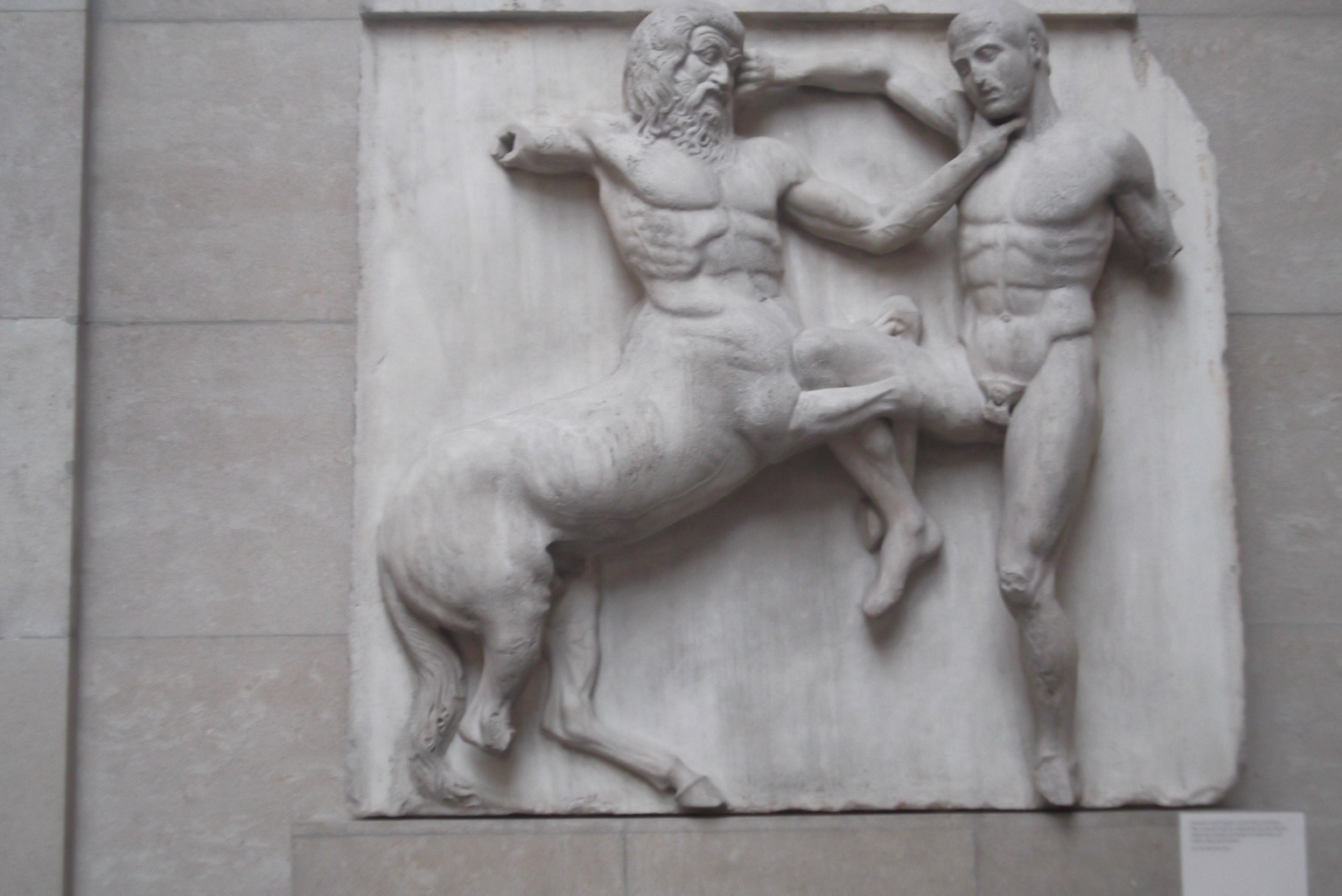
I went to the British Museum, which is a funny name for it, because not much that is in there is British at all. Of course the most well-publicized example of this is the Elgin Marbles (no longer called the Elgin Marbles, for understandable reasons, since the label screams “English imperialist toff nicks priceless cultural treasures from impoverished Balkan nation”). The commentary on the wall doesn’t allude to this point of view at all, but tetchily makes the point that they would have been destroyed if they hadn’t been removed to London, and that in any case they are world heritage and deserve to be in a “world museum” such as the British is. Greeks can’t match that, obviously, though they are welcome to the few they still have. That’s what you call balance. Having said that, no doubt if the Greek government was still in possession of all its marbles in 2012, it would probably have to sell them as part of its austerity drive, and they’d end up right back in London anyway. Or more likely in Germany…
but wherever they are, they are still unbelievable pieces of sculpture: the Greek representational miracle of the fifth century BC. When you first see them they might appear comically absurd – torsos floating in air – but look more closely and the line and flow in the carving, the way the stone is brought to life, is quite amazing:

20120715-083321.jpg

20120715-083524.jpg

20120715-084656.jpg

20120715-084801.jpg

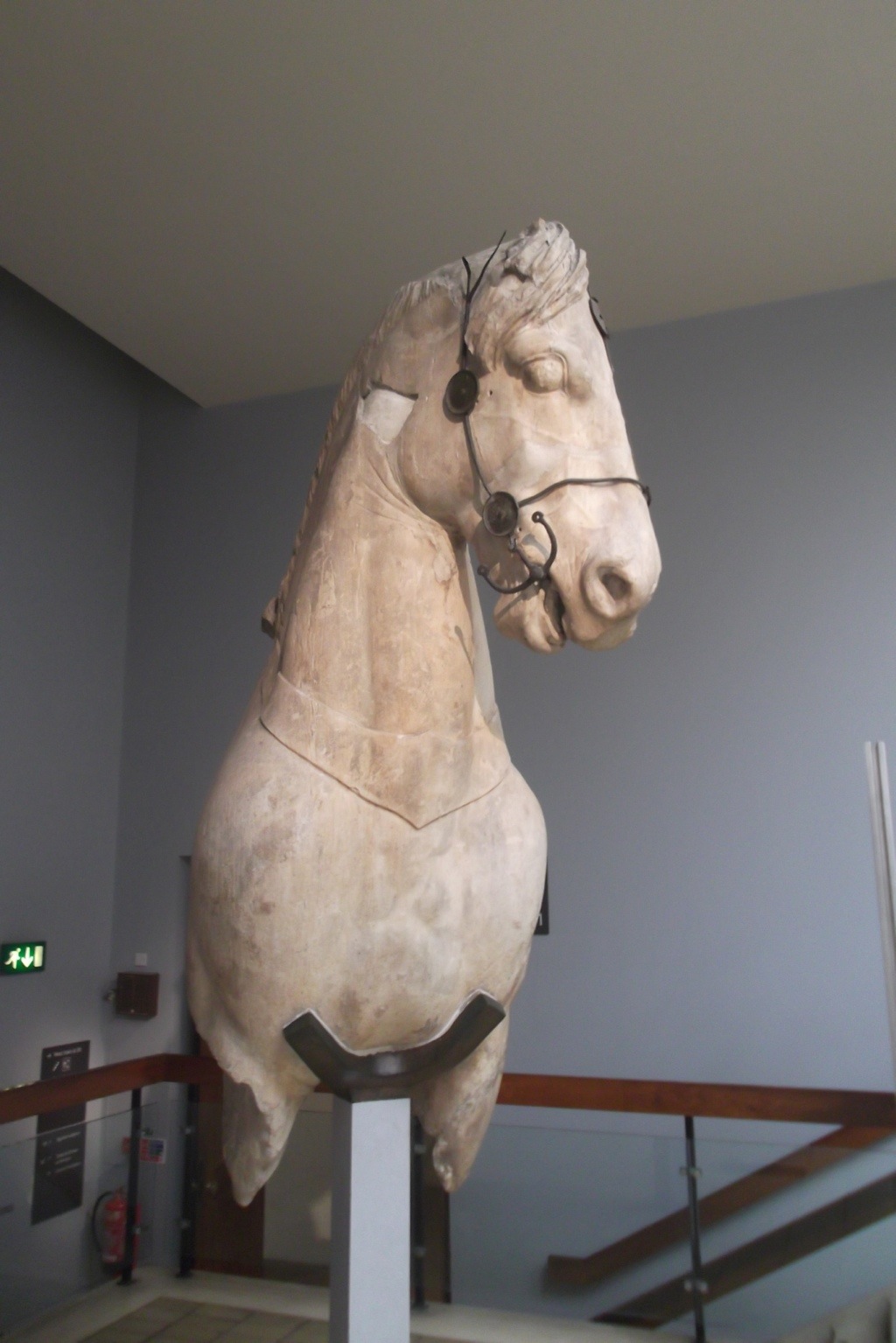
this horse from a century later, at Halicarnassus:

20120715-085025.jpg

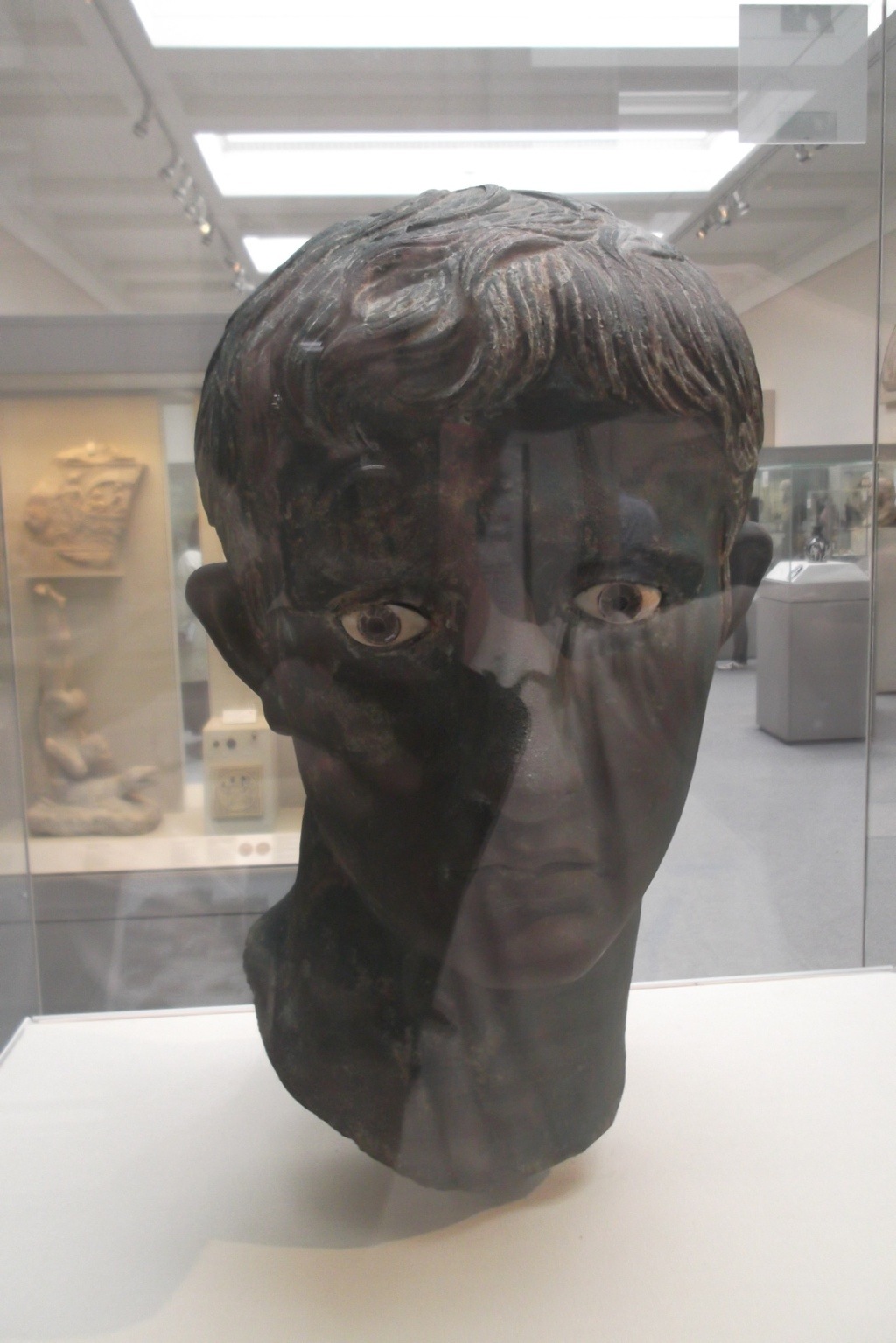
Those were the highlights of the Greek collection. For the Romans, if you’ve seen once the standard issue statues of Caesar Augustus and the five good emperors that were identikitted all over the empire, you’ve pretty much seen them all; but this head of Caesar Augustus was a bit different, and I enjoyed the story behind it:

20120715-085414.jpg

He looks unusually sad and worried, as though there’s a danger someone might cut off his head and steal it. In fact that’s exactly what happened: a Sudanese raiding party took it home from upper Egypt and buried it in the entrance to their temple so that everyone would walk on it, a gesture of supreme contempt. And that’s where the British archaeologists found it nearly two millennia later, and how it came to be in London.

Posted in England, someone's England, road | Tagged , , , , , , | 2 Comments

not quite fever pitch

Today is Cup Final day, Ian’s first: Chelsea v Liverpool. He is 19 days younger than I was when I watched my first, in 1971: Liverpool 1 Arsenal 2, with Steve Heighway, in flaming red, scoring from near the corner flag, and Charlie George flat on his back in his sunny yellow shirt in the Wembley sunshine after hitting the winner, thus completing Arsenal’s League and Cup double (at that time the fourth double in 72 seasons, though since then it has been won seven times in 41 seasons – testament to the growing power of money in the game).

I remember watching this in bright colour on our fourth day in our newly bought suburban Wimpey home (ten months after my mother walked out of my parents’ house, two months after I lost him for good, and two months before their divorce became absolute, itself two months short of 25 years of marriage) even though for the first few years we only had a black and white TV. I also clearly remember Heighway scoring from the right, though in fact he did so from the left…

In the Yorkshire circumstances of the day I was bound to follow Leeds United – I had missed their Cup Final replay loss to Chelsea the year before (although my mate Simon Webb, himself a Leeds fan, was not slow to point out that his namesake had scored the winning goal), but in 1972 I was sat on the floor among a crowd of boys gaping at the neighbour’s big colour screen as Sniffer Clarke thumped the winning header past Geoff Barnett, and Mick Jones limped up in agony to collect his winner’s medal after dislocating his shoulder in the final minutes.

Two days after that Leeds went to Wolves needing a point to win the double themselves; in those days they didn’t broadcast league games in full, and I watched in dismay the brief report on the late-night Yorkshire news as Derek Dougan (of the massive sideboards) sank my exhausted heroes 2-1.

That was in black and white all right – doubly awful as it meant Derby County, and the bitterly hated Brian Clough, winning their first title.

I was a Leeds fan for 19 years, until the aura of racism and violence that dogged the club got to be too much. The final straw came in May 1990, when Leeds beat Bournemouth on the final day of the season to ensure that they won the second division championship while Bournemouth were relegated to Division 3. These things happen in football, but what came afterwards didn’t have to: the thugs of Yorkshire smashed Bournemouth town centre to pieces. That disgraceful performance was enough for me; since then I’ve been strictly neutral.

Ian’s not; he’s a Liverpool fan. So far from a local context, I’m not sure what that means, but he has his kit and all (more than I ever did; my mother’s paltry income wouldn’t stretch to such indulgences back in the early ‘70s). So we’ll be on the sofa tonight at 8.15 (for some reason the game is no longer the traditional  3.00 kick-off, but 5.15, plus three hours for the time difference). Will he stay awake?

Posted in daddymummybabyblog, older, random amnesia | 6 Comments

the face I deserve

“By the time a man is 50 he has the face he deserves.” If you google that, it comes up that George Orwell wrote it; but nowhere does it say exactly where, chapter and verse. So was it him? Almost everything that anyone says online that purports to be wise gets attributed to either Einstein or the Dalai Lama – secular gurus of the recent past – and perhaps Orwell fulfils the same function for a more caustic and sceptical crowd. Anyway, whoever said it, it’s catchy…

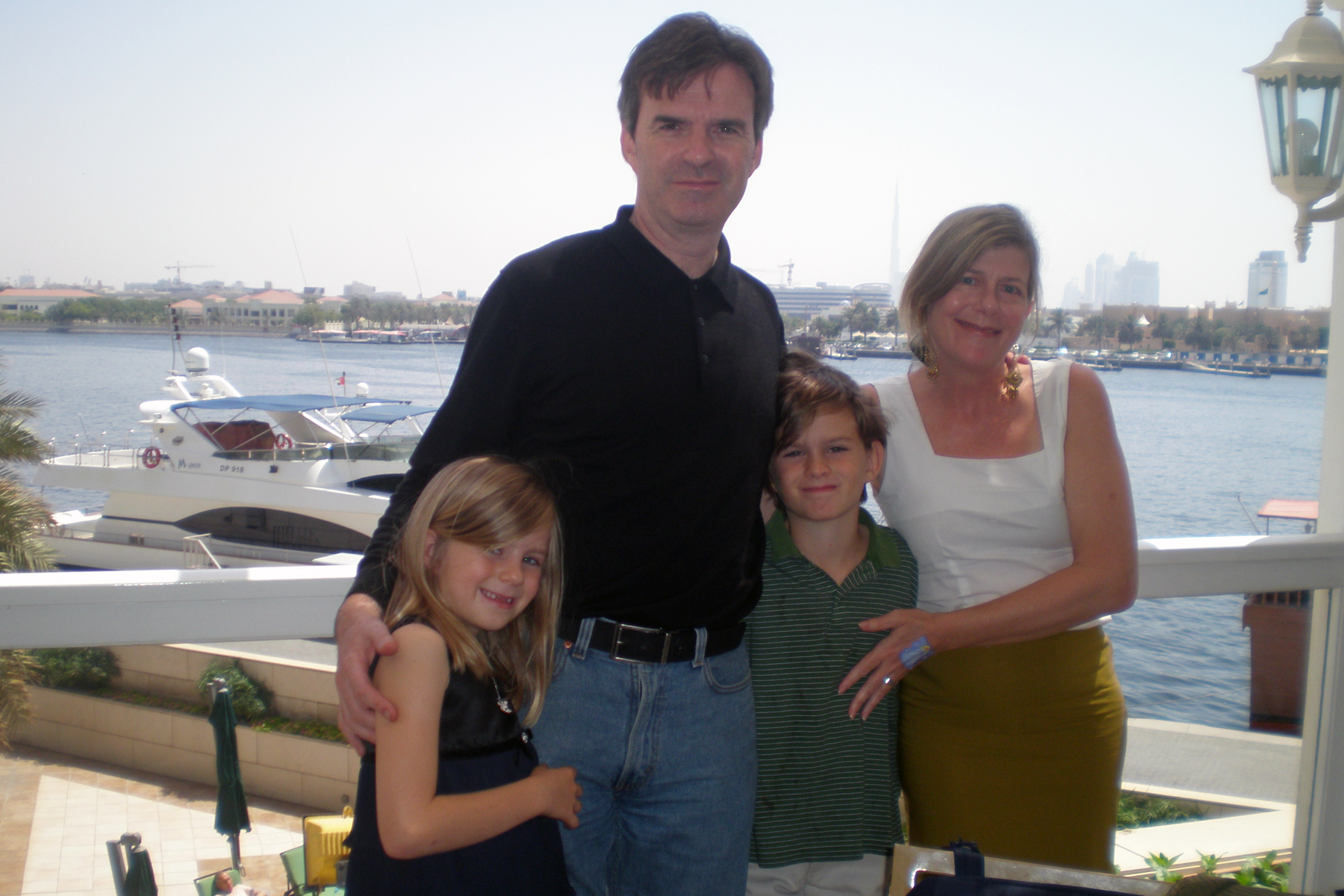
So now I’m 50. I eased the transition by going out and spending $200 (way more than I usually do) on seven-and-a-half bottles: Muscadet, Chablis, Gewürztraminer, Sauvignon Blanc, Châteauneuf-du-Pape, Veuve Cliquot, some Romanian bubbly, and the half a Late Harvest. We drank them over four days, interspersed with a Thai dinner at Al Bustan Rotana, a glittering brunch al fresco by the water at Sheraton Dubai Creek, and a visit to a mediocre tapas place. If it was the life rather than the face I deserve, I’d be doing pretty well. I have no public achievements to my name; and although the internet is full of articles like this by Gary Younge claiming that everything we do is now disturbingly open to public view online, nobody pays the slightest bit of attention to me, my blog, or the photos I put out there. I get on well enough with people, but I could scarcely say I have friends any more, in the old sense; I live mostly within the little circle of love we call our family. I never thought that a life like that would be fine with me, and yet it is. The bottle of Gewürz I bought bore the legend Finesse, Harmonie, Authenticité – if I were to aspire to anything it would be close to that. Well, finesse might be pushing it some…

Until the digits rolled over, all I could see was the mountain of 50 ahead. Over that crest, the vista seems clear all the way to 70. The face I deserve? Dear non-reader, you can judge for yourself, but just now I feel fortunate; I could have done worse, not just with mine, but with those that surround me…

Posted in daddymummybabyblog, older, peak and decline | 8 Comments

The American Future

A curious title for what is a work of thematic history about America interspersed with passages of personal reminiscence, but Simon Schama’s book was written during the 2008 election, those days of surging hope when it seemed the US might reinvent itself instead of tightening harder into acrimoniously gridlocked incomprehension among its various racial, religious and ideological components. Seems a long time ago now. I suppose it was intended as an exploration of the past as a guide to the future, though its optimistic tone seems set at odds with much of the evidence it presents: anti-Chinese pogroms, the Cherokee Trail of Tears, and the continued presence of the psychopathic ethnic cleanser Andrew Jackson on the nation’s $20 bill, for instance. But not all: the first part of the book is largely devoted to the Meigs family, whose most illustrious member, Montgomery C., built the Capitol dome and brought potable water to Washington DC as well as acting as Quartermaster General for the Union as it out-organised the more tactically accomplished Confederacy to achieve victory in the Civil War. The second raises an important point about the constitutional separation of church and state: that it successfully and enduringly enables a culture in which (unlike Europe, where religion largely expired in the great upheaval of 1914-45) all shades of belief from wacko fundamentalism to militant atheism can sit sincerely side by side without one Talibanising the others, and that this enforced plurality gives America not just incredible appeal but enduring power and effectiveness. That is the side of the American story that it is hard to keep sight of when the political twilight descends, as it has again so frustratingly since 2008…

Posted in anybody up there?, misery for the many, freedom for the few, read | Tagged , , , , | Leave a comment

Storms of My Grandchildren

This first book by James Hansen, the dean of American climate scientists and the man who introduced a mass audience to the concept of “global warming” in a Congressional hearing nearly a quarter of a century ago, was published right before the failed Copenhagen conference at the end of 2009, and not quite drowned out by the phony “Climategate” email scandal. It contains long and detailed tales of high-level political disappointment, as his assumption that once the danger we are in was publicly known, rational authorities would do something, dissolved under the lobbying and disinformation campaigns of narrow special interests, in cahoots with a faith-based ideology that believed there would be compensatory mechanisms (that are not in fact apparent) built into God’s (or whoever’s) plan for human climate. After all, it is our planet, isn’t it? So the Holocene must continue? Interestingly, he places less faith in modeling the future than in the patterns that emerge from millions of years of inference from the climate record – and which indicate that we are heading for disaster, and approaching the point – positive feedback loops – of no return.

The book concludes with an indifferent (but who cares?) piece of science fiction in which, by the 26th century, the earth has become a hot desert planet, devoid of life (or at least any as we know it). It’s Hansen’s (disputed) contention that if we burn up all the coal, the climate will spiral out of control to the point where Earth will become, irretrievably, like Venus. Coming from such an authority, this is scary. He doesn’t mention this in his recent TED talk, but that does, like the book, draw on his fears for his grandchildren as well as his scientific background – making a cogent appeal, both emotional and rational, probably lost amid all the preachers of infinitely more clever devices and the singularity.

So we carry on regardless, and before my grandchildren are grown, if not born, will be like alcoholics fighting over the last drops in the bottle while the house burns down around us.

Posted in anybody up there?, bleakdom: don't blink, lemmingwatch, peak and decline, read | Tagged , , , , | Leave a comment

Byzantium by bus

And so, 30 years after I first conceived the ambition while turning right at Thessaloniki, I came not sailing but on a highway bus (aware, always, of the tyre-tracks of history) to Istanbul-Constantinople-Byzantium. The rain had cleared and we descended across the still-damp, undulating Thracian plain, dotted with distant factories. The Sea of Marmara was a pewter platter away below us to the right, spackled with shafts of light, extending towards distant hills. Then the hills grew tighter and began to sprout roads, project housing, billboards,  industry; planes drifting overhead left to right, traffic thickening into (once again) the largest city of Europe. At length we pulled off the highway and into a bus station – tunnels, ramps, subterranean galleries – that seemed a city in itself. Somewhere in this Byzantine labyrinth it spewed us out onto a pavement from where, by luck, I found a metro station among the sprawl, and rode towards the city centre. At the terminus the escalator emerged into a confusion of grey roads, crowds heading in all directions. I followed signs, and was in turn followed by an old tramp who insisted on taking my money and buying me a ticket for the tram.  I tipped him the change; he scowled disgustedly – but then shouldn’t he have spotted that I was capable of looking after myself?

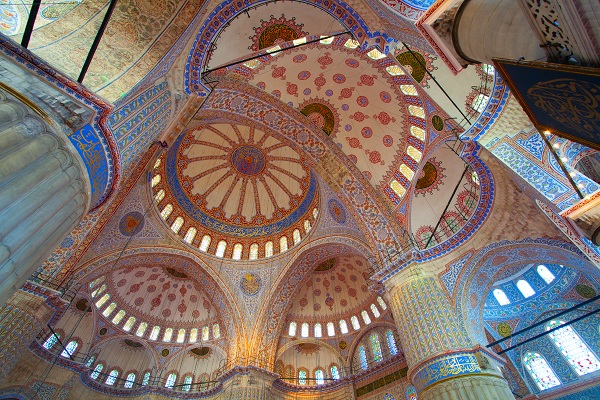
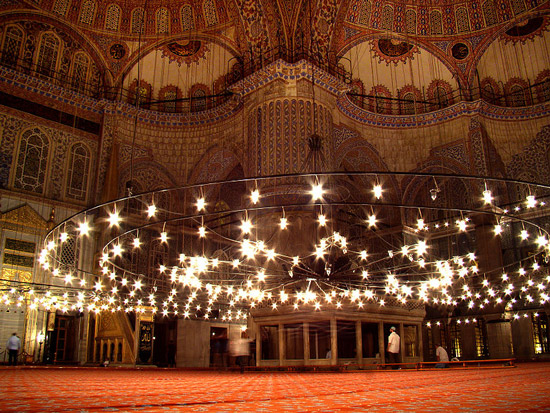
The tram, packed with students, moved forward through tightening streets along a mosque-dotted route filled with shoppers, brand names, and more shoppers.  At Sultanahmet, I alighted and walked across cobbles to the  Blue Mosque: another grand, prepossessing structure, apparently based on the Selimiye version by which I had just remained relatively unmoved in Edirne. This one – six minarets – was on an epic scale too, but blue-tiled inside (thousands of tulips) and glittering with light:

Striking, but just a prelude to the great original dome: the emperor Justinian’s 6th century extravaganza, for 900 years the gold-encrusted omphalos of Orthodox Christianity. And then (according to Wikipedia), May 29, 1453:

Shortly after the city’s defenses collapsed, pillagers made their way to the Hagia Sophia and battered down its doors. Throughout the siege worshipers participated in the Holy Liturgy and Prayer of the Hours at the Hagia Sophia, and the church formed a refuge for many of those who were unable to contribute to the city’s defense. Trapped in the church, congregants and refugees became booty to be divided amongst the invaders. The building was desecrated and looted, and occupants enslaved or slaughtered; a few of the elderly and infirm were killed, and the remainder chained. Priests continued to perform Christian rites until stopped by the invaders. When the Sultan and his cohort entered the church he insisted it should be at once transformed into a mosque. One of the Ulama then climbed the pulpit and recited the Shahada.

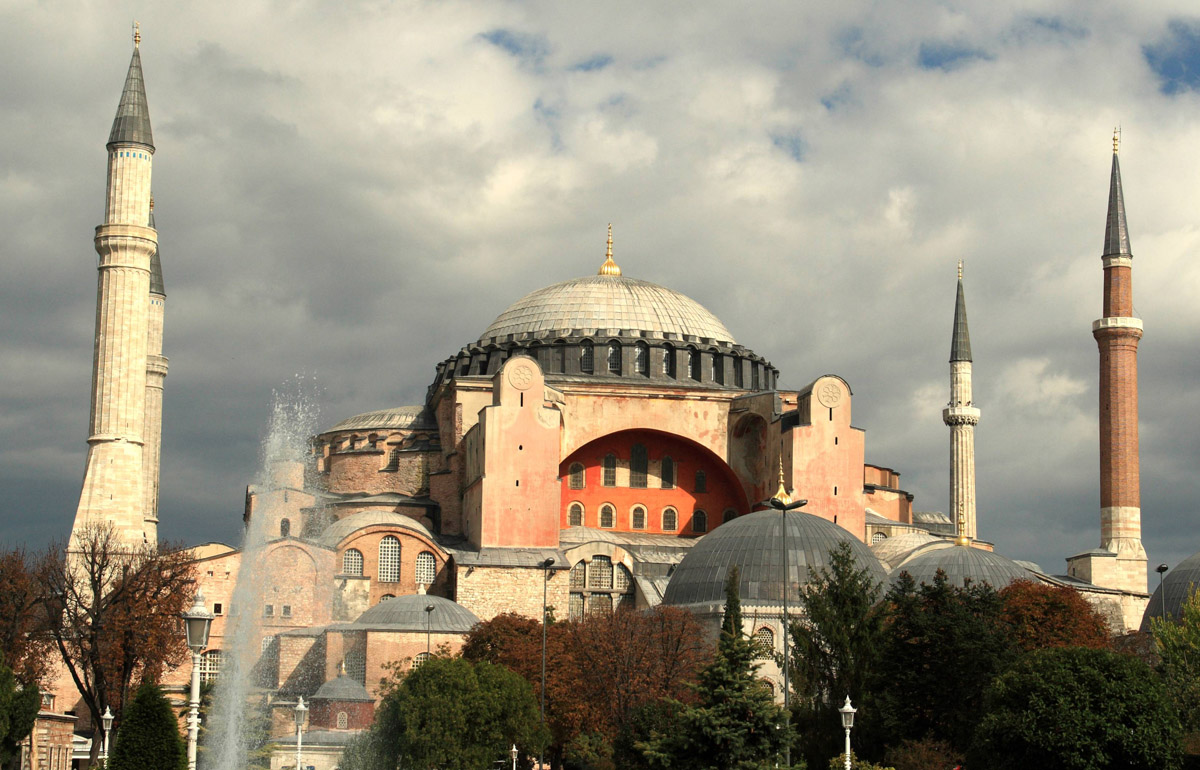
Hence the minarets. From the outside, what surprised me most was that it is built, like some Victorian warehouse, of brick:

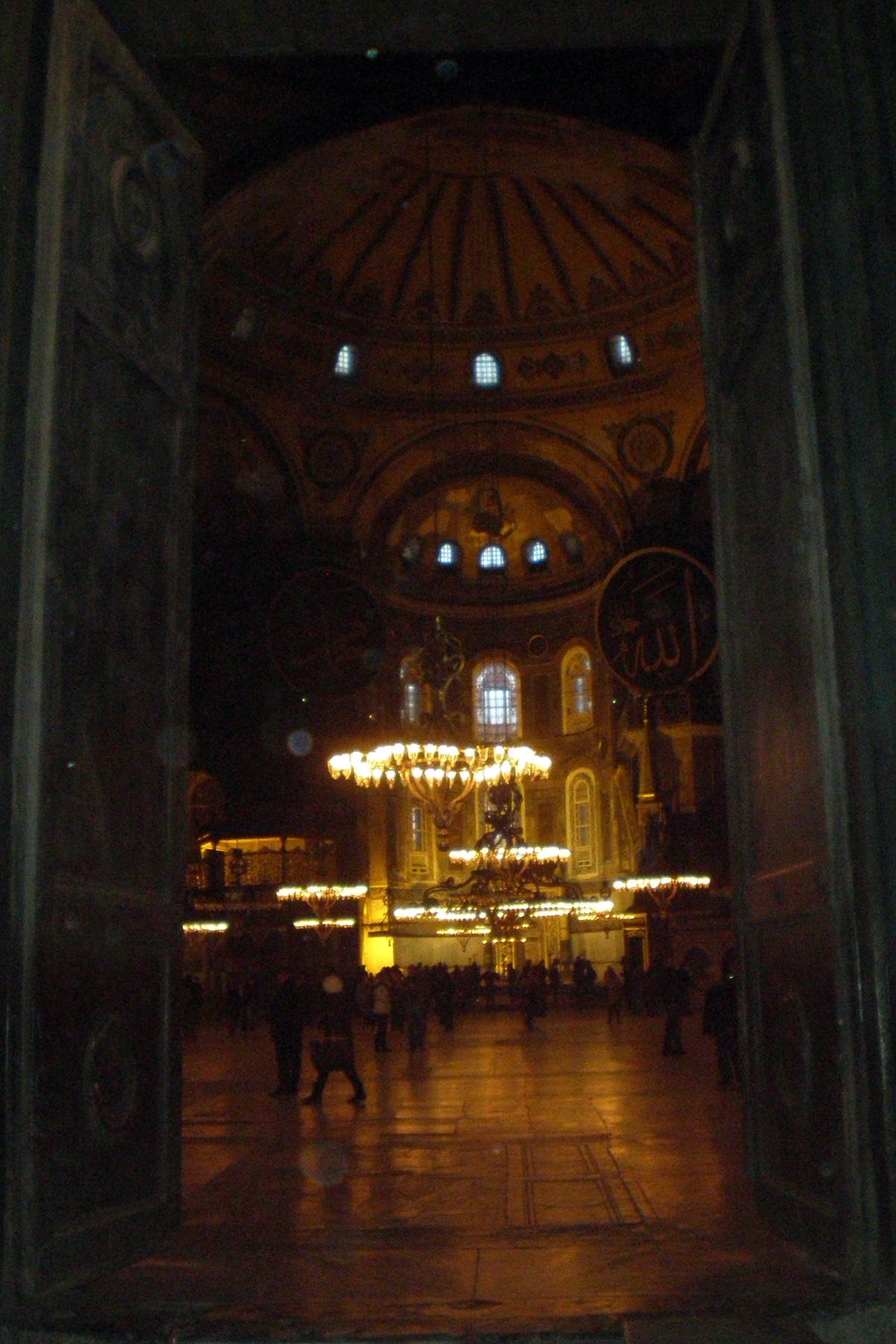
This, though, is like one of those portals – Lewis Carroll’s rabbit hole, the wardrobe in Narnia – where another world is concealed inside a plain (though in this case hardly inconspicuous) exterior. For a start, what’s different about this from most later Christian domes – St. Peter’s, St. Paul’s, Melk, Esztergom, say – is that they are round-topped cylinders placed almost as an addendum on a rectangular structure, while in Justinian’s basilica the dome is the space, and you are glowingly inside it from the moment you step in the door:

entrance to Hagia Sophia, Istanbul

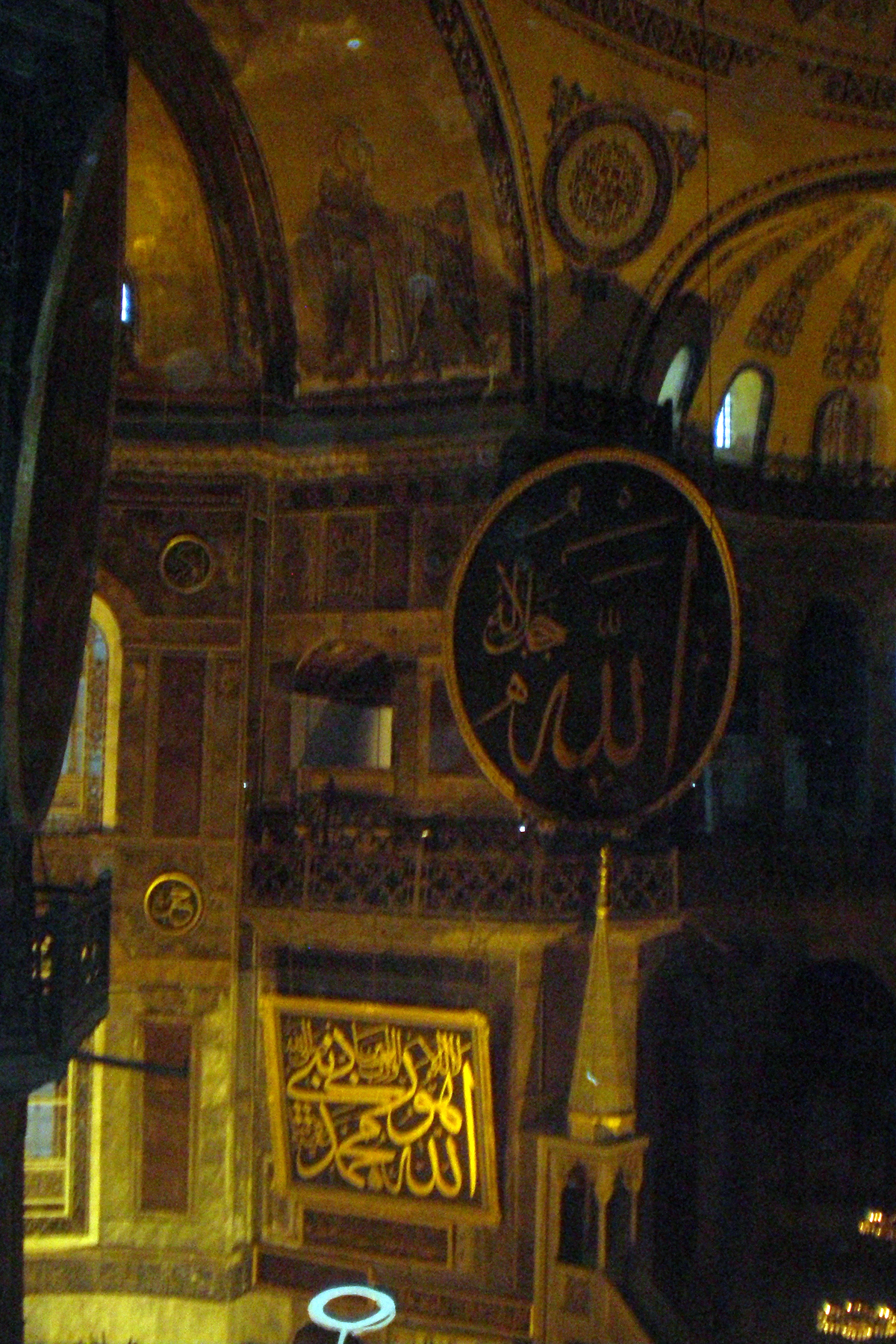
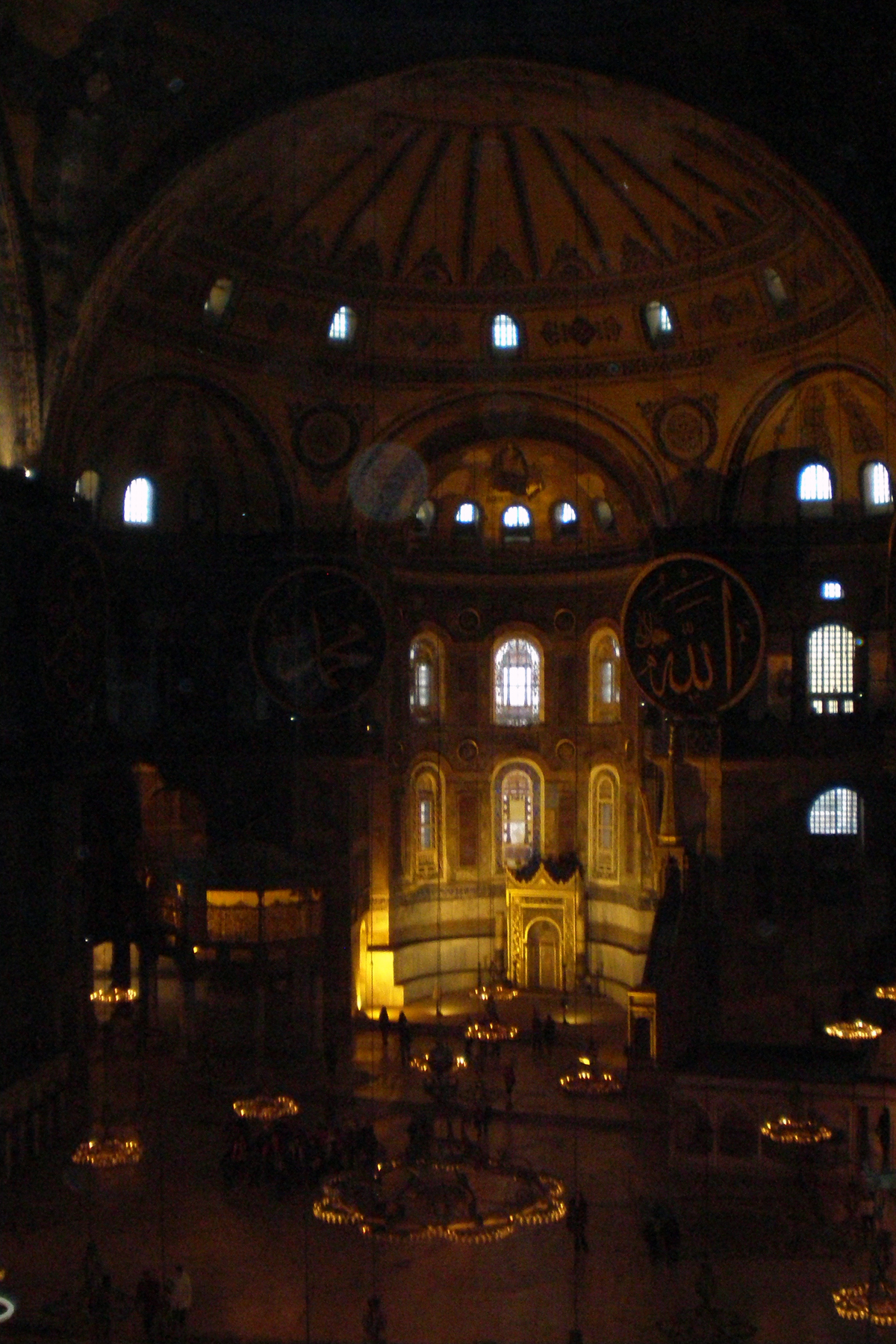
The church – though it is no longer a church, having been for nearly five centuries a mosque, and then sensibly converted by Ataturk into a secular, historical space – is an old lady now; her floors are weathered and crumpled, and in the broad gallery, from rear centre of which the empress used to watch the show, listing like a ship in restless seas. Fragments of the old golden mosaics – many of them battered – remain in places around the walls, in uneasy juxtaposition with the four giant circular lozenges bearing the names of the prophet and his successors in fiery gold on black:

Christian and Islamic iconography, Hagia Sophia, Istanbul

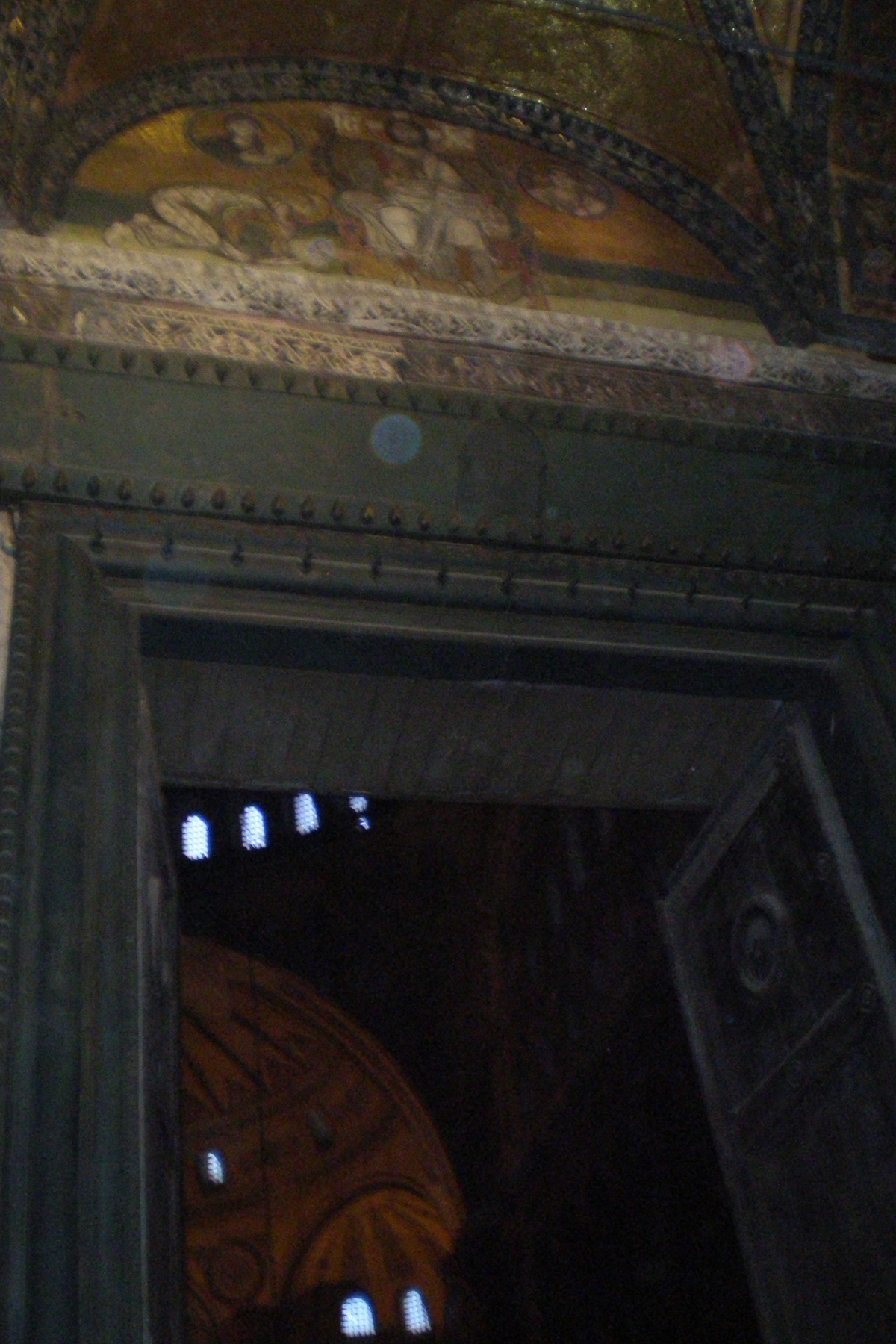
Some of the remaining mosaics are quite spectacular, like this one over the doorway of the emperor bowing to Christ:

Imperial Gate mosaic, Hagia Sophia, Istanbul

But the giant pantocrator icon of the dome is gone, overlaid with Islamic patterning far less distinguished than that in Edirne or the blue mosque; and the mihrab where the altar used to be reinforces the dissonance, angled towards Mecca at several degrees to the south of the main east-west axis:

view from the gallery, Hagia Sophia, Istanbul

The hotch-potch is understandable, and indeed admirable given the competing claims of history, yet the wistful question still hangs in air: what would it have been like to have seen this incredible space in its full glory – the shimmering golden trance of Vatopedi on a hundred times the scale?

Ever since Thessaloniki I had had the rising sense that Byzantium is less of a place or a historical reality than a golden vision creeping in the air, everywhere and nowhere, with mere traces – Meterora, Nikolaos Orfanos or Agios Dimitrios in Thessaloniki, the meditations of Vatopedi – interfacing with the physical plane five-and-a-half centuries after it lost its chief anchor there. Here at the place of that anchor, in Hagia Sophia, the vision, though broken, remains both most powerful and best set in context. Cynics on the internet grumble about the TL20 ( 8)admission charge, but that seems cheap to me: access to this world is priceless. As Judith Herrin says of this edifice: “While it stands, Byzantium will always be present.”

Posted in anybody up there?, road | Tagged , , , , , , , , , , | Leave a comment

mosque heaven: Edirne

From Samothraki I took the ferry before dawn back to Alexandroupoli, arriving in brilliant, freezing sunshine. After 20 minutes, the bus to Orestiada turned inland into thick fog, passing through small towns among roads lined with white single-storey Thracian cottages topped with red-tiled rooves. At Orestiada I waited for half an hour in a grim formica-surfaced bus station peopled with old men in brown and old women in black, in separate  groups at different tables. More fog on the road to Kastanies, the last town in Greece, in the European Union; after the last kaffenion and pizza place, the border post. Schengen this was not: a ten-minute walk on a tight road, no pavements, between tall wire fences with signs announcing that this was a restricted zone; then a pair of Greek border guards wielding machine guns, and a similar pair of Turks. There was a moment of bureaucratic confusion when it emerged that I was carrying euros; Brits have to pay sterling, so after a clarificatory phone call to head office I had to be admitted to Turkey as an Australian.

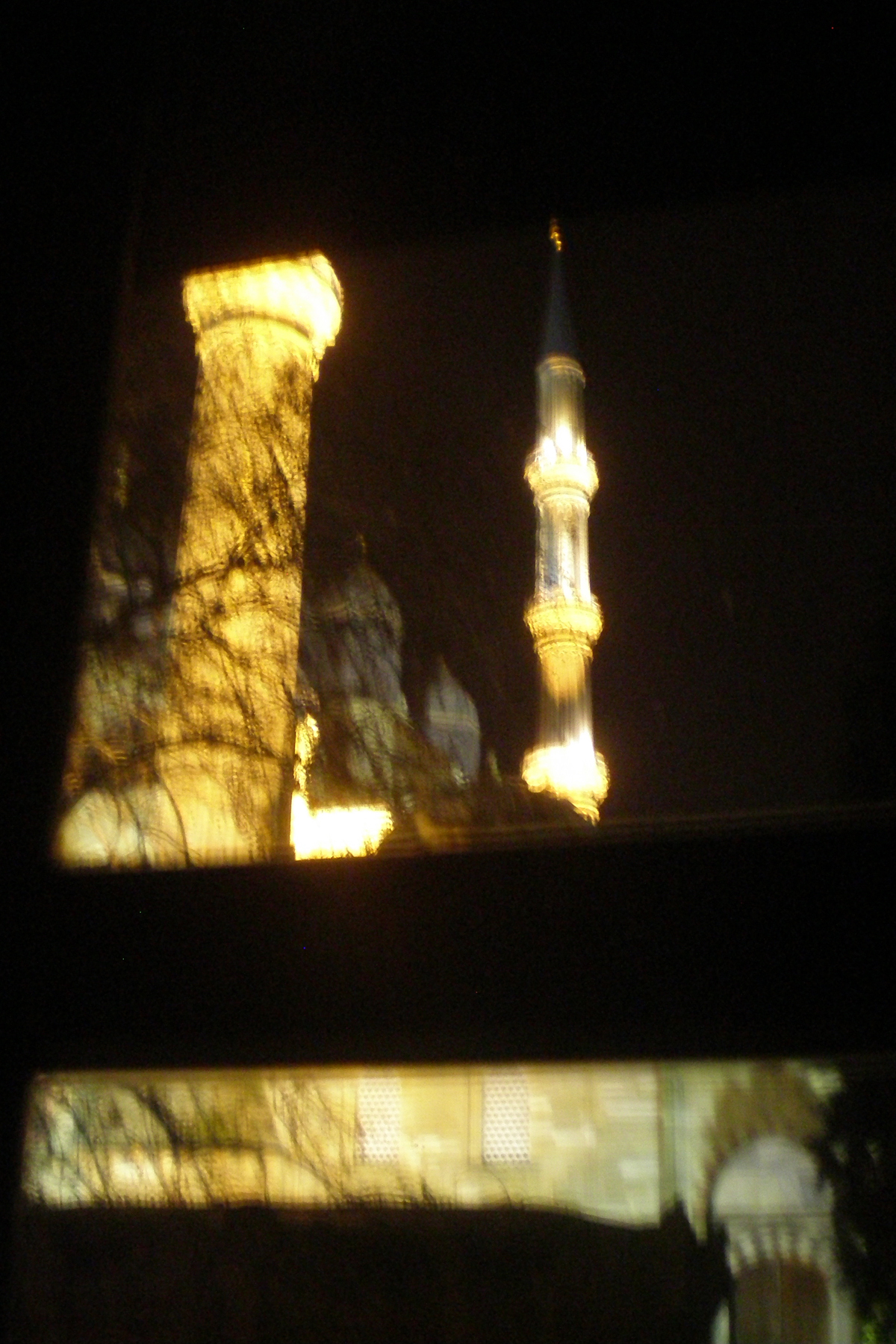
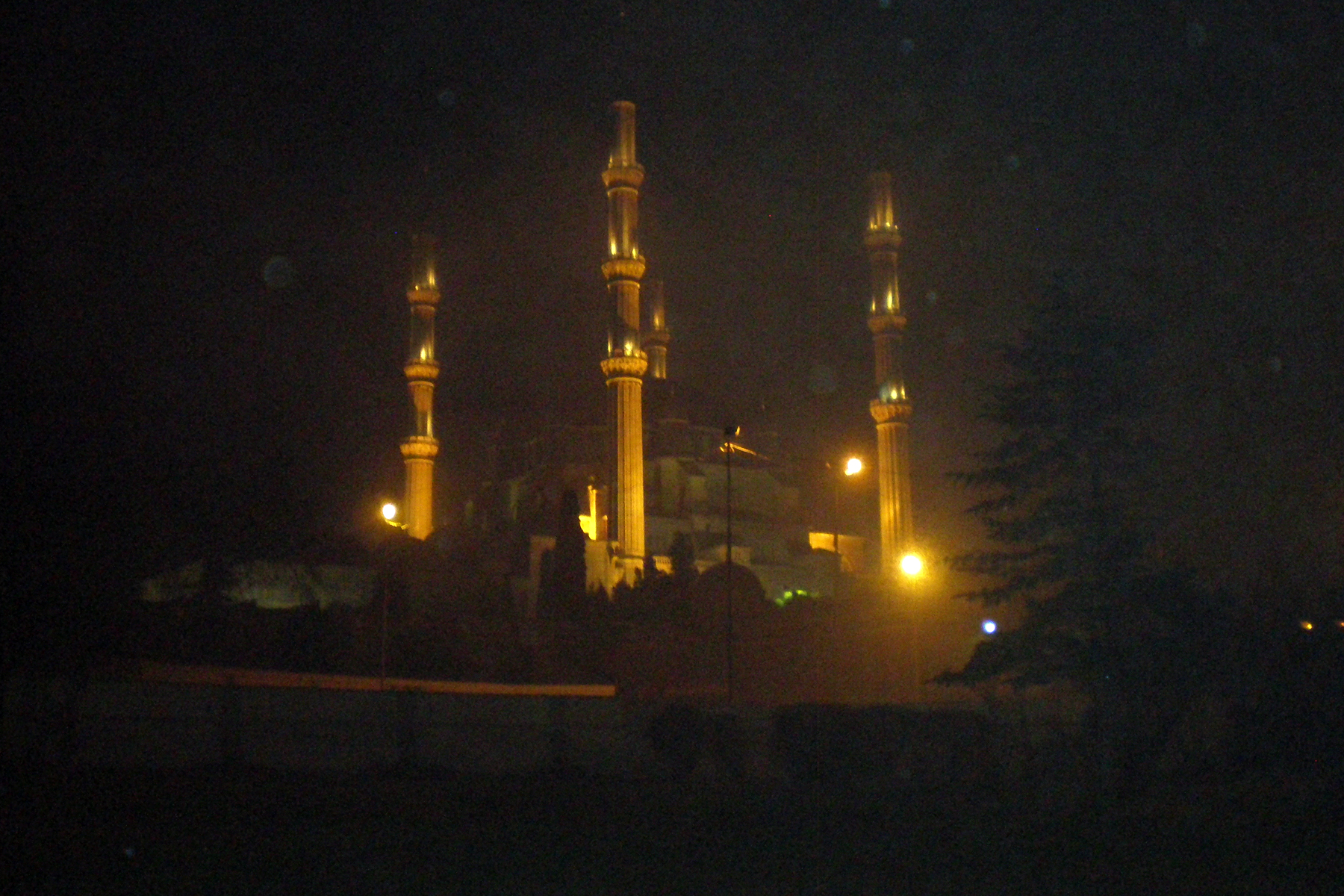
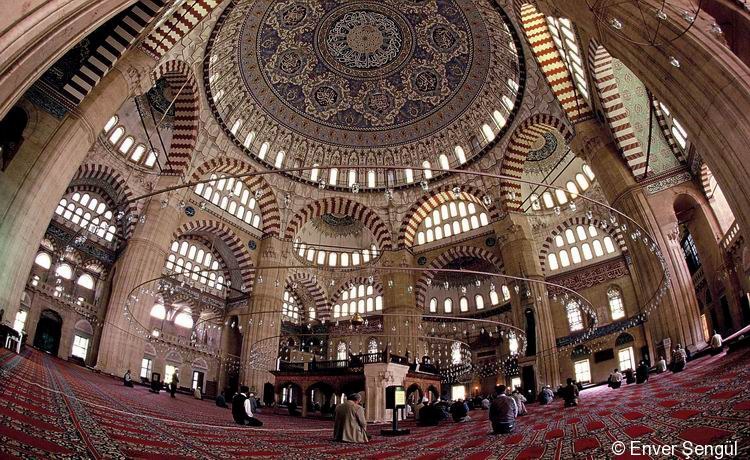
A ten-minute taxi ride across cobbles to Edirne, where the minarets vanished skywards in the fog. My hotel, the Tasodalar, was directly across from the largest mosque in Turkey, the Sulemeiye Cami; I had a bay window which framed its magnificently floodlit bulk:

Selimiye Mosque, Edirne, from Tasodalar Hotel

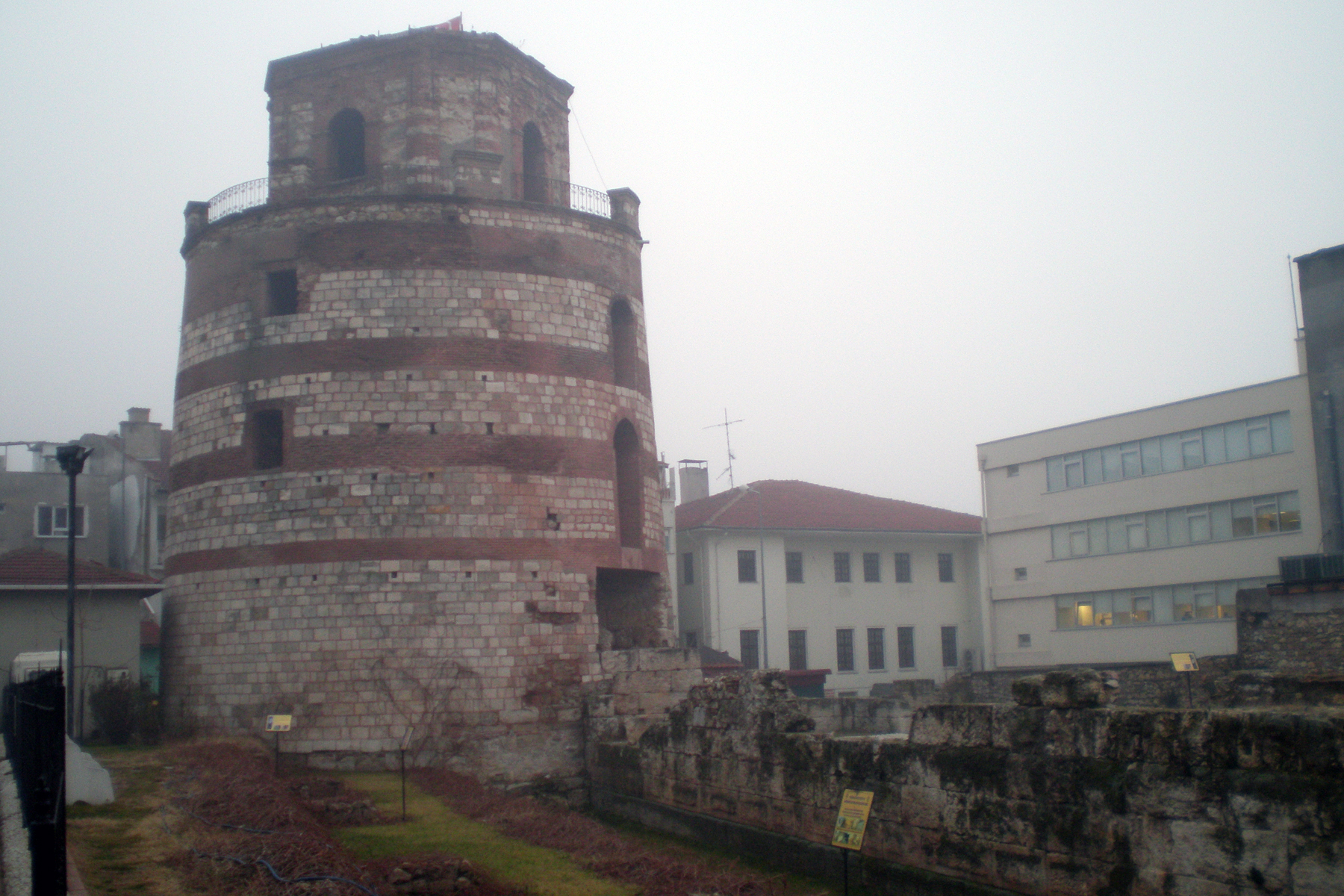
Edirne is older than Islam, though, older than the Christianisation of Rome, indeed even older, in some form, than the Roman emperor who founded it, and for whom it is named (in Greek, Hadrianopolis); on the European approaches to Constantinople/Istanbul, it has been called the most contested spot on the globe, with dozens of major battles fought nearby, from the time of Constantine to the 20th century. All that remains of the pre-Islamic city is one defensive tower and a few ruined walls of Roman buildings:

Roman tower and walls, Edirne

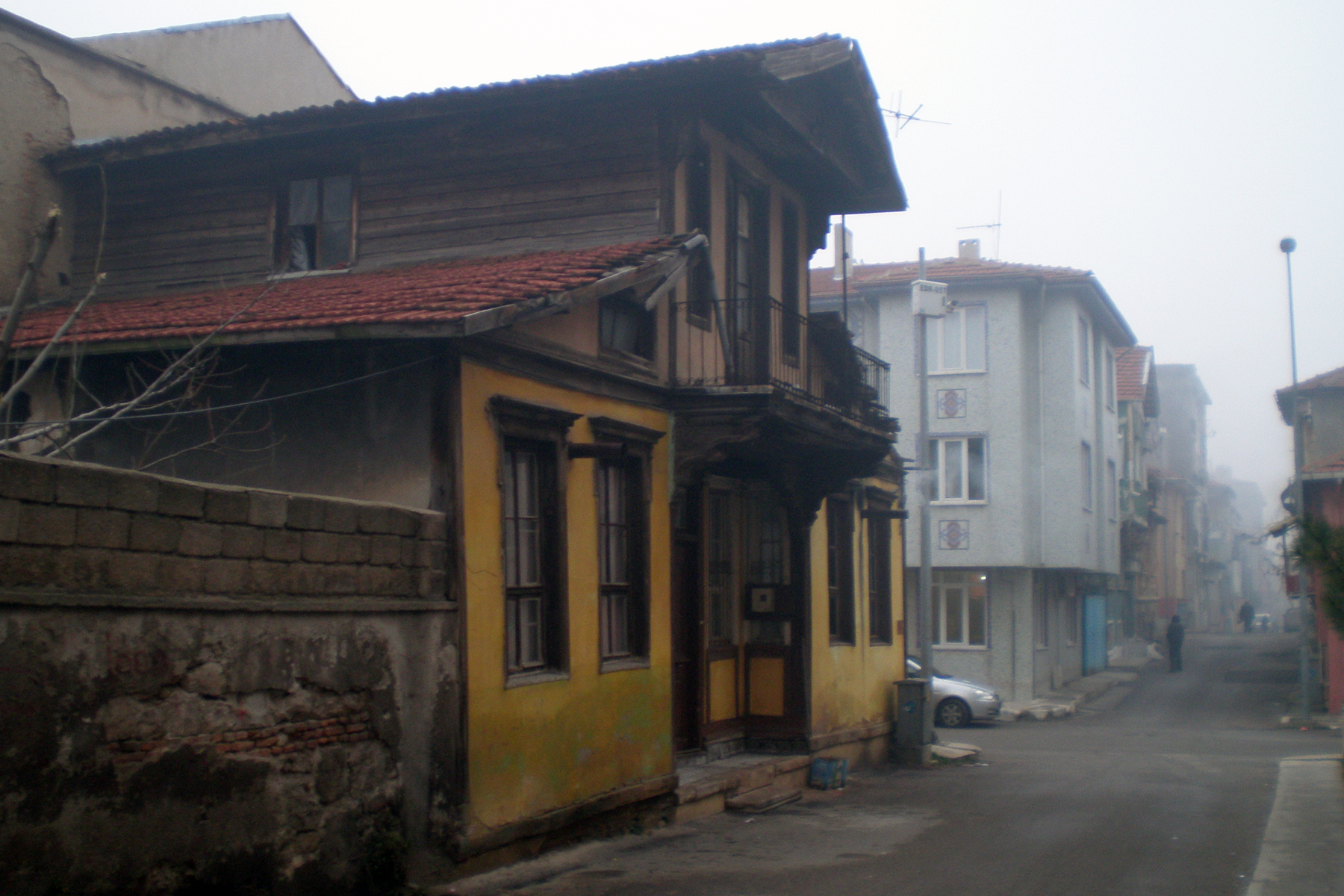
The Ottoman old town seems nearly as dilapidated, with dozens of beautiful wooden houses clearly in the process of collapse, some reduced to facades, though some (like this one) still functioning:

houses in Edirne

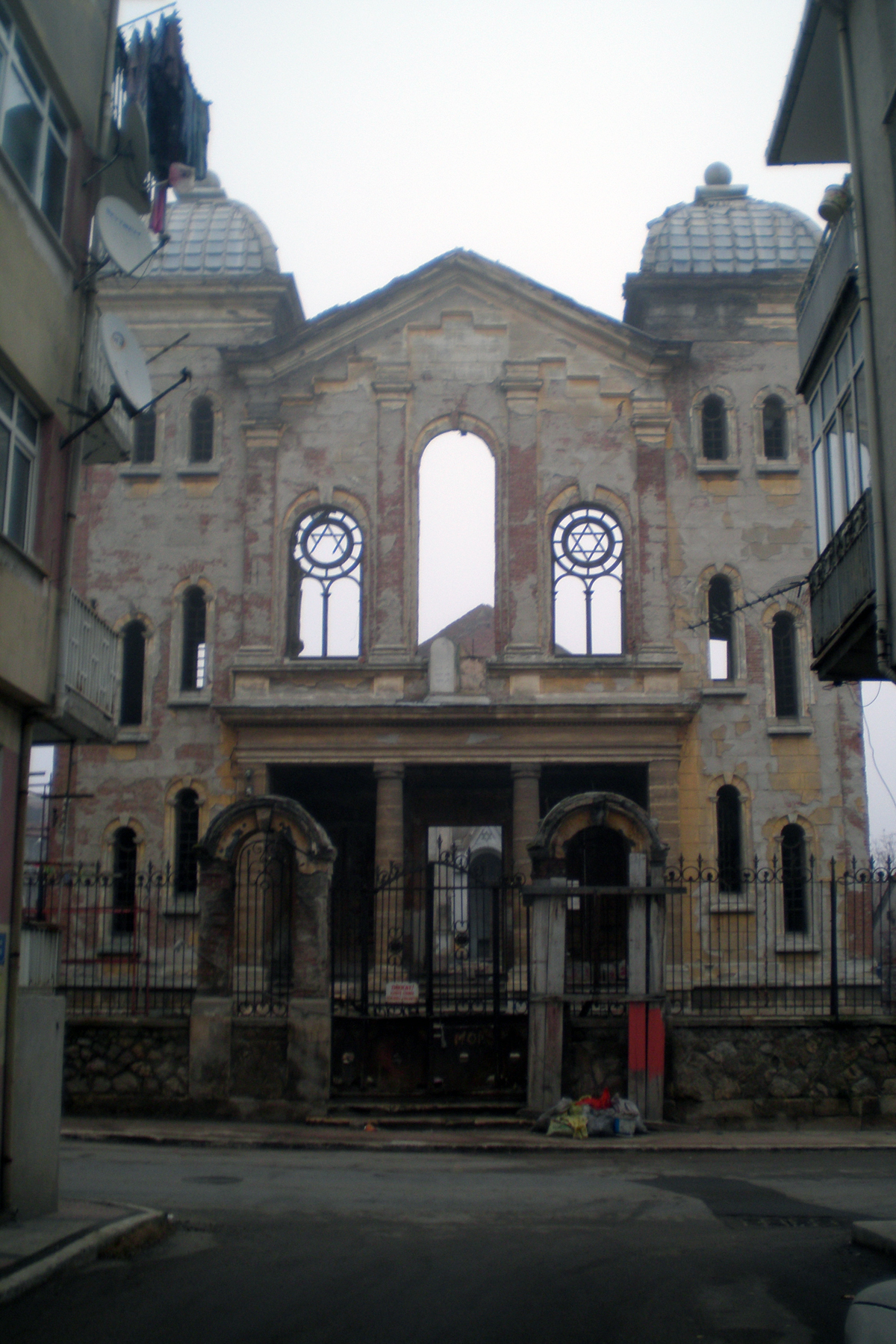
The synagogue is collapsing too, though faster and farther:

Edirne Synagogue

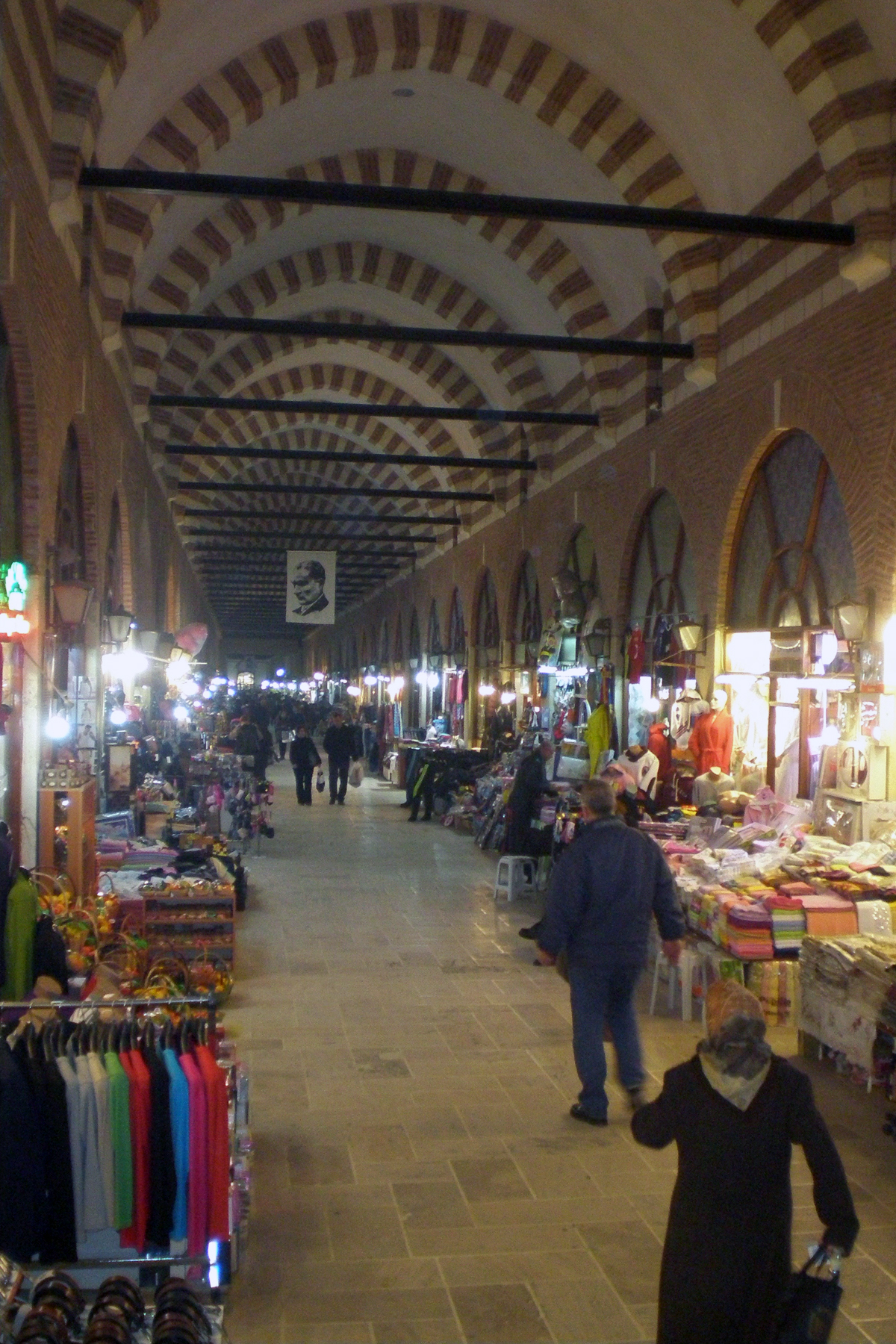
Yet there remain vital structures like Semez Ali Pasha bazaar, grander of the two Ottoman covered markets in Edirne:

Semez Ali Pasha bazaar, Edirne

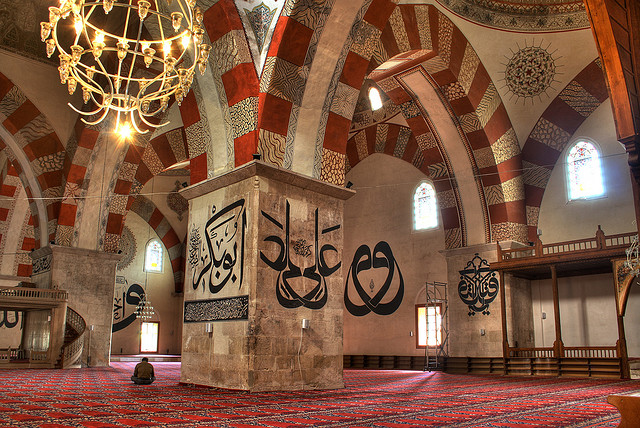
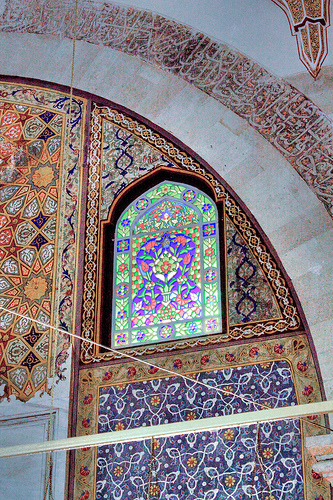
Three hundred years ago, this was Europe’s fourth city, but now the Jews are gone, along with the Christians. What remains, though, are the three great mosques. I’ve already mentioned Selimiye, the ranking one in the guidebooks; but the other two did more for me. First was Eski Cami, dating from the early fifteenth century, the days before the long-plotted fall of Constantinople (ees teen pol – the city) when Edirne was the Ottoman capital-in-waiting. Squat and richly solid is the first impression – even warm and cosy in the pouring January rain – but dominated by the fecund calligraphy of the giant wall inscriptions:

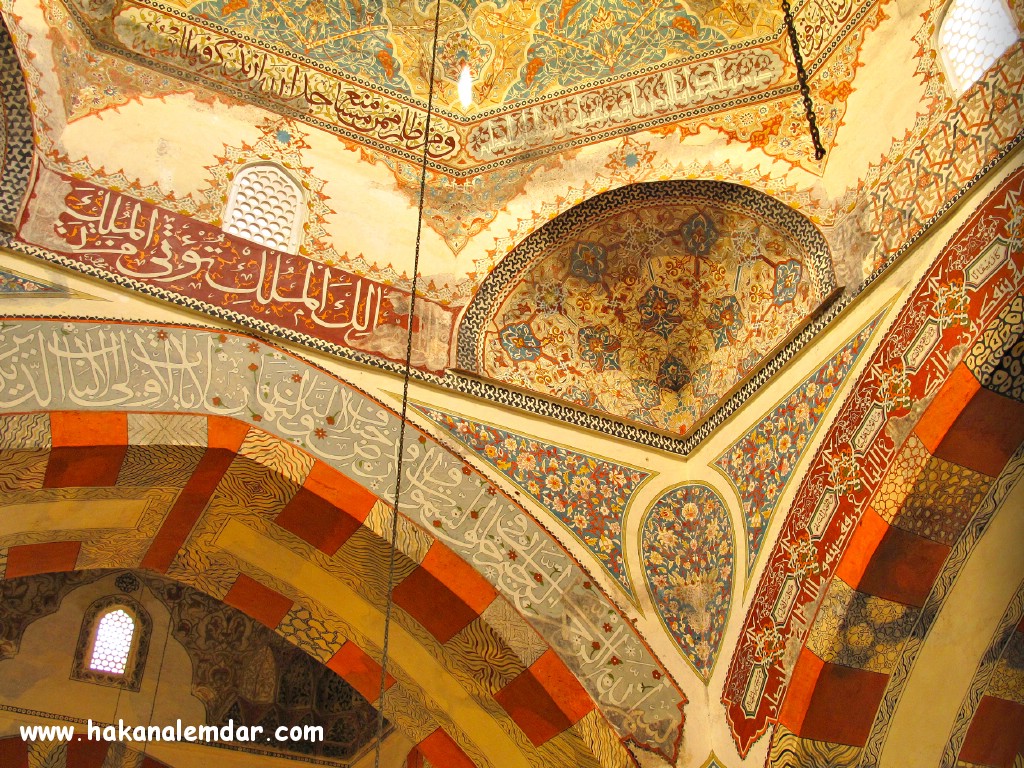
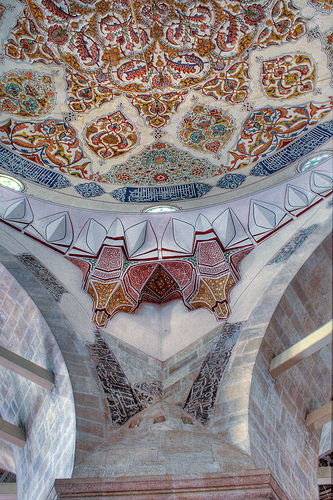
Look at that ball of flaming microbial life away up on the angle of the right-hand arch! The rising eye doesn’t take long to notice the incredibly variegated and intricate designs of the angles and ceiling niches, like this one, say:

Eski Cami mosque, Edirne

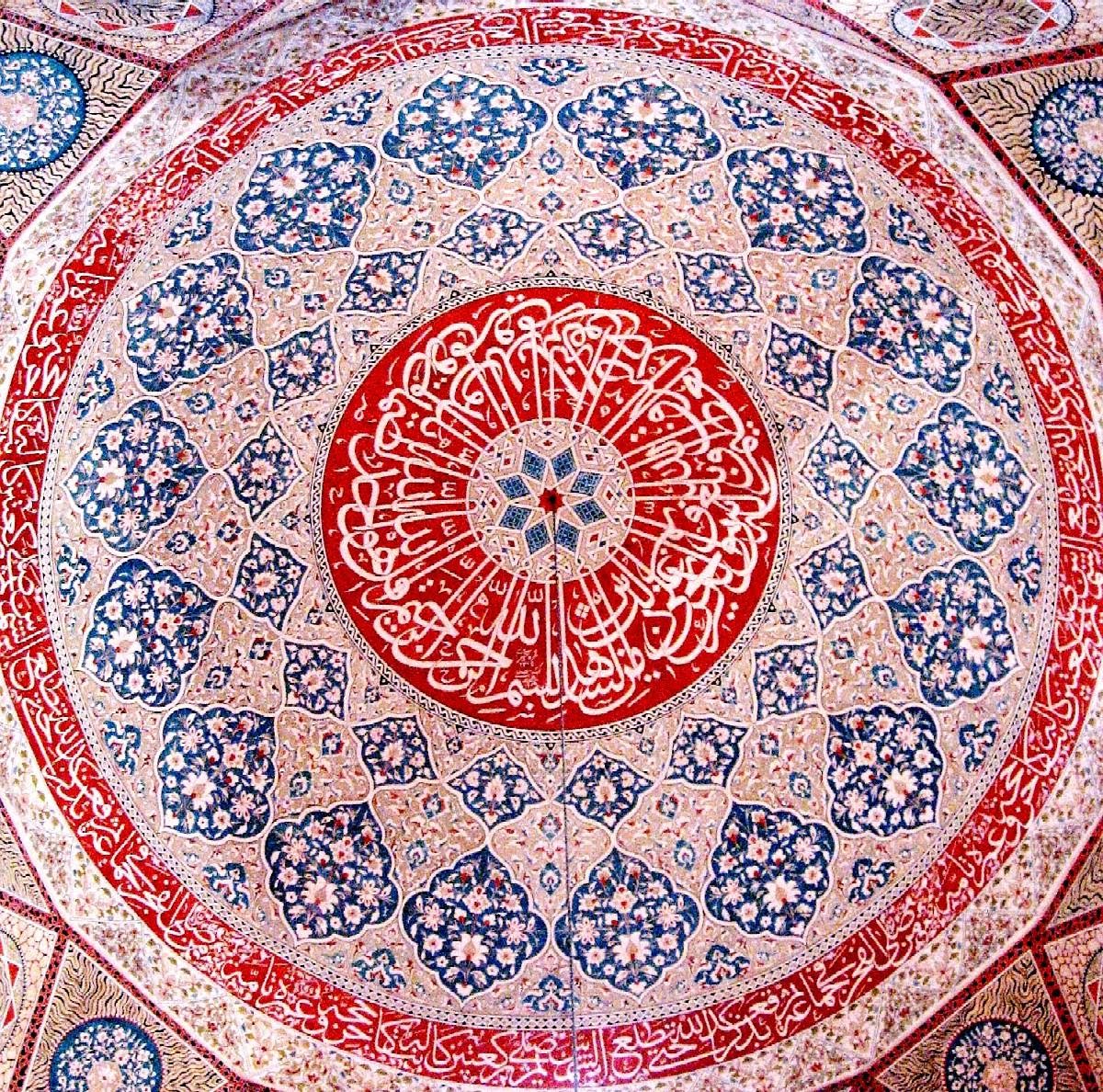
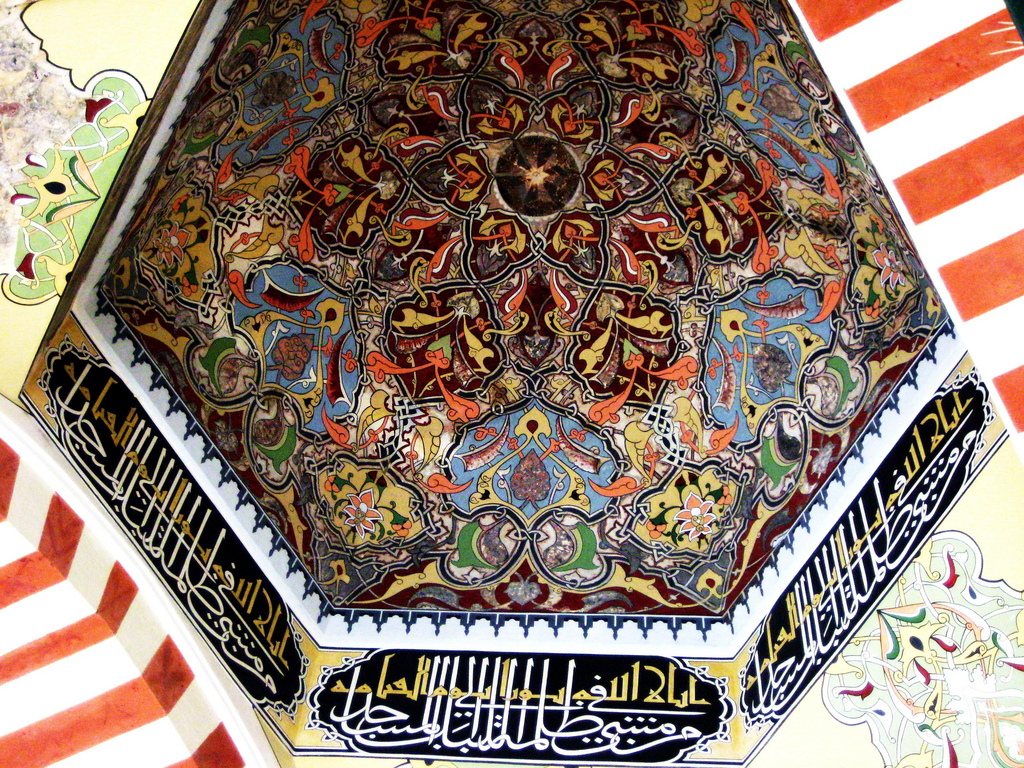
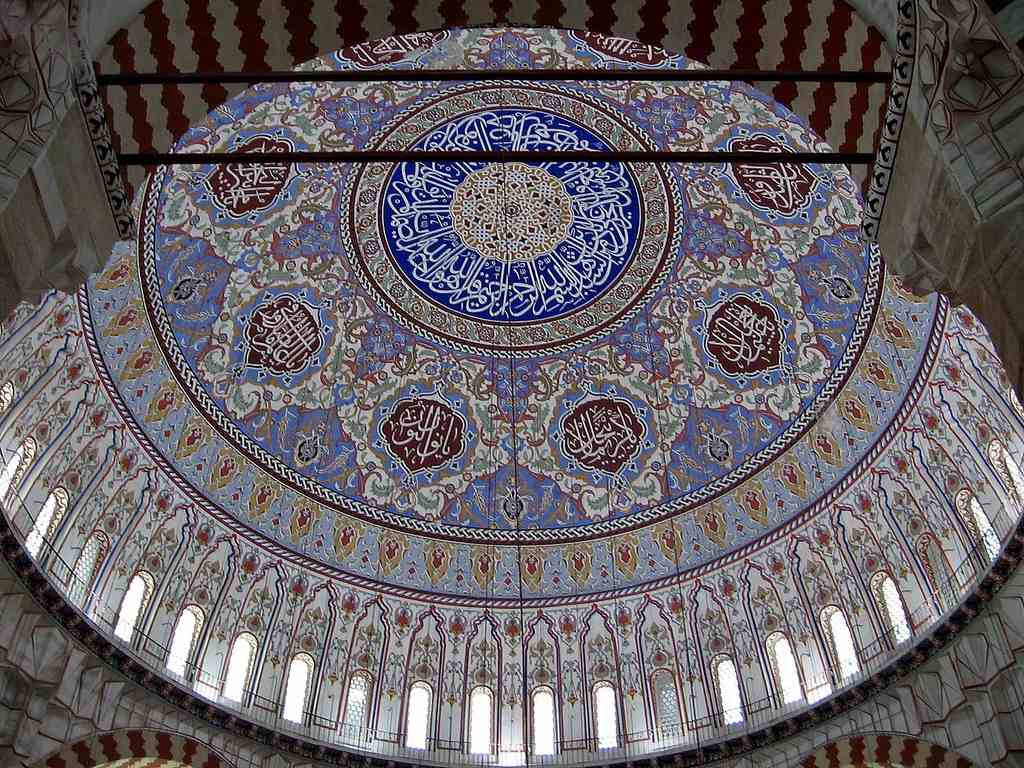
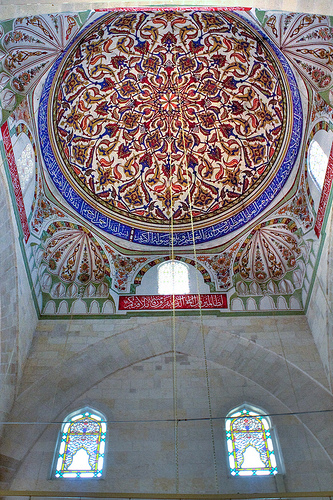
And at the top of it all is this:

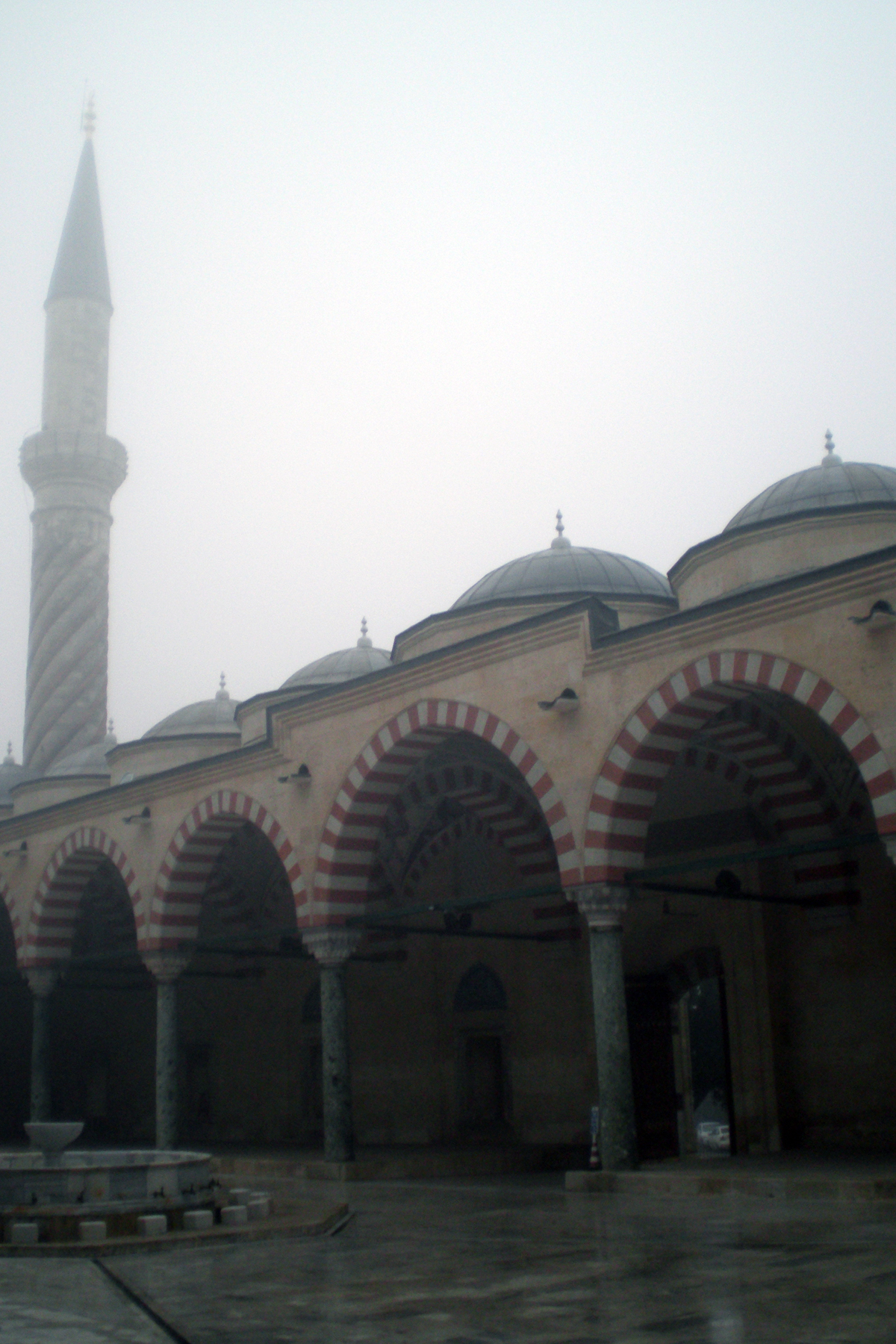
Knocked out by that, I was expecting little from the second mosque, Üç Şerefeli Cami, completed in 1447 – but it turned out to be the best of all, even if its entrance stipulations owed a little to inflamed imaginations (see bottom right) about who might try to gain access:

Üç Şerefeli Cami mosque, Edirne

The courtyard (here in the rain) struck, it seemed deliberately, a balance between intimacy and grandeur:

Üç Şerefeli Cami, Edirne

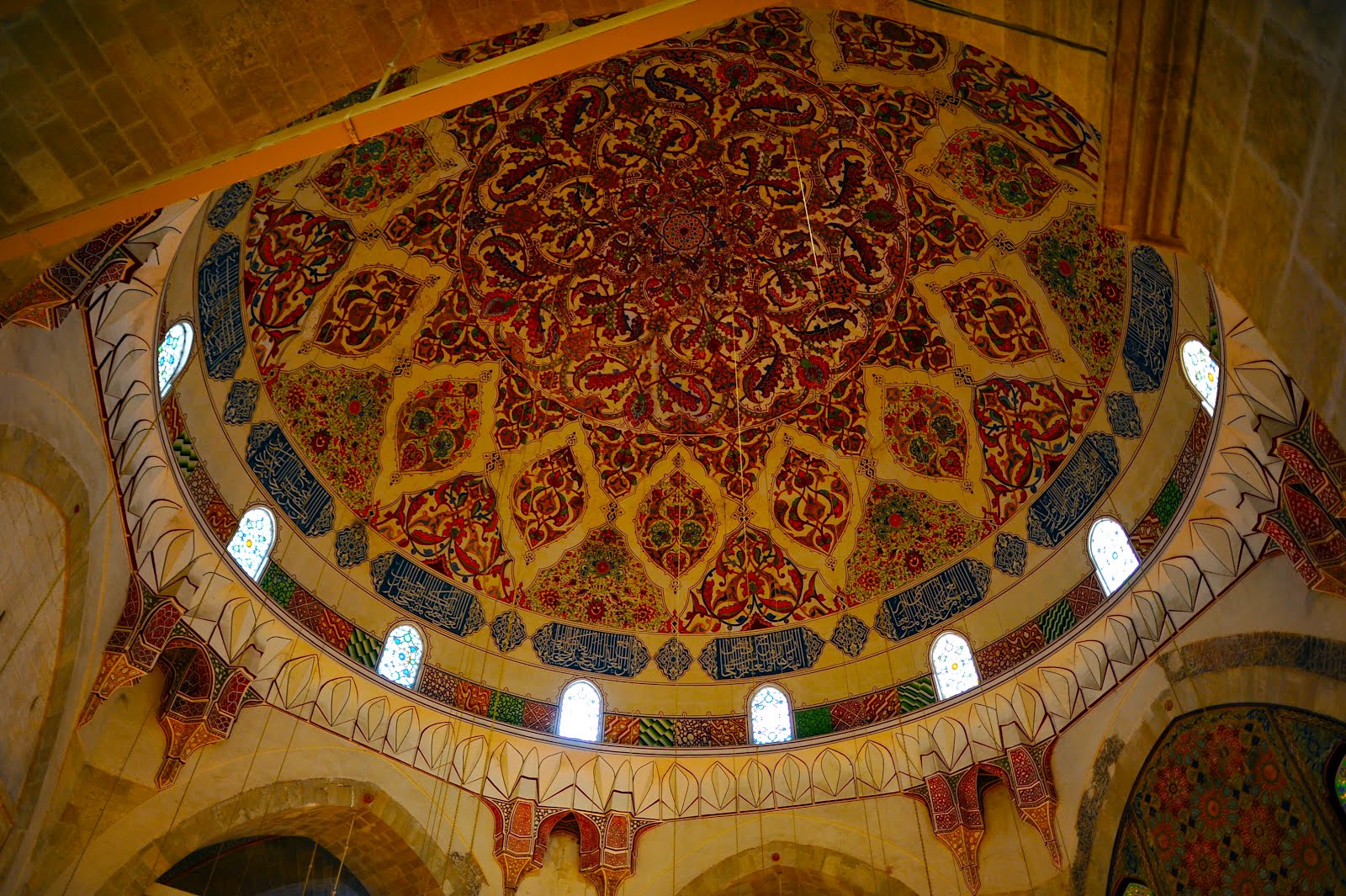
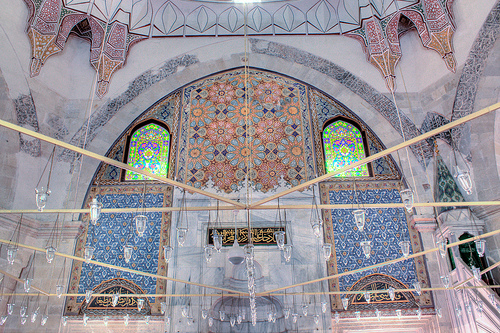
Inside is an internally curved space of incredible sophistication and comfort, yet with every detail of every niche and corner independently thought out. Somehow, although the grand public space requires that you can’t hide – you can hide. And that’s just the area plan and the three-dimensional space, before you even you get to the intricacies of the ceilings and their supporting niches. When you do, what can you say about this?

Staggering.

I was expecting even more from the Selimiye Camii, designed over a century after the other two, when, after Constantinople – Byzantium – had become Istanbul, the Ottoman Empire was in its pomp. Designed by (so they say) the greatest of Ottoman architects, Mimar Sinan, it even has its own Wikipedia page. Impressive from outside, no question:

Selimiye Camii, Edirne

And yet, sorry, somehow it just didn’t do it for me. Too grand, too regular, too overstated – too much the formal performance of an Empire at its height. Without the aspirational energy of the earlier creations, it felt like an elaborately, gorgeously, intricately, pompously stuffed shirt (not that I could have done it…) Here, so you can judge for yourself, are some pictures:

Posted in anybody up there?, road | Tagged , , , , , , , , , , | 1 Comment

The God Delusion

I suppose how you receive Richard Dawkins might depend on where you start from. A lot of his points about the folly of religious thinking in this book seem perfectly reasonable, if not unarguable, to the point where it almost seems he is straw-manning; after all, it’s well over a century since Darwin and Nietzsche comprehensively took apart the religious viewpoint as an explanation for origins and ethics (I understood this as a boy, and have never changed my mind). From that point of view, it isn’t easy to see what he’s getting quite so worked up about. On the other hand, there are no doubt many who still believe in the stuff he’s attacking, or who have suffered from the psychological torture that is sometimes inflicted in the name of religion, and what he writes may be useful for them.

Where he really misses the point, though, is when it comes to the nature of experience. I am not one of those who has experience of a personal God with whom they have a relationship, but I know those who do. Dismissing this as an inappropriate extension into adulthood of the childhood phenomenon of the “imaginary friend” doesn’t make it experientially any less real, nor less valid or meaningful for those who share it. It may ultimately be explicable in biological terms, but, like the taste of fine wine, or fresh water from a mountain stream, any scientific account is secondary in experiential terms to its real meaning, at best  bringing up the rear like an intellectual schoolboy dispensing interesting facts – hardly a match for the power of the experience in itself. And then there’s his attitude to religious phenomena (call them fictional if you like) such as the Holy Trinity, which he regards as an absurd and transparently illogical piece of gobbledygook. Well, yes, it is, on rational terms – and that’s just the point! Concepts like this (and the Zen notion of one hand clapping) are precisely meant to crack the carapace of rationality, and lead us beyond it into a realm of experience which is beyond the terms which rational thought sets. You might as well keep a racehorse tethered – though as it turns out, science has now provided us with some of its own examples of these supra-rational phenomena through quantum mechanics: how can a particle be in two places at once? How can a particle also be a wave? That’s pretty mind-bending (and, incidentally, has to be taken on faith by the majority who don’t understand the maths…)

Finally, there’s his unfortunate tendency to attack not just the partisans of religion, but the neutrals too, deriding agnosticism as a cowardly choice. But since when was the statement “I don’t know” a weak-minded position in the face of the ultimate unknowns, for his interpretation of which he himself admits he has no positive proof (although he engages in some entertaining speculation about multiverses)? This denigration, the vitriol towards all religion, the supreme faith in rationality and the scientific method as a description of everything – especially when shared with what looks like a smug group of mutually congratulatory pals like Daniel Dennett and Christopher Hitchens (of whose final illness he peculiarly wrote: “Every day of his declining life he demonstrated the falsehood of that most squalid of Christian lies: that there are no atheists in foxholes. Hitch was in a foxhole, and he dealt with it with a courage, an honesty and a dignity that any of us would be, and should be, proud to be able to muster” – Hitchens wasn’t in a foxhole, he was in the best cancer hospital in the United States) – begins to look like dogma to me. The greatest mystics have said that the ultimate truth is nameless; isn’t it a bit presumptuous to assert that you can name it when you haven’t?

Posted in anybody up there?, read | Tagged , , , , | Leave a comment